“It sounds like you were brought up by a pack of wolves,” the teacher said. “I guess I was,” I said. I took a semi-private class to explore family dynamics. We were doing show and tell of old family photos. I don’t remember which story or photo led to that remark but it made a sense.
Nobody taught me how to be human, how to communicate, how to deal with feelings, how to foster relationships, how to love, etc. My father taught me how to survive in a hostile world.
It was the world of his construct.
My father didn’t say, “Don’t show your vulnerability.” He just pounced on me when I was vulnerable. He was the kind of person who instinctively knew where it would hurt most and push the spot hard.
My father didn’t say, “The best defense is offense”. I just learned to attack back harder, verbally and energetically– if I were a big man, I would have fought back physically but I was a petite girl — and retreat fast so that my father wouldn’t catch me. I ran back to my room and block the door with furniture, since the door didn’t have a lock. He yelled from the other side of the door. “You have your father’s temper,” my mother said. I was just defending myself because I didn’t want to be eaten by the wolf.
He never hit me but his verbal attack was violent enough. “I’m gonna beat the shit out of you!” he yelled from the other side of the door.
“I’ve learned watching you and Dad,” later my younger brother said. “I just stayed in my room and didn’t talk to Dad. We didn’t have any interaction.” I guess he was smarter than me or just adopted a different strategy for survival.
When I got hurt or felt weak, I didn’t cry. Crying would attract wolves and they wouldn’t come to comfort you. I learned to lock myself in a cave and wait until I regained strength. I felt like an injured dangerous animal, licking the wound in a dark cold place, with body tightened, claws out, growling.
My father made sure that I understood the world was out there to get me. He made sure that I knew I was ugly, unlovable and worthless, so anybody who might offer a hand to me must be trying to get something out of me. When I was proud of something about myself, he spat at me, “Got a bighead, haven’t you. Who do you think you are?”
I had beautiful hair when I was a teenager. It felt like expensive silk threads. That’s the only part of my body I was sure I could be proud of, because I got compliments all the time. So I kept it long. “Your stinking loose long hair is everywhere,” he complained. I had my hair cut very short. “What a stupid haircut. You look so ugly,” he said.
Home was not a safe nurturing place for us kids but a bootcamp. It was as if he was preparing me for being ridiculed and shamed by the world outside of my family. If he could harden me and toughen me enough, I wouldn’t be beaten down by anybody else.
If you are a wild beast to be afraid of, nobody would come to you to take advantage of you. Being asked of a favor is in itself the sign of weakness on your part. Don’t be off guard. Let them know you are somebody not to be messed with.
My father told me again and again never to be a guarantor of anybody. Actually it makes a sense since many people he knew lost everything because they trusted somebody and co-signed their debt.
He did a good job. I grew up a woman who saw everybody a potential aggriever. When somebody wanted to be friends with me, I thought, “What do you want?” I didn’t understand that somebody could want to be friends with me just because who I was.
My high school BFF called me a barbed wire. Somebody I worked for called me a naked blade. I thought it suited me and that I was satisfied. The message was loud and clear. Don’t you dare to come close to me.
My father passed at the ripe age of 86, after suffering several years from Alzheimer’s. At a nursing home he was slightly paranoid delusional but most of time pleasant old man. However, once in a while he suddenly yelled, “I’m gonna hit the shit out of you.” The staff thought it was Alzheimer’s disease that made him say such a violent thing. “No, it is how he always is,” I said in my mind.
And I grew up to be an angry she-wolf. At one point I really believed showing my kids having power over the others was the best defense. I called it a baseball bat strategy. I imagined myself threatening them with a baseball bat, to make them follow a line. It was because I loved them. I had to teach them how to survive. The threatening energy of my father’s yelling was registered in my psyche as a destruction of a baseball bat blows.
It was fortunate that I just had imaginary kids.
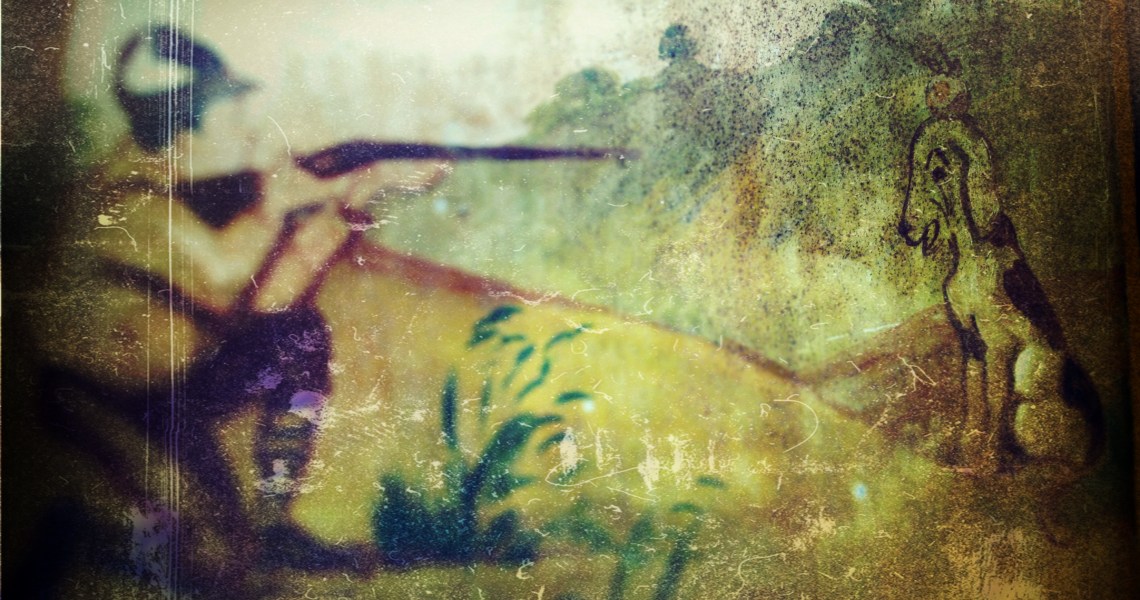
This is how a family trauma is inherited through generations. I was locked up in the world his negative paradigm shaped. My father painted over his daughter’s vibrant world with his gloomy palette. I don’t know what made his world so grim because we didn’t tell stories about ourselves. But I’m sure he thought his life sucked.
It took me 20+ years of therapy to attain paradigm shift. The world is not dangerous. (Fortunately I don’t live in a war zone.) People just want to be friends with me because they are interested in who I am.
I had to peel the old paint chip by chip to reveal the original vibrant pallet of mine. I had to demolish the wall that confined me a brick at a time. Next to me there always was a ghost of my father putting back the brick that I took out.
I had to learn giving up anger wouldn’t make me a victim. I had to learn I could be open to the world if I knew how to set a firm boundary. I had to learn acknowledging my vulnerability would make me more strong. The skillset I learned in the bootcamp would be with me no matter. And I could be a tough cookie and an emotionally vulnerable person at the same time.
Don't paint your kid's world with your pallet, just teach them skills and let them paint theirs.

 Somatic Awareness