The Nervous System Remembers

I always have the urge to go to the bathroom before I leave home, especially if I’ll be in a car for a long drive. It doesn’t matter that I went to the bathroom just twenty minutes ago. If I ignore the urge, I feel anxious.

My father used to ask us, his children, “Did you go to the bathroom?” just before we got into his car. If I didn’t take the cue and go “just to be safe,” he would complain, ridicule, and reprimand me if I needed to use the bathroom before his designated pit stop. I was just a kid.

I didn’t realize that my nervous system had been conditioned by my father’s strict rule.

Years later, I took a self-defense class for women. Men wearing ridiculously thick protective gear pretended to be sexual offenders and simulated attacks. The female participants then practiced kicking and striking strategically assigned target areas, just as we had been taught. We trained for several weeks.

At the end of the course, we shared our experiences. One woman said she always felt the urge to go to the bathroom after the simulated attack and defense exercises. She explained that it was exactly what she had done after she was raped. Her story made a deep impression on me.

Our nervous system doesn’t forget.

No amount of talk therapy would have eliminated my urge to go to the bathroom. The body remembers. The nervous system keeps score.

So how do I convince my nervous system that I don’t actually have to pee—that my bladder isn’t full?

Ironically, I learned the answer when I stopped taking an anti-anxiety medication cold turkey.

The medication had been prescribed on an as-needed basis. Over time, for various reasons, I began taking it every day. I didn’t realize I had developed a dependence on it. After the stressful period was over and I went on vacation, I stopped taking it. It was a very low dose, so I had no idea it could cause such severe withdrawal symptoms.

I woke up every hour from nightmares. Throughout the day, I felt a strong urge to urinate every hour, even though my bladder wasn’t full. After ruling out a urinary tract infection—I happened to be staying with a friend who was an infectious disease specialist—I discovered that urinary urgency is a common withdrawal symptom. Because benzodiazepines depress the central nervous system, withdrawal can manifest as an overactivation of the sympathetic nervous system.

If I couldn’t regulate my autonomic nervous system, I worried that I would reinforce the pattern and end up needing to use the bathroom every hour indefinitely.

So I told my nervous system that it was a phantom urge and that my bladder wasn’t going to burst. I held it for thirty minutes longer, then an hour longer. Each day I gradually extended the time before going to the bathroom. After several days, both my bladder and my sleep returned to normal.

One of my friends teaches nervous system regulation techniques for people with CPTSD. I understood the theory, but I hadn’t truly put it into practice. Now I understand how powerful those techniques can be.

I still have moments of anxiety, moments when I used to reach for a pill automatically. Now I see them as signs that my sympathetic nervous system has become unnecessarily activated. Instead, I calm myself with breathing techniques and wait for the activation to pass.

So far, it’s working.
Tinnitus

This essay is about chronic suicidal ideation as a symptom, not an expression of current intent.

I realized that suicidal ideation is like tinnitus for me.

Because of Meniere’s disease, I have tinnitus in one ear. When I was having severe attacks, every morning I woke up hoping the ringing had miraculously disappeared. Every morning, the moment I opened my eyes, it came roaring back. It was a loud, high-pitched sound that was always present. The louder it became, the more likely it was that a severe attack was coming. Even now, I feel anxious whenever I hear the high-pitched sound they use in horror movies to signal that something ominous is about to happen.

Fortunately, my Meniere’s disease went into remission, and I no longer have severe attacks. Some residual symptoms remain. I have lost most of the hearing in one ear. I lose my balance easily. And I still have a constant, low-grade tinnitus in my deaf ear.

Most of the time I am not consciously aware of it, but it is always there. Occasionally it grows louder, and I slap the side of my head with my palm, as if I could reset it. When everything around me is quiet, I hear it.

I have had suicidal ideation since I was very young. The impulse has always been with me. It is just a thought, and I have never seriously acted on it, but I hear a voice saying, “Jump. Jump. Jump.” My mind automatically imagines ways I could kill myself. Sometimes that voice becomes very loud.

After decades of therapy and simply reaching a certain age, I realized that it was never a wish to die.

I once watched a film about an actor who overdosed after a scandal destroyed his career. Did he intentionally kill himself, or was it an accident? The film suggested another possibility: perhaps he simply wanted to sleep deeply, wake up, and reboot his life.

I understood immediately.

What I really wanted was to be free from the roles assigned to me by other people—to stop being a character in someone else’s story. I wanted to begin my own life, free from relational trauma, outside the architecture of my family, free from expectations that had been imposed on me.

When I reached that realization, I proudly told my psychiatrist that my suicidal ideation had disappeared.

But it came back.

Not as loudly as before, but like tinnitus, it is always there. Sometimes it gets a little louder and I notice it. Most of the time it fades into the background and I ignore it. But it is always there.

Perhaps my nervous system developed this pattern because of the life I lived. It is simply following an old neural pathway.

Perhaps what I need now is not to fight it, but to patiently teach my nervous system that I am free.

Help is available

If you’re having thoughts of self-harm or suicide: calltext 988, or start a live chat with Suicide & Crisis Lifeline. It’s free and confidential. You’ll reach someone who is trained to listen and support you.

Tear of Hannya: The Fire that Became the Sea


Hannya’s Tear

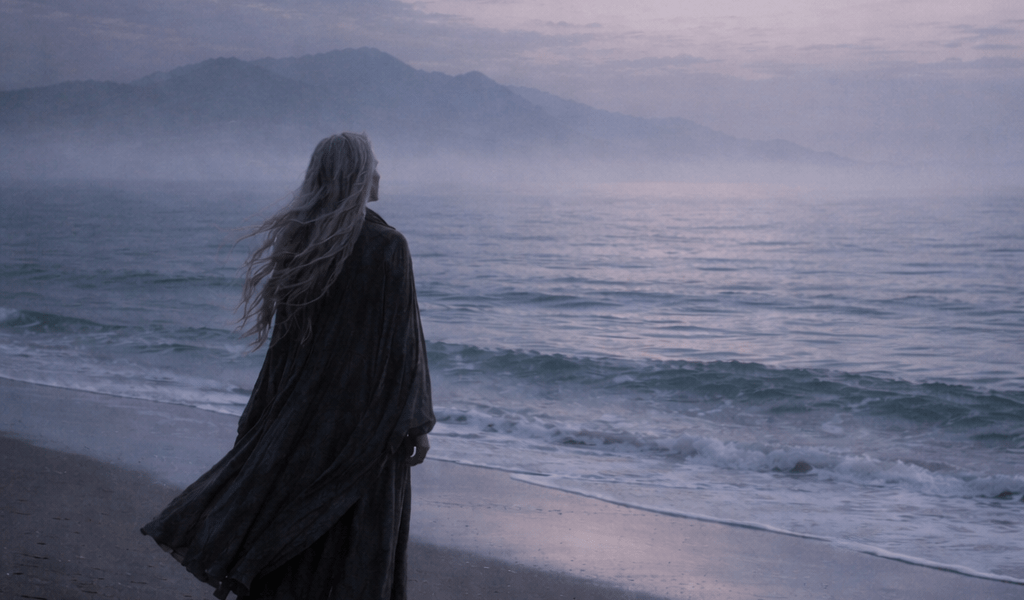
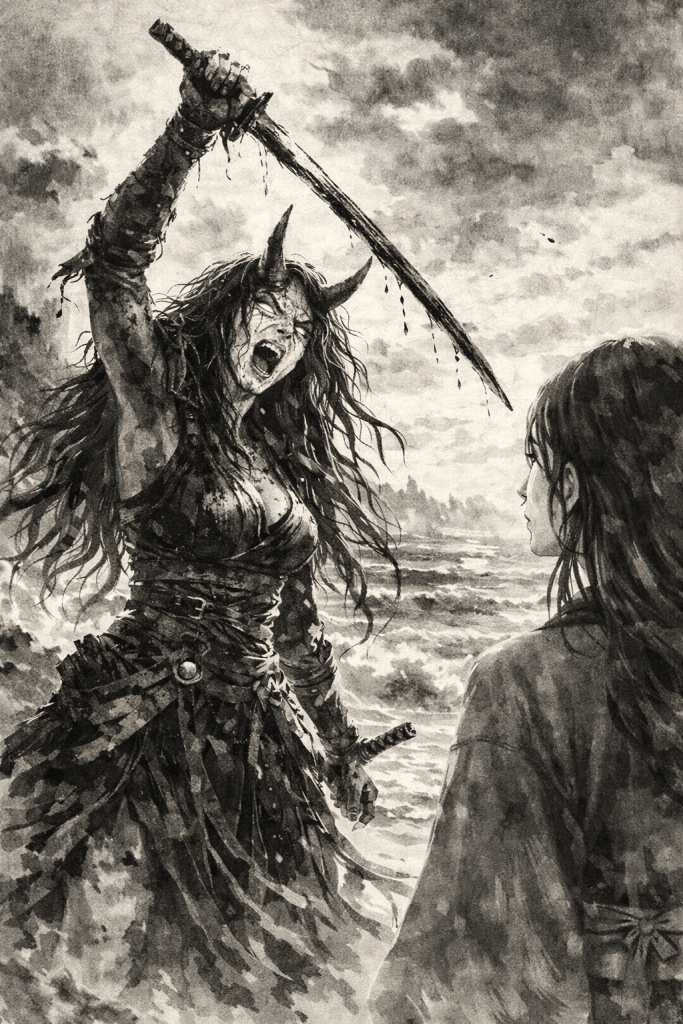
An old woman stood on a desolate beach, staring out at the sea. The ocean wind blew through her long gray hair. The hour was neither night nor day, neither dusk nor dawn. The sea was calm. Beyond it, the blue-gray shadow of distant land floated on the horizon.

She had come a long way. So long that it could not belong to a single lifetime. She had walked through several lives to finally arrive at this distant sea.

I am tired.
So tired.
I want to die.

The wind moves through my hair—hair that was once so angry it flamed upward and burned the sky.

Blazing visceral anger burned my entrails like an ungutted fish thrown into a fire. It charred me from the inside out. Now my heart has lost the heat of burning coal and left me with ash-gray hair.

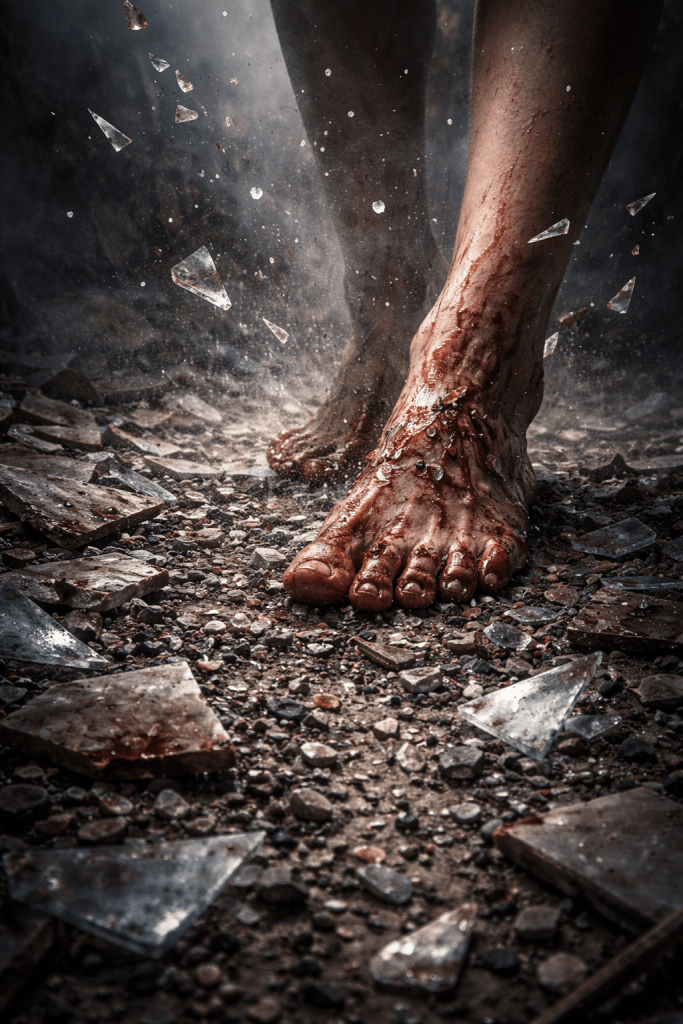
Every step I took was across shards of tile and gravel.

Every Breath I drew was studded with broken glass.

Where did I come from? I no longer remember. It was too long ago.

All the way here I slashed, stabbed and sliced. Blood gushed and sprayed over me—on my face, my neck, my arms. It burned my skin and hardened it into rusted iron.

I hid in dark places for days and nights, wounded and motionless while the shadows of enemies passed by. I was always watching, always alert. And when I slept, I dreamed of blood and dismemberment, waking to the smell of burning flesh.

That was the only way I knew.

It was my way.

In my hand I see a sword darkened with dried blood.
I have become the thing I feared.
An Oni who only knows how to fight.

And now I find myself standing alone on this beach. No more bodies to leave behind me. Where is my fire? Where is my anger.

It is gone.

There is no enemy left to kill.

What did I do to deserve lives of perpetual fighting? I have survived, and there is no one left to kill. And I am standing here alone.

I am tired.

I want to die.

I want to end this for good. No more fighting. No more bloodshed. No more hiding. I want to dissolve into total oblivion. No more memories. No more me.

Then what is holding me here on this silent beach?

The waves come and go, come and go, through thousands of nights and days.

Let me dissolve into that place where sea and sky are indistinguishable. That is the only way I can stop fighting.

Please do not make me turn into an Oni again.

“Who is it?”

The Oni suddenly turned.

For a moment her hair flared upward. Her muscles tightened. Her eyes widened. Her hand gripped the sword, ready to kill.

Then she saw a little girl.

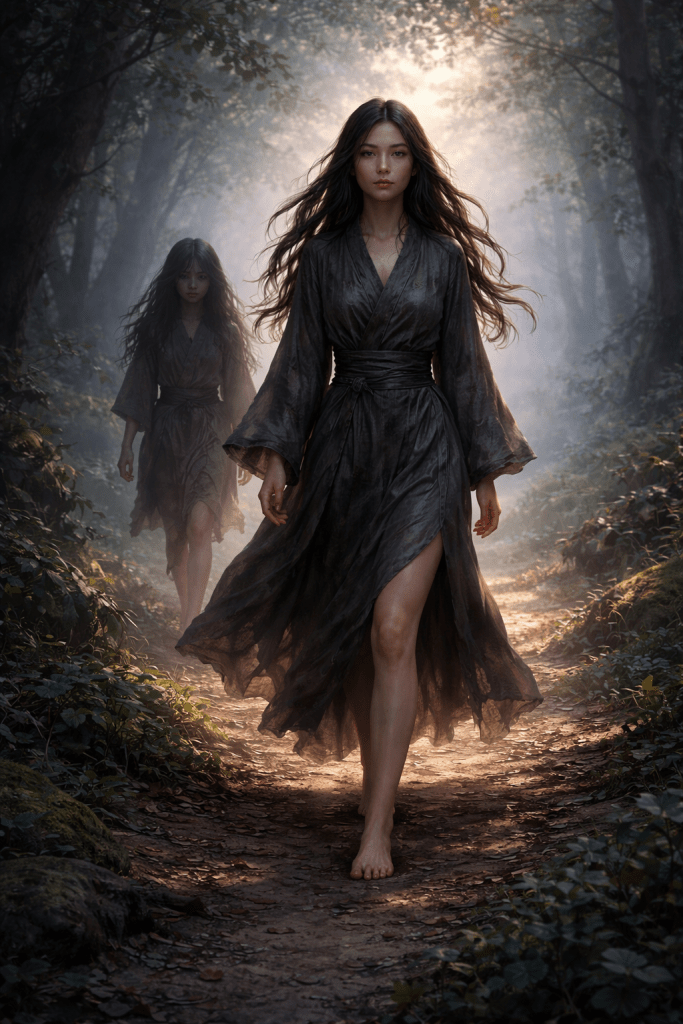
The girl slowly stepped out from the woods and walked toward the Oni. With every stride she grew older—her hair longer, her legs stronger, her eyes wiser.

The Oni remembered the girl.

Three or four lifetimes ago she had begun fighting for the child, to protect a helpless, vulnerable little girl.

Then she forgot the child.

And after that, she forgot what she had been fighting for—or against.

She fought simply for the sake of fighting.

That was when she became an Oni.

And now look—the child has grown into a woman, soft as she wishes to be, supple as she needs to be. She is smiling.

And look—she beans not even a scratch.

The Oni felt her anger flare again.

I was the one who fought all the way here.

Where were you when I lay in a ditch, holding my breath in the darkest hour of the night?

The Oni faced the woman and raised her sword high.

She was about to strike when the woman said quietly,

“I am your way.”

The sword shattered in the Oni’s hands.

And in the woman’s hand a sword appeared—clean as the first beam of morning sunlight falling across a hill heavy with dew.

She thrust it through the Oni.

Sweet breath flowed through her like sunlight streaming through leaves.

The Oni shed a single tear.

With that tear she dissolved into her,

becoming the sea and the wind—

where she is no more and dreams no dreams.

Images are AI created.

©J.U. 2004

HAND Reveals

Surprisingly, hands retain a sense of personhood almost as much as the face. They are often left untouched until later stage of dissection because working on their small and intricate surfaces requires skills and anatomical knowledge. Hands are another major interface with the outside world—not much socially but physically and emotionally. They are our probes into the physical world, our means of acting on intent, and a way to express emotions.  

When we are born, we are held with hands, fed with hands. The first contact with the outside world is through hands of our caregivers. Hands have a high concentration of nerve endings, and we navigate the world by touching. Our first instinct when we encountering something new is to reach out and touch it. If it is unpleasant, we learn to withdraw our hands. The more we touch, the more intricate our understanding of our environment becomes. 

What would happen when a naturally curious child exploring their word hear their parents say “Don’t touch it” again and again. It may be the child is about to touch hot surface and the adult intends to keep them from harm and injury. It may be the child is about to touch an expensive fragile object and the parent is afraid that they would break it. Every time a child hear “Don’t touch it” their world gets smaller and more dangerous. Their energetic reach out to the world is cut short. 

Imagine being a child at the dinner table with all the adult guests. You’re hungry, you reach for the breadbasket, and suddenly—“Don’t touch it!” your mother snaps, slapping your hand, or worse. What do you think that child would feel in their body the next time they reached out for something?

I was that child.

Now imagine if that child happens to be a kinesthetic, tactile learner. I learned to pull back, to contract, to shrink away from the outside world. After decades of living in that confined state, I realized I had to retrain my inner child. So, I took her to the zoo and the aquarium. I let her push every interactive button, touch everything that was allowed to be touched. For once, I gave her permission.

We interact with others and express our emotions using our hands. Hugging and holding of hands are physical expressions of affection. We lend a hand when somebody needs help. When we are safe, we are in good hands. We work together, hand in hand. We stay involved by keeping a hand in, even getting our hands dirty. But when we can’t act, our hands are tied, and the matter is out of our hands. Hands, in many ways, represent our life in action. 

We touch others with our hands, but have you ever thought about what information your hands are conveying? I used to be a teaching assistant for a body awareness class at an acting school. When the students were in odd numbers I would step in as a partner for pair exercises. Once I partnered with an attractive young man, and I gave him the assigned bodywork. Then we switched roles. The moment he touched me, I felt sorry for his girlfriend—or boyfriend. It was like being poked with an inanimate object, like a piece of wood. He wasn’t really there. Did my hands feel as inanimate to him as his did to me? I couldn’t help but wonder if he had never been touched properly by his family. What kind of childhood would leave a person so absent in their hands? 

I grew up in a family  where the sense of boundaries was unclear. I don’t remember my mother’s touch, except when I was sick. I experienced inappropriate touches from family members. Even so, I can be present in my hands. Being present in your hands is crucial for manual therapists—and for actors. Your hands tell a lot about you. 

When you’ve experienced inappropriate touches in early in life, you can become very sensitive to the intent behind others’ hands. Trust your feelings and quietly walk away. The other person might be unaware of their underlining intent, or it could just be your interpretation. Either way, what you felt is real. So walk away.

I once trained with a master of martial arts. He was also an energy healer with quite a following. After a year of training, one day he offered me hands-on healing session. He laid his hands on my upper chest. I had paid for sessions with him before and never felt threatened. He didn’t do anything inappropriate; he just laid hands on my chest. But unpleasant memory resurfaced. 

I thought about it for a while. Was it just my imagination? The master, this guru, was probably doing me a favor with this treatment, and I shouldn’t doubt his good intentions, right?  (I was younger then and perhaps more attractive than the older disciples.)  But then it hit me—this might be exactly what happened in those yoga guru sexual abuse incidents. I trusted my instincts and left the group. Otherwise, I would have allowed the past repeat itself, again and again. 

With a high concentration of nerve endings, your hands are both receivers and transmitters. Use them mindfully. In the anatomy lab I held the hand of a cadaver and contemplated what he might have touched, throughout his life—from birth to death. I wondered how he touched, how he navigated the world and how he interacted with others. Was his touch loving and caring? What was the last thing he touched before his death? What did he reach for, and what did he recoil from?  This hand held his child, caressed his lover, petted his dog, wiped tears, and waved goodbye…

The only time I saw the skin of a living human slip away was in a drawing depicting the aftermath of the atomic bombing in Hiroshima. The skin (specifically, epidermis) of the hand slipped off like a glove, caught at nails, hanging from the fingertips. Otherwise, while not impossible, it’s very difficult to remove the skin of hands in one piece. The skin of the hands is intimately bonded.  

copyright 2025

Father’s Day

Probably fortunately, I only ever had one father—so I assumed all fathers were like mine. I didn’t understand why Father’s Day was such a big deal.

He passed away long ago at the ripe age of 87. From the outside, he looked like a “good enough” father. He provided for us and supported my brother and me through much higher education than he ever had. And yet—I hated him. As far as I know, my younger brother felt the same.

He never hit us. But he was emotionally and verbally abusive, especially toward my mother and me. When I visited my parents, I stopped talking to him. My brother wouldn’t even set foot in the house. Later, when Alzheimer’s took hold, he was admitted to a nursing home. I didn’t love him, but as a “good enough” daughter, I visited him every day while I was in town. He didn’t recognize me. I sat beside him, spoke gently, massaged his shoulders. He wasn’t as nasty as before—maybe because he no longer knew I was his daughter. Still, from time to time, he shouted cruel things at the other residents. The staff would smile and say, “That’s the dementia talking, not him.”

But I turned to my mom and said, “That’s exactly how he always was.”

Since childhood, I’d been the main target of his emotional outbursts. In a nutshell, having a daughter was, to him, a waste. He made it clear he wished I hadn’t been born a girl. He told me I was too ugly to be loved by anyone. That became the foundation of my identity.

I grew up believing I wasn’t lovable as I was. That I would never be good enough for anyone. I didn’t trust men. I hated him.

Still, I did what I could out of duty. He died alone. I made it to his wake and funeral. No one cried.

I have a friend I’ve known for 30 years. Her worldview is completely different. She loves her parents deeply, and they love her. Her father lives in assisted living and is adored by the staff. He always told his three daughters they were cute and pretty, just as they were. Being his daughter was reason enough to be loved. Her older sister treats her own daughters and granddaughters the same way. My friend says love flows naturally in her family. She believes in love. She knows she is beautiful, and she knows she deserves love from men.

I once told her, “I don’t understand love.” She didn’t understand what I meant—until we shared our stories.

Not all fathers are the same. Not all families are the same. Not everyone’s idea of love is the same.

I can understand, at least partly, what made my father the way he was. I can feel compassion for him. But I still don’t love him. I never felt loved by him. That kind of feeling, I reserve only for my dogs.

So on Father’s Day, while many people celebrate, please remember:
Some of us can’t.

Multiverse Madness

You may have heard the famous Eastern philosophical parable about a man who dreams he is a butterfly, only to awaken and wonder: is he a man who dreamed he was a butterfly, or a butterfly now dreaming he is a man?

Doctor Strange in the Multiverse of Madness reminded me of that parable. In the film, dreams are portrayed as stories unfolding in alternate universes. Interestingly, the only person who can travel through the multiverse is the one who has never dreamed.

Have you ever had the same dream over and over? Not exactly the same, but different variations on a single theme? I used to have dreams like that.

One of the recurring dreams I had after a messy divorce was about my ex-husband. In those dreams, he had remarried and had a daughter and a son. They were some of my worst nightmares. He had cheated on me while I was undergoing infertility treatment, and by the time we divorced, I was too old to conceive. I had lost my chance to become a mother.

I dreamed this scenario again and again. The emotional anguish felt so real, it lingered even after I woke up. His betrayal stained the landscape of my inner world with grief and suffering. In waking life, I felt mostly anger—but underneath it, I carried a deep well of loss and sorrow.

In these dreams, I always lived in some kind of apartment. Each one felt strangely familiar. Sometimes I would find myself in the exact same apartment I had dreamed of before—with the same landscaping outside, the same scent in the air, the same humidity in the walls. I knew that place.

It’s been twenty-five years since the divorce, and I’ve finally stopped having that dream. Still, it feels as if I once lived in that apartment—in this life.

Then I began to wonder: maybe that was my life in an alternate universe. It’s about the inner choices we make—who we decide to become. Every decision spins off another timeline, another universe where a different version of you lives out the consequences of that choice.

If I had clung to the anger and suffering, maybe that nightmare would have been my reality.

These days, I rarely dream. Maybe my life has finally settled into this reality.

P.S. My ex-husband did remarry, but he never had kids. As for me, I’ve made peace with the fact that motherhood and I were probably never meant to be. Crisis averted—for the children.

Do I want to see tomorrow?

I lost my anchor.

My dog was my tether to reality, to this life. He was undeniably real. He lived entirely in the moment. When I woke in the middle of the night, lost in the vast nothingness—confusion and darkness pressing in—I would reach out and place my hand on him. He was warm, solid, breathing. Alive. And in his version of reality, if he was alive, then so was I. I felt safe in the world he held for me. It was as if I were drifting in a night ocean of existential anxiety, and he was my life raft.

With his passing, I lost my favorite version of reality.

I don’t have to protect anyone. I don’t have to take care of anyone. I don’t have anyone to come home to. I don’t have to worry about losing him anymore.

What remains is my own version of reality.

Every morning, I wake up and start my routine. I make coffee, brush my teeth, check emails. I function well. I smile. I chat with neighbors. I act normal. But I am not here. I’m floating an inch above the ground, like a plastic bag caught in the wind, weightless and directionless.

Once in a while, I do feel real. On a recent trip, I went to a shooting range and practiced pistol shooting for the first time. In that moment, I was completely focused. The weight of the gun in my hands, the shock waves reverberating through my body, the hot shells grazing my skin—burning, tangible—I felt alive. For that brief moment, the act of shooting was my anchor. (Don’t worry, I won’t shoot any living being, including myself.)

Then I came home, and my fragmented reality returned.

Fortunately, I can hold it together. I don’t have the affliction my cousin does—the one that warps reality beyond repair. I can pretend. I can fit in. I just don’t feel alive.

So I go to the gym. I work out on one of those torture machines. The intense contraction in my quads pulls me back into my body, back into the present.

Do I want to see tomorrow?

I don’t know.

But I want to be here now. In my body.

Is it how normal people are feeling?

I sent my beloved dog across the rainbow bridge one month ago, and I’ve been depressed ever since. I still cry and feel his absence deeply. The sharp pain and heaviness in my chest have lessened, but they’re still there.

I go out every day—talking to neighbors, having lunch with friends, attending events I’m invited to, and spending hours at the gym. I’ve been working out daily.

Without the need to walk my 80+ pound dog three times a day, I suddenly have more uninterrupted time. I’ve been channeling that into my writing project, which is progressing well.

I also have two trips planned, something that would’ve been impossible when I was caring for a 13-year-old large dog. I’m doing everything I can to avoid spending days in bed, mindlessly watching Netflix all day and night. I’ve been there before. I know how it happens, and I know how to prevent it.

At the same time, multiple changes have happened in my life—not particularly happy ones.

From the outside, I probably look fine. I’m functioning well. But I’m not okay. I don’t feel alive.

Even when I laugh, enjoy conversations with friends, or run on a treadmill for an hour, I feel… hollow. Like a cow, grazing mindlessly on grass, waiting to be slaughtered, unaware of its fate.

And I ask myself: Am I depressed? Or is this just how most people feel, going through the motions of everyday life?

On Facebook, everyone presents their happy, vibrant lives. But are they really alive, or do they just think they are?

As the old Chinese parable says: Am I a monk dreaming of being a butterfly, or a butterfly dreaming of being a monk?

Touch: Your Brain’s Interpretation

Even though the sensory receptors in the skin are mechanoreceptors, it is your brain that interprets the signals they send. Since the brain remembers past experiences and the emotions associated with them, touch is never merely a  touch. Even the same mechanical touch can be felt differently—it can be loving, caring, comforting, or healing; sensual or sexual; cold, abusive or invasive. Even when you think your touch is neutral, it’s up to the receiver’s brain to interpret it.

When I was in my late thirties, I went through infertility treatment. To check if my fallopian tubes were open, I underwent a very uncomfortable test. The pressure I felt inside my body was so invasive that I instinctively contracted my entire body, bracing myself. Then the technician’s assistant gently placed her hand on my arm. I melted. Her touch was neutral, and I don’t think she was consciously trying to comfort me. I felt it came from her spontaneous empathy. 

I have Meniere’s disease. One day, I had a Meniere’s attack in a gross anatomy lab and had to lie on a cold linoleum floor for some time, clutching a barf bag. I told everybody that nothing could be done to relieve my suffering and asked them to keep me safe and leave me alone until the symptoms resolved. I threw up in the bag and was hyperventilating in a fetal position. Some people can’t tolerate witnessing suffering without doing anything; it might make them feel powerless. A few of them placed their hands on me, perhaps to soothe or heal. I just had to endure the unwanted touch. They were mechanically the same kind of touch, but my brain interpreted them differently. One was comforting and the other was annoying.

As a child, I experienced improper touches, which were a violation of boundaries. This experience made me sensitive to the intent behind a touch. I don’t remember receiving loving touches from adults in my family during my childhood. My nervous system used to react to every touch as if it were a danger. Sometimes, a touch triggered tremendous rage, while other times, it made me feel nauseous. It took me a long time to learn to discern a safe touch from an unwanted one. I’ve learned to set boundaries and to choose how to respond, not just to react. 

copyright 2024

Split

I watched Split and Glass on Netflix, where a fictional character with Dissociative Identity Disorder (DID) develops a personality with superhuman strength. James McAvoy was phenomenal, shifting seamlessly from one persona to another on screen. The story is a textbook case of severe childhood trauma: the psyche fractures to protect the vulnerable self. One of his identities, “The Beast,” punishes the undamaged—those who haven’t suffered.
[Spoiler Alert] The Beast sees the damaged as pure.

That’s what drew me in.

I have a friend with DID. Sarah is brilliant, cultured, well-read, and funny. She took many younger, “damaged” women under her wing. She was the one who introduced me to Broadway, gifting me tickets to Sondheim. We’d sit in cafes, visit restaurants, and talk about arthouse films and everything else. Her life sounded like a novel. She told me she was one of the first female TV producers—or something close. I’m not sure if Sarah is the original. I met two of her other selves: Tommy, a boy who constantly said, “Sorry,” and another, terrifying one—probably her internalized mother.

The switches weren’t as clean as in the movies. She once said she had a “Flat Earth Committee” in her head, which decided what she could or couldn’t do. That committee often said she wasn’t allowed to leave her apartment.

Before her DID diagnosis, she’d been given a charcuterie board of mental health labels: agoraphobia, depression, anxiety disorder. She’d been prescribed all kinds of medications. None of them helped.

Many friends tried to help her. After all, when she showed up as “Sarah,” she was wonderful. But over time, that became rarer.

I was the last one who tried hard. I had this urge to rescue someone else—maybe instead of rescuing myself. Her disorders were inflated versions of mine, so I could speak her language to a certain extent.

I don’t have DID. I’ve been dissociated, but not to that degree. I had dysthymia and episodes of major depression. Sometimes I wasn’t “allowed” to get out of bed. I had extremely low self-esteem and poor communication skills—unless I was in a professional setting. Then I became articulate, competent, impressive. I still have a voice inside that occasionally whispers, “Jump” or “Kill yourself.”

Over time, I realized that some of Sarah’s other personalities were sabotaging anything that might make her better. Whenever she admitted to feeling improvement, they lashed back—as if healing would erase them. As if their survival depended on her staying damaged. Ironically, their original role had been to protect her.

They exhausted me, as they had exhausted many before me.

I haven’t seen Sarah in years. She reaches out once in a blue moon—only in moments of desperation. The last time, it wasn’t even her. A mutual friend contacted me because no one had heard from her. Turned out she’d fallen and been hospitalized. She didn’t have her phone in the hospital room, so she couldn’t reach anyone. But she came up with an ingenious solution: she befriended the woman in the next bed and asked her husband to deliver a handwritten note to my building.

That’s Sarah—resourceful and fiercely capable when it matters. She once told me she’d made a deal with the “committee” to keep her alive. One of her friends with DID had died by suicide. Sarah wasn’t going to be one of them.

Eventually, I accepted Sarah as she is. There’s no “original” Sarah waiting to be recovered. She was already many when I met her. I just didn’t know it. She contains multitudes. Every piece of her is my friend. And I’ve let go of the childish fantasy that I could save her—or anyone else.

Everyone splits, to some degree.

There are incidents I don’t remember, but my body seems to. I don’t have a single, monstrous trauma, just layers: a verbally and emotionally—possibly sexually—abusive father; a manipulative, passive-aggressive mother; a narcissistic aunt; a silent, possibly borderline grandmother. Add to that a culture soaked in misogyny, inappropriate touches, and the absence of loving contact—and I was left scarred.

I didn’t split, but I did build personas: a tough bitch and an abrasive man—my internalized father—to protect the vulnerable child inside me.

I’ve spent decades re-parenting that little girl. I wanted her to grow up into who she could have been if she had been loved and left alone: a happy, loving, beautiful girl. A confident, capable woman who could love and be loved.

I didn’t become exactly what I hoped—but I like who I’ve become. I’m happy with this version of myself.

You can’t restore the original child. But you can hold your scars with tenderness. You can carry your pain gently, like something sacred. And in doing so, you become who you were always meant to be:

Clean and pure, with old scars.
Survive. Then thrive.