The Wayfarer : Where Day Meets Night

A wayfarer came up to a village on his way to another day. The sun was shining brightly in the very middle of the sky. The field was filled with golden waves. Over rolling hills, cattle and sheep were drowsily munching on soft green pastures. Men and women with their nicely tanned skin, working in the fields tending cattle and picking berries, waved at the wayfarer. Waving back, he walked into the village. The day was bright. Smells of freshly baked bread, noise of running hens, stalks of sunflowers welcomed him.

The wayfarer had passed through many villages. Some were starving, some were sick, and some were fighting. To his tired eyes, this village was a paradise.

A man with strong hands came out to welcome him.

“I travel from the past to another day. Your village can be my today. Would you give me permission to stay for a night? Tomorrow I will be heading for another day,” the wayfarer said.

“Please allow me to have you as our guest, and tell us stories of your world of the past,” said the man of the village. They shook hands. The wayfarer saw something strange fly across the face of the welcoming man, but was not quite sure what it was.

There was something strange about the village. Everything was so bright in the mid-day sun high in the center of the sky, and everything looked flat, as if it were cut out of paper. What the wayfarer did not notice was that nobody cast a shadow here. What the man of the village noticed was the wayfarer’s dark shadow on the ground when he reached his hand out.

The man of the village said to the wayfarer, “Our king lives in a castle on the hill. His majesty loves to hear stories of other countries. He will throw a great feast for you.” Then the man took the wayfarer to the great castle on the hill.

The king himself welcomed the wayfarer. He was old but a strong man with deep tan. He used to be a fearless warrior, somebody whispered into the wayfarer’s ear. The feast started with music and dancers. Roasted ducks, eggs, bread and cheese. Wine flowed from pitchers. Noble men and ladies in the castle ate and drank. Even guards were with goblets filled with wine. The wayfarer started to tell his story of the past.

The king said, “My dear royal guest, tell the Prince, my only son, your story.   He has never seen the ocean or the mighty rivers you crossed. He has never known other countries, where other kings, queens, and princesses reside in their castles. He is now in the field riding his favorite horse. He will return soon.”

The Prince was a handsome young man. His hair and his eyes were as dark as a forest at night. And he had a shadow. His shadow was so black against the bright white-washed landscape. It was as if somebody cut out darkness itself and pasted it at his feet. When he moved, the dark shadow moved with him.

“Here comes my son. He is my joy and our hope.” The prince dismounted his horse and reached out his hand to the wayfarer. Only the prince looked real among the paper cut-out people.

The wayfarer told stories of dark night in the woods, the mighty river he crossed, great warlords’ castles, white mountains of ice, a frozen river of winter, the sun setting into the ocean, dark caves where dragons and monsters lived. The prince listened to the story with his dark eyes shining.

The feast went on and on. The jar of wine was never left empty. Plates full of food just appeared on the table one after another. Music filled the court of the old king.

“I traveled over hundreds of thousands of miles. I passed through many villages and kingdoms, and I have never seen such a wonderful feast as yours,” the wayfarer said. “Your kingdom must be blessed and filled with golden light like drips of honey on every single crop.”

For an instant people fell silent. Just the music kept on filling the void.

The prince said, “I do not know if I am blessed or not, since this is the only world I know from the beginning of my life. However, a strange feeling sometimes catches me. I miss something, something I have never known.”

The sun was bright and still in the middle of the sky. The wayfarer could not tell how long he had been drinking and eating. The sun never set, and the night never fell. Suddenly, tiredness overcame him. He fell asleep.

When the wayfarer woke up, he found himself in a blinding darkness. His clothes were wet, but he found it cool and pleasant. He heard water running nearby. His eyes started to see dark shapes of trees. It was night—blissfully dark night.

There was no moon, but he could see. The wayfarer wondered where the mysterious light came from. It was a cool blue-green light, which did not convey warmth. It was not the kind of light that came from a single source. Then he realized that some trees were glowing slightly.

This was the strangest forest he had ever seen.

“They thought you were dead,” a man’s voice came from the forest.

The wayfarer jumped and turned toward the voice. A man stood there in a long dark gray robe.

“I did not mean to scare you. I am a priest and serve the high priestess of our order. An owl told me that they sent a dead man up the river. It’s been a while since the last one.”

“Then, this is the country of the dead, isn’t it?” the wayfarer asked.

“No, you are not dead. And if you do not know where you are now, you must be a stranger.”

The wayfarer explained his journey and the strange village.

“They mistook you for dead and sent you to this side of the river to be buried.   We bury their dead as well as ours in this forest of night. They did not mean harm. We do not mean harm to you. But I must take you to our high priestess. She has never been out of the woods.”

The wayfarer was curious and decided to follow the priest.  Although the priest also seemed to glow slightly, it was not enough to light the way.  The priest noticed his companion’s awkward steps and stopped to break a small branch from a nearby tree.  He handed it to the wayfarer, and then he cupped his hands at the end of the branch.  The slight light started to concentrate.  It was a soft cool light, similar to that of fireflies, with a touch of yellow.  The light breathed in a slow steady rhythm at the end of the stick.

They walked deep into the woods.  The noise of dead leaves and breaking branches under their feet echoed in the darkness.  It was an unusual forest.  The night was as strange as the day on the other side of the river.  “It’s the silence,” the priest murmured.  Anybody who has ever spent a night in woods knows that the woods should be more alive at night.  But here they hear no cricket sing, no frog croak, or no night crawlers howl.  Even leaves of the trees did not rustle.

The trail led them into a clearing, where they found a small spring.  The water was radiating cool sapphire blue light.  The wayfarer was drawn to the spring and he kneeled down on the edge.  He put his hands into the water.  It was cool like dew that touches your feet when you step into a field early in the summer morning.  He scooped up water from the spring.  The water was glowing in his hands.  Every drop of water dripped from his hands back into the spring was glowing.  

“This spring is the sacred place for us,” the priest said.  “Our order has guarded this spring since the beginning of the time.  Please proceed into our temple.”  The wayfarer looked up and found a grotto opening.

He followed the stream of sacred water into the grotto.  The cool blue glow of the stream guided him further into.  The priest followed behind him in silence.  Footsteps echoed softly and the cool moist floor seemed to breathe at the touch of his feet.  When it breathed, it glowed.  

The wayfarer didn’t know how long he walked in the grotto night.  Sometime the path led him up and sometime down.  The underground stream disappeared and appeared again.  

Then the wayfarer stepped into a clearing in the woods.  He found himself where he started.  Besides the blue hue of the sacred spring, standing the high priestess as if the full moon just stepped down from the sky.  

“The owl told me we had a visitor from the other side,” the priestess spoke in a soft voice.  “He came from the place far away,” the priest said.  “I found him by the river.”  The priestess face lit up.  “It has been long time since the last stranger passed by.  Tell me about the place you came from.”  

The wayfarer told the stories of his long journey from the past: a night in the woods, the mighty river he crossed, great warlords’ castles, white mountains of ice, a frozen river of winter, the sun setting into the ocean, dark caves where dragons and monsters lived.  Then he told the story of the strange village of people with no shadows.  When he told about the dark eyes of the prince, the priestess’ blue eyes shined.

The night was soft and permanent.  Nothing moved in the woods.  Then the wayfarer realized the priestess was not there.  And there was no moon in the sky.  The priest came to sit next to him and started to tell the story of the Night and the Day.

“Before our priestess was born, there was a time we had both nights and days.  The villagers were farmers and we were medicine people living in the woods.  We crossed the river to go to the market in the village to exchange our fruits, nuts, mushrooms, herb and medicines for their bread and cheese.  The villagers came to the sacred spring to receive blessing.  Babies, the newly married, the sick, and the dying, every one of the villagers came here sometimes in life to receive blessings.  Some moved in the woods and became one of us.  Others moved out to the village and became one of them.  Our children played together crossing the river back and forth.  

There used to be a flock of birds here, nesting in the woods.  In the morning they flew out to the field and at night they came back to the woods to rest.  One day a king’s man shot at a bird crossing over the river.  One bird fell down to the ground and died, and then it turned into gold.  The man smelt the gold and made a golden goblet.  He poured wine in the goblet and nobody could make the goblet empty.  It just kept on filling itself with heavenly wine.  Then, another man shot another bird down.  It was smelt into a golden plate.  Fruits and berries grew on the plate.  Eventually, no more sick to come to the spring to pray.  Bird by bird, the day got longer.  No more babies to come to bathe in the spring.  Bird by bird, the night got longer.  When the last bird fell from the sky, the day took over the night, and the night the day.  In the king’s court, wine flowed endlessly in the goblet.  Night fell on our woods and never left.   Our people dissipated into the darkness of the night woods.  

Now we can’t step out of the darkness, and they can’t step into the darkness. 

Only one baby was born in the woods after the last bird failed to come home to nest.  Our priestess is the only one who emits light in the woods,” the priest said in a sad voice.

“And only one baby was born in the village after the last bird fell.  The prince is the only one who carries shadow in the day,” the wayfarer said.  “Yes, you are right,” the priest said.  “And we will be separated until the day meets the night…”

Looking at the spring glowing blue, the wayfarer fell asleep.  In his dream, he saw sky full of golden birds flying across the river to the woods.  

When he woke up, it was night.  The priest was nowhere in sight.  He was lying under a tree near the spring, with soft moist ground underneath his body.  He stood up and started to walk back into the woods, toward the riverbank.

Standing on the cool grass at night, he saw the village in the perpetual high noon across the silvery river.  He took a huge breath and dove in the river.  The water wrapped him and embraced him in its arms.  He dove further down and everything seemed to be arrested.  It was quiet as stones.  A moment he thought he saw a school of children —or were they some kind of exotic fish?— swimming further upstream.  

Then he looked upward and shot up into the glaring sun.  It was a fine day on the other side of the river.  A villager saw the wayfarer walk out of the river.  The man ran to the court to tell the king that the dead man crossed the river back.  

The wayfarer went to the court and told the story of the silent night woods and the priestess with silvery hair and sky blue eyes.  The king listened to the wayfarer and gave a big sigh.  

“Nobody but the dead can cross the river between the night and the day.   You are the first one ever who came back from the night. “  

The Prince with dark hair was listening in silence, and then said to the wayfarer, “Take me to the river where you came back to life.”

The wayfarer took the prince to the river.  On the other side of the river, the dark woods were silent.  The prince stood there staring at the woods, with his shadow dark and short on the ground.  

On the other side of the river, the priestess followed footsteps of the wayfarer to the river bank.  The wayfarer saw her standing in the dark shadow of woods, with her silvery hair flowing down to the ground.  

“There she is,” the wayfarer said to the prince.  

“Tell me what you see,” the prince said.

The wayfarer told the prince what she was like, and how she stood there across from the Prince just beyond the reach of the daylight.  

Suddenly, the prince jumped in the river and started swim across.  The river swallowed the prince and he disappeared in the water.  The current was fast and water was cold.  He swam hard and finally reached at the bank.   He came out of the river and found the wayfarer standing in the sun.   

“Tell me what you see,” the prince said.

The wayfarer told him what he saw.

The Prince and the Priestess remained there looking at each other, as if they could see each other.  

The prince jumped in the river and came out of the river in the sun.   The wayfarer told him what he saw. 

The prince jumped in the river and came out of the river again and again. His night-dark hair was wet, reflecting the sun. His dark eyes grew deeper every time he emerged.

The wayfarer noticed that every time the prince came out, his shadow grew a little longer. Each crossing lengthened it.

After one hundred eighty-two times, his shadow became so long that it reached across the river to the other side.

The priestess stepped out of the night woods and walked into his shadow. They finally saw each other for the first time.

The prince stepped into his own shadow toward the priestess. His shadow remained stretched across the river.

They walked toward each other on the bridge of shadow.

In the middle of the bridge, they met.

And there, they dissolved into each other.

They heard thousands of golden birds fly across the river.

Somewhere in the village, a shadow flickered.

Somewhere in the woods, a leaf trembled. 

© J.U. 2007

The image is AI generated.
Just in Case

I’ve always wanted to be one of those rare people who can move at a moment’s notice with just two suitcases.

One of my friends has moved countless times—within New York City, from the East Coast to the West Coast, and even across the Pacific—in pursuit of better opportunities as an actress. Every time she moves, she sheds more of her belongings. Most of the time, she has lived in shared houses or apartments.

“I only keep one nice cup and one plate I love,” she once told me. She has a Tiffany teacup and a Wedgwood plate.

She doesn’t cook.

I have also moved many times, from one apartment to another in the city, as my relationships fell apart. Eventually, I came to live alone in increasingly smaller apartments. I have now lived by myself in the same small apartment for more than fifteen years.

I’ve done my share of shedding, but in general I’ve always had difficulty letting things go. Some things I kept because of their sentimental value, some because I thought I might need them someday, and others because I imagined I might use them for craft projects.

I am not a craft person.

While living in this apartment, I have encountered three cases of hoarding.

My father was a hoarder. Whenever I visited my parents and tried to sort through the belongings I had left behind, I was disgusted to find the room stuffed with toilet paper rolls, tissue boxes, and cheap bars of soap. Why do toilet paper rolls so often trigger scarcity anxiety? I rearranged the piles of toilet paper and other supplies just so I could make enough room to move around. My father complained.

I felt physically sick. It was like looking into his troubled mind. There was clearly something wrong with him. He kept everything and threw away nothing. Sometimes he picked up things other people had discarded and brought them home because they might be useful someday. We thought he was simply thrifty. After he retired, it became much worse.

After he was moved to a nursing home, we were finally able to clear out his belongings. My mother had no attachment to any of them. His better clothes and anything of value were donated to a charity. Without him there to protest, we got rid of the junk he had accumulated over the years. My mother was dumbfounded to discover several broken bicycles in the shed.

“Where did he get them?” she asked me.

He must have schlepped them home from neighborhood garbage dumps… just in case. He simply couldn’t resist the urge.

People might call it a depression mentality. Perhaps. He grew up in an era of scarcity, and it was a mindset shared by his generation. To a certain extent, it could even be considered a virtue. I have to admit that I inherited some of that mentality myself.

After he passed away, I helped my mother clear out the closets where he had stored his things. Deep inside, packed away in cardboard boxes, I found his psyche—clinging to mementos from every stage of his life, as if trying to hold mortality at bay.

I found his old clothes, tattered and dusty. Among them were the uniforms he had worn as a bank clerk, at least fifty years earlier. Then I came across a stack of pay slips over his entire career at the bank. I was at a loss for words.

Next I found old newspaper clippings from our hometown. One was a small article with a photograph of a group of young nurses. Slowly it dawned on me that one of them was my mother. Another clipping was about something I had written, with my photograph beside it. I didn’t even remember it. I showed my mother the article about the nurses. She didn’t even look at it before tossing it into the garbage. I threw mine away, too.

He never made an effort to know who I was. I was just another newspaper clipping to him, packed away in a dusty cardboard box with the other mementos of his life.

I still don’t know who he was.

But now I know his fear, his anxiety, and his insecurity.

About fifteen years ago, a friend of mine with Dissociative Identity Disorder asked me to help her clean out her apartment. Since she never let anyone inside, very few people knew how she was living. At the time, I was highly dissociated myself. She probably recognized a similarly traumatized psyche in me, and that may have made her feel safe enough to let me in.

Her apartment was in a state of extreme chaos. Everything that entered the space simply piled up without any sense of order. Letters, papers, and plastic bags fell onto the floor and remained there for years. New clothes, still with their tags attached, were buried beneath empty boxes alongside stained clothes. There was barely enough room to move.

It was a shock to my nervous system, but I didn’t feel it. I compartmentalized my emotions and focused on the task at hand, helping her create a little space with some semblance of normalcy.

It was like an archaeological dig. As I cleared away one layer, I uncovered things from the previous year, then the year before that. It became difficult when I began to recognize pieces of our shared past: handouts from our psychospiritual training program, essays by fellow students that she had reviewed, handmade scarves one of the artist students gave her every year. She was loved and trusted by so many of us, yet throughout those years she lived inside this chaos, building a fortress of possessions to keep the outside world at bay.

For about a year, I helped her carve out enough space for her simply to exist. Then she shut down. Before long, the apartment had returned to its original chaos. Perhaps she couldn’t tolerate even the slightest sense of normalcy.

That apartment embodied her psyche. While I was there, it felt as though multiple voices were speaking at once, without context. I stayed numb because if I had allowed myself to feel, I don’t think I could have survived the overwhelming chaos I was trying to bring into some kind of order.

When she was “allowed”—her word—to go out, she could present herself as a perfectly normal person. Brilliant and intelligent, thoughtful and kind, she was a wonderful woman. She was also a mentor to some of us.

I remember one evening when she treated two of us—both struggling with family trauma—to a Sondheim musical. She was funny, articulate, and sophisticated, dressed in a beautiful Eileen Fisher outfit, her favorite brand.

At the end of the evening, we each returned to our own worlds. I went back to my small, cluttered, but safe apartment. The other woman returned to her apartment in the East Village, where her husband was waiting. My friend returned to her own space, where chaos alone prevailed.

As more and more things accumulated in her apartment, there was less and less of the person we knew.

To me, it became clear that the apartment was her. Her confusion, her shame, her fear, her profound frustration, her madness—they all lived there.

Because of severe childhood trauma and the mental illness that followed, She had never been able to metabolize everyday life.

I saw something of myself in her. From that point on, I began consciously and deliberately letting things go.

I didn’t want to become her.

The third case was my aunt, who passed away at the age of one hundred. I was the executor of her will and had to empty her house before we could sell it. I never imagined she was a hoarder. Her home was always neat and beautifully decorated. I began by burning her photo albums simply because I couldn’t bear the thought of her personal photographs ending up in a garbage dump.

Then I realized she had been a major hoarder.

There were thousands of photographs of her. Everything was about her. It was as if she were the center of every party she attended, every trip she took, every occasion she was part of. Thousands of photographs documented the life she presented to the outside world.

Like my father, she kept everything. I found old tickets, postcards, and little souvenirs from her extensive travels tucked away in drawers. I kept feeding them into the fire.

Then I moved on to the closets. They were meticulously organized, filled with hundreds of boxes, most of them carefully labeled in her own handwriting. Inside were the leftover supplies from every craft she had ever taken up. She was extraordinarily talented and threw herself into one craft after another. For several years she would immerse herself in it, creating beautiful things, and then she would move on to the next one. The remnants of each passion were carefully packed away and preserved. Some of the boxes had remained unopened for decades.

She kept everything.

She built an armor out of her creations and achievements.

I don’t know who she was. It was as if someone had cut the figure out of a photograph. The background remained perfectly intact, but where she should have been, there was only a blank white space.

We digest food. We also digest life’s experiences—if they are fully lived, they become part of us. If they are not, they remain outside us as unfinished business. Sometimes they become objects we cannot throw away.

Now I look around my apartment and ask myself what I can let go of. I don’t need mementos of my life once I’ve metabolized it.

On Father’s Day

My mom called and told me to come home to see my father. I was in my twenties, living by myself in a big city. My father was hospitalized and scheduled for surgery.

It was surgery for suspected lung cancer, and my mom, who was a nurse, expected him to die soon.

“Don’t tell him. Just pretend you’re home for the holiday.”

At that time, in my home country, it was common not to tell patients they had cancer, especially if it might be terminal.

I didn’t feel sadness, anxiety, or any of the emotions considered appropriate in such a situation.

“OK,” I said, and I went home to see him in his hospital bed.

It turned out that the tumor was benign. He lost one-third of his left lung, but he would live.

My mom spent most of the day with him at the hospital. When I came home, she wanted a break and asked me to stay with him for a couple of hours. He didn’t need twenty-four-hour nursing care, and I was not the nurturing type. Still, I stayed with him to give my mom a break.

Every thirty minutes or so, he would ask, “Is Mom back yet?”

This guy is like a kid, I thought.

We didn’t have any emotional connection. I had never felt loved by him. Actually, I didn’t know what being loved felt like. I had never felt seen by him. I didn’t love him. I didn’t even care about him.

I was told to play a role, so I played it.

While we were alone in the hospital room, he said, probably more to himself than to me, “This time I thought I was gonna die.”

He had Type 2 diabetes and often had health scares. His father died from diabetes when he was very young. His older sister died, leaving behind a young son whom he helped raise. Then, when his wife was pregnant with a boy, he himself was diagnosed with diabetes.

He was afraid to die.

His entire life seemed devoted to avoiding the fate he believed awaited him.

That was the first time I saw him—not as a father, but as a frightened man facing his own mortality.

The second and last time I felt an emotional connection with him came much later.

He was in his eighties and had Alzheimer’s disease, along with complications from diabetes. Whenever I visited my mother, I went to see him in the nursing home every day, sometimes twice a day.

He no longer recognized me as his daughter.

I was simply a nice lady who visited him and gave him massages.

Oddly enough, that made it much easier for me to be with him.

He was just a frail old man.

One day, I sat beside him and told him about the dog I had recently lost.

Suddenly, he said, “Don’t tell that story. It makes me so sad…”

I saw him.

He loved dogs.

He had never expressed his feelings openly, but he was the only person in my family who truly took care of our dogs. When a dog died, the rest of us moved on without much sentiment, but he was the one who mourned.

OK.

At least we had something in common.

I didn’t visit him because I cared about him or because I loved him. I visited him and took care of him because it was the role I was expected to play: the good, caring daughter who flew all the way from the United States to see her father and visited him every day.

A loving daughter for a loving father.

I didn’t feel any love.

I didn’t know what love felt like.

After I returned to the United States, my mom called one day to tell me that he was dying.

It was clear that I wouldn’t make it back in time, and I didn’t care.

What was the point?

We had never had an emotional connection.

He died in the nursing home after my mother went home to rest.

I flew back for his funeral.

I didn’t feel grief.

I felt relief.

Finally, he was gone.

I was free.

I don’t feel guilty for not loving him.

If I don’t know what being loved feels like, how could I have loved him?

I still don’t feel love toward him, but I have learned compassion.

He did the best he could.

He simply didn’t have the emotional capacity to be present with me.

©2026 JU

Grandma’s Tree

There was a grandmother who had no grandchildren. She loved woods and forests and traveled all over the world. When she was younger, she went abroad in search of unusual trees in strange forests, in strange countries.

When she got a little older, she could no longer endure the cold of Iceland in winter or the boiling heat of India in summer. So she began to look for trees in her own country. She went to the Green Mountains, the White Mountains, the Blue Mountains, the Red Mountains, the Yellow Mountains—name any mountains in this country, and she had been there. Not only mountains, but swamps and bayous in the South, to see cypress trees with Spanish moss hanging from their branches. She took pictures of trees and drew maps so she could visit them again.

When she got older, she could no longer fly across the country or drive over the great plains. So she began to visit mountains and forests nearby. She drove to national parks and forests in the region and walked the trails until she found a tree that quietly drew her in. She still took pictures and made maps. The walls of her house were covered with trees.

When she got older and could no longer drive, her nephews and nieces took turns bringing her to the lake, where she sat in a chair and looked at the forest beyond.

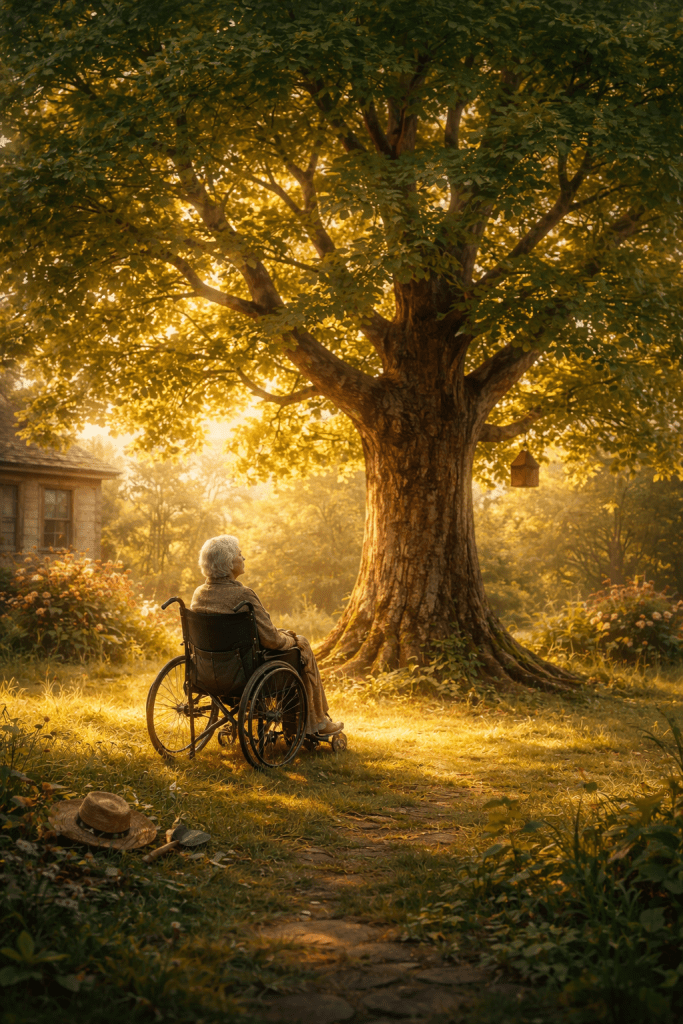
Finally, she became too old to travel and sat in a wheelchair. The children of her nephews and nieces sometimes pushed her to a nearby park. She no longer took pictures or drew maps. She simply sat under a tree and spent one or two hours looking at the trees.

One of her nephews understood why she had traveled all over the world taking pictures of trees. She had never told anyone, but to the boy it was obvious. She had been searching for a tree to die under, so that her spirit could enter the tree and live on.

He was eager to know which tree it would be. Whenever he visited her house, he studied the photographs on the walls. Was it that grand sequoia, or that mighty oak? Or the bristlecone pine in the desert? He promised himself that whatever tree she chose, he would take her there. He would bring her back to it.

Whenever he asked her, she only smiled and said, “I will let you know when the time comes.”

The grandmother grew older still, until she could no longer leave her bed. She still had not told the boy which tree she had chosen, and he began to worry she would not be able to make the journey.

Then one morning, the time came.

She called the boy and asked him to take her to the backyard.

There stood a tree with nothing particular about it. In fact, no one had really noticed it before. It was not young, nor old. It was simply a tree no one paid attention to. The boy pushed her wheelchair to it. She stayed there for a while and died quietly.

The boy could not understand why she had chosen this ordinary tree. Even if she could not travel far, there were still many dignified trees in the nearby forest that would have suited her better. He had promised to take her anywhere. And after thousands of photographs of thousands of trees all over the world, she had chosen this unmarked tree in her own backyard—a tree she had never once taken a picture of.

After her funeral, the boy entered his grandmother’s room. He took the photographs down from the wall one by one. On the back of each photo, the name of the tree, the date, and the place were carefully written—except for one.

It was a picture of an unremarkable tree in a deep and remarkable forest.

On the back it only read:

Kiquawa tree.

No place. No date.

“I will find it,” the boy said. “I will visit them all and find that tree. Then I will understand why.”

Author’s note: This story is about a lifelong search that slowly turns inward. The grandmother’s journey is a necessary wandering until the difference between one tree and another begins to dissolve. It’s the search of identity, which is only found in yourself and each person needs their own journey.

© 1994

Kiquawa Tree

When heaven slept, dreaming a dream of a thousand rivers in the sky, its only child crawled out of the cradle of wind, crawled to the edge of the cloud, and fell to the earth.The wingless child fell without a wail, and died.

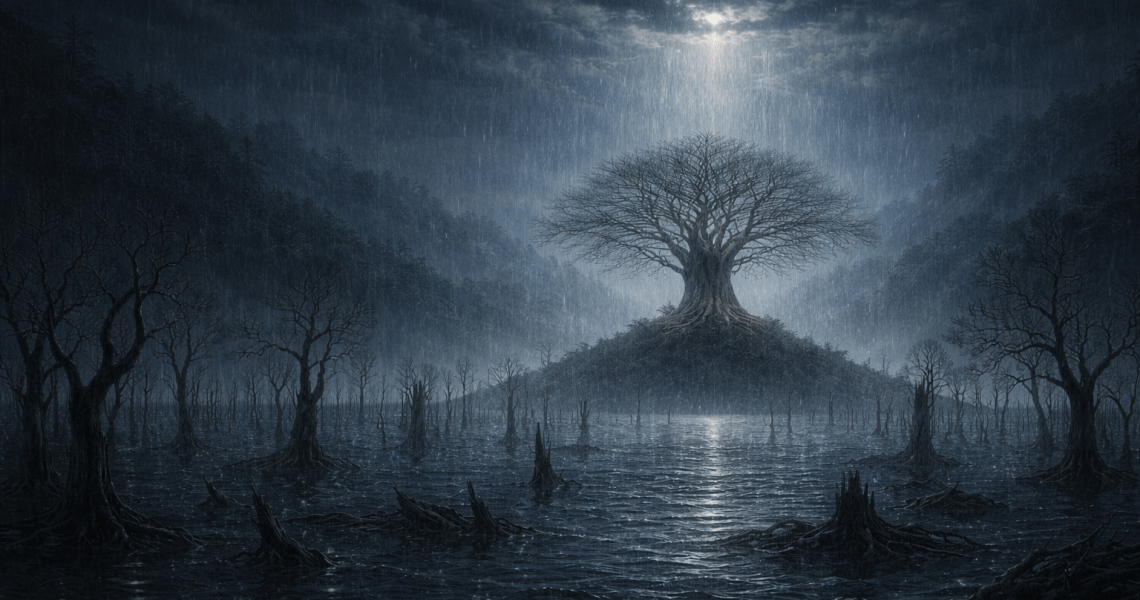
When heaven lost its only child, the first drop of its tear fell upon a Kiquawa tree on a hill. Then it turned into rain that would never end. It rained and rained upon all the creatures of the earth. Day turned into night, and the earth turned into the sea, at the bottom of which the drowned forest stood silently, like a wingless bird without a singing voice.

The Kiquawa tree on the hill looked down upon the earth and up toward the sky, and asked heaven not to let its tears flood the world.Heaven said,

How can you tell me not to cry? I have lost my only child. My child fell to the earth. The earth engulfed my wingless child and did not give it back. I look down and see the earth full of beings, yet none are mine. My tears will never cease, until all the earth lies beneath the sea of my sorrow, as silent as the starless night of the sky.

The Kiquawa tree said,

Then let me bear your child. I will take in your tears and nurse the child with them. I will give my limbs for its bones. Your tears will be its blood, and its flesh will grow. When it grows, it will worship you from the earth. You will have forests full of children to look upon you.

After one hundred sixty-eight days and nights, the rain quietly ceased. Half of the night turned into day, and the Kiquawa tree bore a child. It suckled tears from the earth. The earth grew dry, and birds began to sing.Then another Kiquawa tree bore another child, who suckled more tears from the earth. Gradually, half of the sea returned to land, and the forest was filled with children of the Kiquawa trees.

When the wingless children grew, they admired heaven, whose tears had become their blood. When a child died upon the earth, it was buried beneath a Kiquawa tree. Its bones returned to the tree, and the tree drank its blood and returned it to heaven as morning mist. Somewhere in the forest, another Kiquawa tree would bear another child.

Still, from time to time, heaven silently sheds tears for the only child it lost long ago.

© 1996 J.U.

Author’s note:

This story is a myth of grief that cannot be undone. What is lost is not recovered, but transformed. Through the body and the earth, sorrow becomes life again.

Of course, the images are AI generated.

HAND Reveals

Surprisingly, hands retain a sense of personhood almost as much as the face. They are often left untouched until later stage of dissection because working on their small and intricate surfaces requires skills and anatomical knowledge. Hands are another major interface with the outside world—not much socially but physically and emotionally. They are our probes into the physical world, our means of acting on intent, and a way to express emotions.  

When we are born, we are held with hands, fed with hands. The first contact with the outside world is through hands of our caregivers. Hands have a high concentration of nerve endings, and we navigate the world by touching. Our first instinct when we encountering something new is to reach out and touch it. If it is unpleasant, we learn to withdraw our hands. The more we touch, the more intricate our understanding of our environment becomes. 

What would happen when a naturally curious child exploring their word hear their parents say “Don’t touch it” again and again. It may be the child is about to touch hot surface and the adult intends to keep them from harm and injury. It may be the child is about to touch an expensive fragile object and the parent is afraid that they would break it. Every time a child hear “Don’t touch it” their world gets smaller and more dangerous. Their energetic reach out to the world is cut short. 

Imagine being a child at the dinner table with all the adult guests. You’re hungry, you reach for the breadbasket, and suddenly—“Don’t touch it!” your mother snaps, slapping your hand, or worse. What do you think that child would feel in their body the next time they reached out for something?

I was that child.

Now imagine if that child happens to be a kinesthetic, tactile learner. I learned to pull back, to contract, to shrink away from the outside world. After decades of living in that confined state, I realized I had to retrain my inner child. So, I took her to the zoo and the aquarium. I let her push every interactive button, touch everything that was allowed to be touched. For once, I gave her permission.

We interact with others and express our emotions using our hands. Hugging and holding of hands are physical expressions of affection. We lend a hand when somebody needs help. When we are safe, we are in good hands. We work together, hand in hand. We stay involved by keeping a hand in, even getting our hands dirty. But when we can’t act, our hands are tied, and the matter is out of our hands. Hands, in many ways, represent our life in action. 

We touch others with our hands, but have you ever thought about what information your hands are conveying? I used to be a teaching assistant for a body awareness class at an acting school. When the students were in odd numbers I would step in as a partner for pair exercises. Once I partnered with an attractive young man, and I gave him the assigned bodywork. Then we switched roles. The moment he touched me, I felt sorry for his girlfriend—or boyfriend. It was like being poked with an inanimate object, like a piece of wood. He wasn’t really there. Did my hands feel as inanimate to him as his did to me? I couldn’t help but wonder if he had never been touched properly by his family. What kind of childhood would leave a person so absent in their hands? 

I grew up in a family  where the sense of boundaries was unclear. I don’t remember my mother’s touch, except when I was sick. I experienced inappropriate touches from family members. Even so, I can be present in my hands. Being present in your hands is crucial for manual therapists—and for actors. Your hands tell a lot about you. 

When you’ve experienced inappropriate touches in early in life, you can become very sensitive to the intent behind others’ hands. Trust your feelings and quietly walk away. The other person might be unaware of their underlining intent, or it could just be your interpretation. Either way, what you felt is real. So walk away.

I once trained with a master of martial arts. He was also an energy healer with quite a following. After a year of training, one day he offered me hands-on healing session. He laid his hands on my upper chest. I had paid for sessions with him before and never felt threatened. He didn’t do anything inappropriate; he just laid hands on my chest. But unpleasant memory resurfaced. 

I thought about it for a while. Was it just my imagination? The master, this guru, was probably doing me a favor with this treatment, and I shouldn’t doubt his good intentions, right?  (I was younger then and perhaps more attractive than the older disciples.)  But then it hit me—this might be exactly what happened in those yoga guru sexual abuse incidents. I trusted my instincts and left the group. Otherwise, I would have allowed the past repeat itself, again and again. 

With a high concentration of nerve endings, your hands are both receivers and transmitters. Use them mindfully. In the anatomy lab I held the hand of a cadaver and contemplated what he might have touched, throughout his life—from birth to death. I wondered how he touched, how he navigated the world and how he interacted with others. Was his touch loving and caring? What was the last thing he touched before his death? What did he reach for, and what did he recoil from?  This hand held his child, caressed his lover, petted his dog, wiped tears, and waved goodbye…

The only time I saw the skin of a living human slip away was in a drawing depicting the aftermath of the atomic bombing in Hiroshima. The skin (specifically, epidermis) of the hand slipped off like a glove, caught at nails, hanging from the fingertips. Otherwise, while not impossible, it’s very difficult to remove the skin of hands in one piece. The skin of the hands is intimately bonded.  

copyright 2025

Face Reflected

Sometimes, face, hands, and feet are left undissected for a longer time unless there is a dissector specifically interested in these areas. Novice dissectors often feel a strong hesitation to make incision on those structures. We tend to identify individuals by their faces, as it is the most public and social part of the body. It serves as the primary interface between “I” and the society. We can’t see our faces directly: what we see is merely a reflection in a mirror or an image captured by a camera at a particular moment. As a result, a person’s self-image does not always align with their physical face. 

When I went home for my father’s funeral, I found my junior high yearbook.  I recognized the faces of girls I hadn’t seen in decades; one by one, they came back to life in my memory. I knew those teenage girls; they looked exactly as I remembered. I turned pages looking for my photo, but I couldn’t find it.  I felt confused, being certain I was in the yearbook. I started over from the first page, and with each turn, the faces of the girls became clearer in my memory. Still I couldn’t find my own face. 

On the third try, I finally found my name under a photo. She was a beautiful teenage girl. I didn’t recognize her because I had been told I was an ugly, unattractive, miserable creature—an image I had come to believe due to the distorted reflections I had been shown. Did I look ugly to you, Dad?  Or did I threaten you?  Did I look ugly to you, Mom?  Or did you also believe what Dad saw? 

Anyway, it’s too late. I lost the chance to live the life of a pretty girl and became a plain looking high school student. When I remember my high school years, I see myself as that unpopular girl with long hair hiding half of her face, like Violet Parr in The Incredibles, believing that she is invisible. My best friend is that popular girl who dates the football team captain. Years later, I had the opportunity to attend a high school reunion. One guy—who was neither the football team captain nor an academic high achiever—told me that I had been his crush in high school. I was stunned.  “You were a beautiful and intelligent girl,” he said, “and I admired you.”  I didn’t know.  I knew he liked me, but I couldn’t believe that anyone would genuinely like me. So I missed the chance to live the life of a popular girl in high school. When surrounded by distorted mirrors, we come to believe the distorted images they reflect.  

Some people are desperate to modify their faces to match their self-image. Skin is often rubbed, massaged, moisturized, medicated, and painted. It is sometimes cut, stretched, peeled, threaded, paralyzed, and modified in various ways. The skin of face, in particular, receives the most attention. 

I often see older women in my neighborhood with skin stretched unnaturally, resembling a Japanese Noh mask. For those individuals, the skin is not an archive of their life’s history but rather a screen on which they project their fears about the future. They are desperately trying to reverse the time, even though their faces, frozen in a perpetual state of youth, no longer reflect who they truly are. 

The skin is continuous throughout the body, and you won’t find perforated lines to guide your cuts. You need to decide where to make an incision. Where does the face start? The skin on the face is quite thin, so you won’t see much subcutaneous adipose tissue. Instead you will find the parotid glands, which look like pads of fat, under ears. Working on it requires a meticulous attention. 

One facial expression muscle you might miss if you don’t know its location is the platysma. In many dissection workshops, it is mistakenly cut away along with subcutaneous adipose tissue. When I managed to save it from being partially cut away with the superficial fascia, I was fascinated. This extremely thin and broad muscle, which extends from the chin to the upper chest, resides between the sheets of subcutaneous adipose tissue. I can activate it and make it pop up. Despite being easy to miss during dissection, this muscle is not immune to modification: platysmaplasty, or neck lift, is a common procedure. 

Once the skin and superficial fascia are removed from the face, the cadaver looks less personal and more like an anatomy chart. 

copyright 2025

The story you tell about them might not be their real story

We were standing in the lab, looking at three cadavers on dissection tables. As workshop participants, we were to choose a body to work on.

One was a slender woman with unnaturally perky breasts. Her nails were impeccably manicured, her hair full and glossy. She was beautiful.

Another was a heavily boned woman with a muscular build. “She must have been an avid hiker,” someone said.

The third was a woman of significant size.

She looked exactly like a good friend I had—someone who suffered from psychological and mental health issues and who had steadily gained weight until she was nearly immobile.

I felt a pang of sadness when I saw her body on the dissection table, and I experienced a slight aversion to standing at her station. No, I didn’t want to dissect her. I already knew it would be physically harder to remove her superficial fascia.

And yet, somehow, I ended up at her table.

As I began releasing her from the bounds of skin, I couldn’t help but project. I imagined the subcutaneous adipose tissue as emotional baggage she had accumulated over a lifetime, or maybe as a thick armor she wore to shield her psyche from the outside world. Under the tremendous weight, it felt like she had been collapsing inward.

The layer of superficial fascia we freed from her dermis was sizable—just as she had been with her skin on. We began removing the adipose tissue, as if freeing her from the tortured existence of living in a large body. It was hard work. The layer was easily three inches thick in her midsection.

As I worked, I thought about all the nerve endings embedded in that adipose tissue. She probably had ten times more nerve length than I do. This was a hypersentient state of being.

And then, beneath the adipose, her muscular structure appeared—and we were all astounded.

What had been hidden under that armor of fascia was not a collapsed, atrophied frame. She was robust. I had never seen an elderly female cadaver with such powerful muscles. Her legs were so strong she looked like she could’ve squeezed the life out of a big, bad cowboy. Her gracilis was not slender at all; it was substantial. None of us had ever seen gracilis muscles like that.

Her musculature had supported the weight of her adipose armor. She had the body of an Amazon warrior. There was no trace of wasting. She must have remained mobile and active until quite recently, carrying her physical existence bravely.

Internally, too, she was robust.

Her organs were intact. No calcified arteries, no arteriosclerosis. Her colon was six feet long, padded with a healthy amount of visceral fat. No fatty liver. No damaged kidneys. No fibrosis in the uterus. Her heart was beautiful. Her lungs were slightly darkened, but free of adhesions.

She was healthy.
Much healthier than I am.

The slender, model-like woman, on the other hand, had gone through hell. Once her skin and minimal adipose were removed, her body appeared almost transparent. Cancer had riddled her form—metastatic, likely starting from the breast. A chemotherapy port protruded from her chest.

She was a fighter, too.

I find myself reflecting on my projections.

You can’t tell who someone is just by looking from the outside.
The story you tell about them might not be their real story.

Multiverse Madness

You may have heard the famous Eastern philosophical parable about a man who dreams he is a butterfly, only to awaken and wonder: is he a man who dreamed he was a butterfly, or a butterfly now dreaming he is a man?

Doctor Strange in the Multiverse of Madness reminded me of that parable. In the film, dreams are portrayed as stories unfolding in alternate universes. Interestingly, the only person who can travel through the multiverse is the one who has never dreamed.

Have you ever had the same dream over and over? Not exactly the same, but different variations on a single theme? I used to have dreams like that.

One of the recurring dreams I had after a messy divorce was about my ex-husband. In those dreams, he had remarried and had a daughter and a son. They were some of my worst nightmares. He had cheated on me while I was undergoing infertility treatment, and by the time we divorced, I was too old to conceive. I had lost my chance to become a mother.

I dreamed this scenario again and again. The emotional anguish felt so real, it lingered even after I woke up. His betrayal stained the landscape of my inner world with grief and suffering. In waking life, I felt mostly anger—but underneath it, I carried a deep well of loss and sorrow.

In these dreams, I always lived in some kind of apartment. Each one felt strangely familiar. Sometimes I would find myself in the exact same apartment I had dreamed of before—with the same landscaping outside, the same scent in the air, the same humidity in the walls. I knew that place.

It’s been twenty-five years since the divorce, and I’ve finally stopped having that dream. Still, it feels as if I once lived in that apartment—in this life.

Then I began to wonder: maybe that was my life in an alternate universe. It’s about the inner choices we make—who we decide to become. Every decision spins off another timeline, another universe where a different version of you lives out the consequences of that choice.

If I had clung to the anger and suffering, maybe that nightmare would have been my reality.

These days, I rarely dream. Maybe my life has finally settled into this reality.

P.S. My ex-husband did remarry, but he never had kids. As for me, I’ve made peace with the fact that motherhood and I were probably never meant to be. Crisis averted—for the children.

Ding Dong, the Witch is Dead

I got a call from my 92-year-old mother. She had just been informed by the nursing home that my 100-year-old aunt passed away in her sleep—her heart had stopped.

I had visited her just a month ago and sat with her, talking. She had stopped responding a long time ago, but her heart kept beating with the help of a pacemaker. She swallowed whatever mushy food her caregiver spooned into her mouth and wore diapers.

This is not how I want to spend the last years of my life.

I loved her when I was a child. She lived next door to my parents, and she spoiled me with sweets, cute dresses, dolls, and stuffed animals—whatever I wanted, she bought for me. Every day, I waited eagerly for her to come home and ran to give her a hug. Sometimes, her breath smelled of alcohol.

My father was emotionally abusive, and my mother was emotionally unavailable. In many ways, it was my single, childless, career-oriented aunt who “adopted” me. She even wanted to adopt me legally at one point, but my parents—outraged—refused. There was no reason for them to give me up; we weren’t poor. I suppose it was her desire to have a daughter of her own.

I used to say I wanted to be just like her. She was my role model: fashionable, independent, capable of doing anything perfectly. She was the first woman in the region to be promoted to regional manager at the national telephone company. She was also incredibly skilled with her hands—especially knitting and crocheting. I had so many beautiful sweaters she made, and people often complimented them.

I, on the other hand, am not crafty at all. I tried, but I could never do anything as well as she could. I’d get frustrated, give up, and she would finish my projects for me. I still sometimes try, but I almost always give up.

She kept her home neat and beautiful, always with fresh flowers from her garden. She adorned the house with lovely things. Though she didn’t cook elaborate meals, she arranged simple dishes with such care that they looked more appealing than my mother’s “here’s your food, eat” style.

I admired her and, as a little girl, I dreamed of being like her—working, unmarried, and childless. That was an unusual dream at the time, when most girls wanted to be brides in white gowns. My parents didn’t respond to my dream at all. They just ignored it.

Life didn’t turn out quite the way I envisioned. I moved to the U.S., got married, worked as an ordinary office assistant, got divorced, lost my job, became an independent contractor, and remained childless. Still, I returned to Japan once a year to visit my parents and my aunt.

Even as a child, I sensed something was off in my family. There was a ghost in the closet—a family secret. Children can feel these things. Even if it’s never spoken, it changes the air.

The closet opened after my father—my aunt’s younger brother—passed away at age 87. My mother began to talk.

It was the scandal everyone in the small town knew. My aunt had an affair with her married boss and got pregnant. At the time, having a child out of wedlock was a deep shame for a respectable family. But she refused to have an abortion. Her lover’s wife was infertile, and my aunt may have believed that having a child would lead him to divorce and marry her.

Instead, he and his wife adopted the baby girl. He secretly allowed my aunt to visit the child, pretending she was just a family friend. But my aunt, lacking boundaries, acted like a mother. As the child grew older and started asking questions, the visits ended. The wife eventually died, but the man never remarried. The girl grew up not knowing she was adopted until her teenage years.

Then I was born into the family. At the time, my parents lived with my grandmother and my aunt. In a sense, my grandmother gave me to my aunt as a substitute. I don’t remember my mother’s touch. I was always with my aunt. Four years later, my brother was born, and this time my mother clung tightly to him. He was always wrapped around her like a baby monkey.

Once the secret came out, the meaning of so many things shifted. When I used to say I wanted to be like my aunt, I meant I wanted to be an independent woman. But my parents may have heard something else—that I admired her for having an affair and bearing a child out of wedlock, bringing shame to the family. My father resented having a daughter—specifically me being a daughter. From him, I absorbed the belief that all men were predators, and I had to fend them off with claws and fangs.

My aunt loved me like a daughter until she lost her mind. Even in my fifties, she’d try to brush my hair and spoon-feed me. She never truly saw me for who I was—only the daughter she lost. I was her living doll.

After my father died, my aunt’s physical and mental health declined. No one in the family wanted to take care of her, and I was the only one who didn’t hate her. So, by default, I became the one responsible.

She lived in her own home for nearly ten years, with various caregivers as her condition worsened. Eventually, she needed 24-hour care.

That’s when her true nature came out. She was highly narcissistic and very demanding. She wanted everyone around her to serve her in exactly the way she expected. She went through so many caregivers. She never forgot who had crossed her.

“Everyone who spoke ill of me died of cancer,” she once said, as if she’d cursed them.

Yes, she cursed me with her projection. She cast me in a role she needed someone to play—and I played it well. I understand she had a hard life, and she endured it the only way she knew how: by casting her pain outward, cursing everyone around her.

After the phone call, I said to myself, “Ding dong, the witch is dead.”

At least I’ve chosen not to curse anyone. That is my freedom.