Author’s note: This story is about trying to become something else and forgetting what you already are.
There was an ugly frog with a huge head, short legs, and even shorter arms in a pond. His head was so huge that even when he was a tadpole, he could not swim through the rocks with the others. They made fun of him.
His legs were so short that when he became a tadpole with legs, he could not paddle as fast as the others. They made fun of him.
His arms were shorter still, so when he became a tadpole with short legs and shorter arms, he could not crawl on the ground like the others. They made fun of him.
When he finally became an ugly frog—with a huge head, short legs, and shorter arms—others did not laugh at him so much. The pond was full of ugly frogs. Some had huge heads. Some had short legs. Some had shorter arms. So he became just another regular ugly frog.
He was heavy, and his legs were short, so when he walked and jumped, he made ridiculous noises.
Flop. Flip. Blap. Blop.
He had a friend who was smart and slender. When he jumped, he made a cute sound.
Hip hop. Hip hip.
Everybody liked the smart and slender frog. He was a good joker. Everybody laughed and loved it. He sang and danced well, and everybody wanted to dance and sing with him. When the ugly frog sang and danced, everybody just laughed at him—even though his singing was not so bad.
When the ugly frog was still an ugly tadpole, he once saw a princess sitting on the grass by the pond. She was blonde and blue-eyed, slender and snow-white. The princess was reading a book to her little sister.
The ugly tadpole listened to the story, but he didn’t understand it because he did not know human language. An old frog who could speak human language told the story for him.
It was a story of an ugly duckling who turned out to be a snow-white swan.
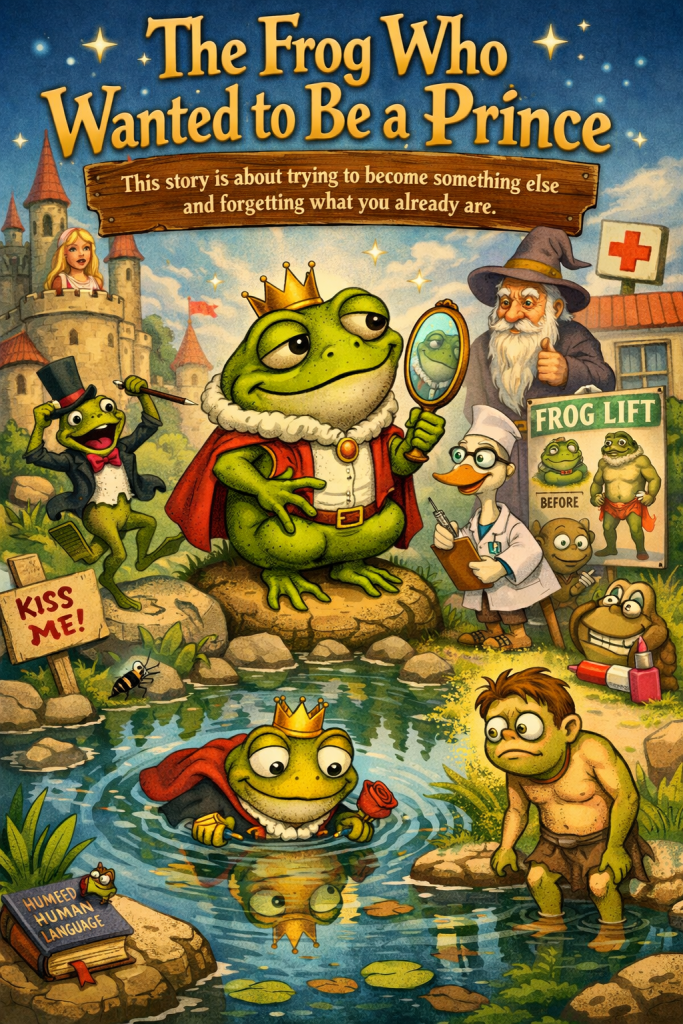
The ugly tadpole dreamed that he would turn out to be a majestic, snow-white king frog. It was fine. Many tadpoles in the pond dreamed the same dream, although they wanted to be regular majestic king frogs—dark green with black dots and shiny skin.
After the ugly tadpole became an ugly frog, he saw the princess again sitting on the grass with a book.
This time, he crawled up onto the ground—Flop. Flap. Blap. Blop.—then hid himself in the grass and peered into the book.
Even though he could’t read human language, he could look at the pictures.
It was a story of a frog. No—it was a story of a prince who had been turned into a frog by a wicked witch. A beautiful princess kissed the frog, the curse was broken, and Ta-ra-ra, he became a prince.
The princess and the prince lived happily ever after.
The ugly frog believed that he was a prince who had been turned into a frog. And if he could find a princess who would kiss him, he would become human again.
It was a tragedy that he had forgotten he had been an ugly tadpole since he hatched from an egg.
The ugly frog thought he had to learn human language to be a prince. He ignored the fact that if he had been a prince, he should already have known human language.
He joined the Human Language Speaking Society. Members spoke human language to each other with a funny ribit ribit accent.
“Heloribit, howribit are youribit?”
“I am finribit, thankibit.”
“I am very pleasiribit to seeeeerribit youribit.”
“Thank youribit very muchibit.”
The ugly frog studied hard—harder and harder—so he could become an ambassador to the pond in the princess’s castle.
He began to speak better human language than the others, even though he still had a heavy ribit ribit accent.
Then one day, his smart, slender friend was sent to the castle.
The ugly frog was upset. Since his friend could not speak human language at all, he did not understand why his friend was chosen instead of him.
So he studied harder. And harder.
When the smart, slender frog hip hop hipped into the castle, a wizard appeared.
The wizard liked the way the frog hopped and jumped and sang and danced, so he said:
“Your hopping and jumping and singing made me happy. I will give you a reward. Make a wish, and I will make it come true.”
Since the smart frog did not understand human language, he did not make a wish. He simply hipped and hopped and jumped on, and went to the pond in the castle.
The wizard smiled and made his wish come true.
The smart frog stayed in the pond, singing and dancing and hipping and hopping, enjoying his life there. After a while, he went home happily.
And he lived happily—hipping and hopping and dancing and singing.
Then the ugly frog left the pond and went to the castle without being appointed to anything.
When the ugly frog flip-flop blopped to the castle, he saw the wizard.
The ugly frog jumped on his short legs and said:
“Helloribit. Howribit doibit youribit doibit.”
The wizard frowned, because the frog’s accent was so heavy that he could not understand what he was saying.
Contrary to general belief, the wizard had never been mean. So he gently asked:
“What are you doing here in the castle, far from your native pond, little frog?”
The ugly frog answered:
“I arbit notttt a ffffrogit. I rrrrrribit am a prrrrince. I havvverrrribit come to seerrrribt a prinncess.”
The wizard listened patiently and realized that the frog somehow believed he was a prince turned into a frog.
The problem was that the wizard had never turned any prince into any frog—ugly or not ugly. In fact, he did not like that story at all.
However, the wizard was too kind to tell the frog the truth. He thought that perhaps some other wizard was responsible.
So he asked, “What do you want?”
The frog said, “Human!!!”
The wizard made his wish come true.
The ugly frog became an ugly human being—with a huge head, short legs, and shorter arms—naked and greenish.
And he still spoke with that funny frog accent.
He ran to a pond in the castle and looked into the water to see his reflection.
Then he jumped into the water and tried to drown himself.
No…
He failed.
Because the ugly frog would never forget how to swim.
That is what he was.
A frog.
© 1992
 Somatic Awareness