I’ve always wanted to be one of those rare people who can move at a moment’s notice with just two suitcases.
One of my friends has moved countless times—within New York City, from the East Coast to the West Coast, and even across the Pacific—in pursuit of better opportunities as an actress. Every time she moves, she sheds more of her belongings. Most of the time, she has lived in shared houses or apartments.
“I only keep one nice cup and one plate I love,” she once told me. She has a Tiffany teacup and a Wedgwood plate.
She doesn’t cook.
I have also moved many times, from one apartment to another in the city, as my relationships fell apart. Eventually, I came to live alone in increasingly smaller apartments. I have now lived by myself in the same small apartment for more than fifteen years.
I’ve done my share of shedding, but in general I’ve always had difficulty letting things go. Some things I kept because of their sentimental value, some because I thought I might need them someday, and others because I imagined I might use them for craft projects.
I am not a craft person.
While living in this apartment, I have encountered three cases of hoarding.
My father was a hoarder. Whenever I visited my parents and tried to sort through the belongings I had left behind, I was disgusted to find the room stuffed with toilet paper rolls, tissue boxes, and cheap bars of soap. Why do toilet paper rolls so often trigger scarcity anxiety? I rearranged the piles of toilet paper and other supplies just so I could make enough room to move around. My father complained.
I felt physically sick. It was like looking into his troubled mind. There was clearly something wrong with him. He kept everything and threw away nothing. Sometimes he picked up things other people had discarded and brought them home because they might be useful someday. We thought he was simply thrifty. After he retired, it became much worse.
After he was moved to a nursing home, we were finally able to clear out his belongings. My mother had no attachment to any of them. His better clothes and anything of value were donated to a charity. Without him there to protest, we got rid of the junk he had accumulated over the years. My mother was dumbfounded to discover several broken bicycles in the shed.
“Where did he get them?” she asked me.
He must have schlepped them home from neighborhood garbage dumps… just in case. He simply couldn’t resist the urge.
People might call it a depression mentality. Perhaps. He grew up in an era of scarcity, and it was a mindset shared by his generation. To a certain extent, it could even be considered a virtue. I have to admit that I inherited some of that mentality myself.
After he passed away, I helped my mother clear out the closets where he had stored his things. Deep inside, packed away in cardboard boxes, I found his psyche—clinging to mementos from every stage of his life, as if trying to hold mortality at bay.
I found his old clothes, tattered and dusty. Among them were the uniforms he had worn as a bank clerk, at least fifty years earlier. Then I came across a stack of pay slips over his entire career at the bank. I was at a loss for words.
Next I found old newspaper clippings from our hometown. One was a small article with a photograph of a group of young nurses. Slowly it dawned on me that one of them was my mother. Another clipping was about something I had written, with my photograph beside it. I didn’t even remember it. I showed my mother the article about the nurses. She didn’t even look at it before tossing it into the garbage. I threw mine away, too.
He never made an effort to know who I was. I was just another newspaper clipping to him, packed away in a dusty cardboard box with the other mementos of his life.
I still don’t know who he was.
But now I know his fear, his anxiety, and his insecurity.
About fifteen years ago, a friend of mine with Dissociative Identity Disorder asked me to help her clean out her apartment. Since she never let anyone inside, very few people knew how she was living. At the time, I was highly dissociated myself. She probably recognized a similarly traumatized psyche in me, and that may have made her feel safe enough to let me in.
Her apartment was in a state of extreme chaos. Everything that entered the space simply piled up without any sense of order. Letters, papers, and plastic bags fell onto the floor and remained there for years. New clothes, still with their tags attached, were buried beneath empty boxes alongside stained clothes. There was barely enough room to move.
It was a shock to my nervous system, but I didn’t feel it. I compartmentalized my emotions and focused on the task at hand, helping her create a little space with some semblance of normalcy.
It was like an archaeological dig. As I cleared away one layer, I uncovered things from the previous year, then the year before that. It became difficult when I began to recognize pieces of our shared past: handouts from our psychospiritual training program, essays by fellow students that she had reviewed, handmade scarves one of the artist students gave her every year. She was loved and trusted by so many of us, yet throughout those years she lived inside this chaos, building a fortress of possessions to keep the outside world at bay.
For about a year, I helped her carve out enough space for her simply to exist. Then she shut down. Before long, the apartment had returned to its original chaos. Perhaps she couldn’t tolerate even the slightest sense of normalcy.
That apartment embodied her psyche. While I was there, it felt as though multiple voices were speaking at once, without context. I stayed numb because if I had allowed myself to feel, I don’t think I could have survived the overwhelming chaos I was trying to bring into some kind of order.
When she was “allowed”—her word—to go out, she could present herself as a perfectly normal person. Brilliant and intelligent, thoughtful and kind, she was a wonderful woman. She was also a mentor to some of us.
I remember one evening when she treated two of us—both struggling with family trauma—to a Sondheim musical. She was funny, articulate, and sophisticated, dressed in a beautiful Eileen Fisher outfit, her favorite brand.
At the end of the evening, we each returned to our own worlds. I went back to my small, cluttered, but safe apartment. The other woman returned to her apartment in the East Village, where her husband was waiting. My friend returned to her own space, where chaos alone prevailed.
As more and more things accumulated in her apartment, there was less and less of the person we knew.
To me, it became clear that the apartment was her. Her confusion, her shame, her fear, her profound frustration, her madness—they all lived there.
Because of severe childhood trauma and the mental illness that followed, She had never been able to metabolize everyday life.
I saw something of myself in her. From that point on, I began consciously and deliberately letting things go.
I didn’t want to become her.
The third case was my aunt, who passed away at the age of one hundred. I was the executor of her will and had to empty her house before we could sell it. I never imagined she was a hoarder. Her home was always neat and beautifully decorated. I began by burning her photo albums simply because I couldn’t bear the thought of her personal photographs ending up in a garbage dump.
Then I realized she had been a major hoarder.
There were thousands of photographs of her. Everything was about her. It was as if she were the center of every party she attended, every trip she took, every occasion she was part of. Thousands of photographs documented the life she presented to the outside world.
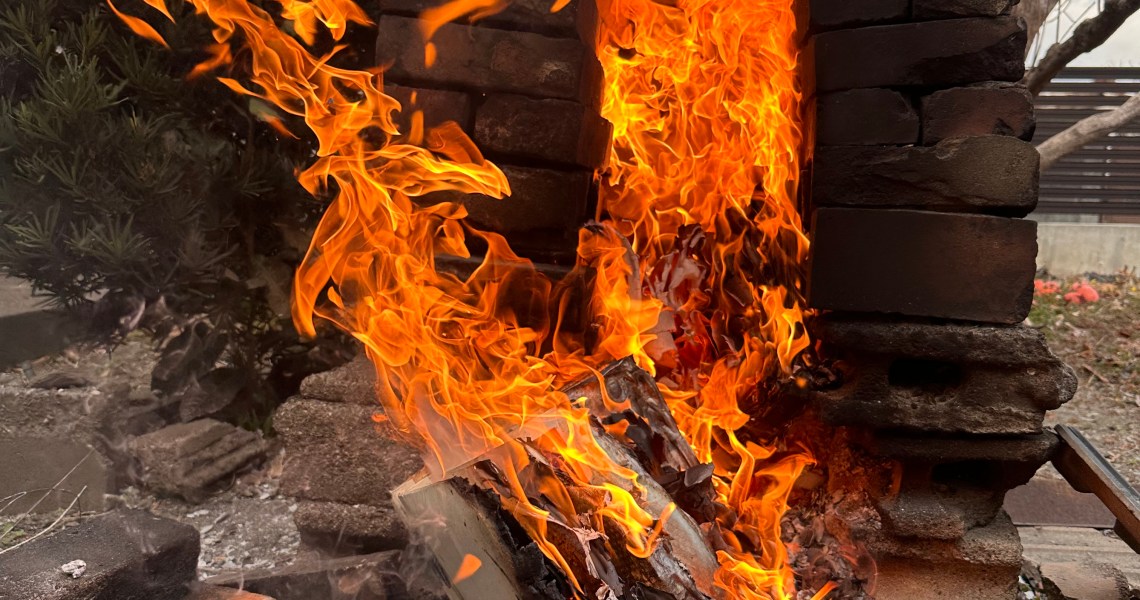
Like my father, she kept everything. I found old tickets, postcards, and little souvenirs from her extensive travels tucked away in drawers. I kept feeding them into the fire.
Then I moved on to the closets. They were meticulously organized, filled with hundreds of boxes, most of them carefully labeled in her own handwriting. Inside were the leftover supplies from every craft she had ever taken up. She was extraordinarily talented and threw herself into one craft after another. For several years she would immerse herself in it, creating beautiful things, and then she would move on to the next one. The remnants of each passion were carefully packed away and preserved. Some of the boxes had remained unopened for decades.
She kept everything.
She built an armor out of her creations and achievements.
I don’t know who she was. It was as if someone had cut the figure out of a photograph. The background remained perfectly intact, but where she should have been, there was only a blank white space.
We digest food. We also digest life’s experiences—if they are fully lived, they become part of us. If they are not, they remain outside us as unfinished business. Sometimes they become objects we cannot throw away.
Now I look around my apartment and ask myself what I can let go of. I don’t need mementos of my life once I’ve metabolized it.