Face Reflected

Sometimes, face, hands, and feet are left undissected for a longer time unless there is a dissector specifically interested in these areas. Novice dissectors often feel a strong hesitation to make incision on those structures. We tend to identify individuals by their faces, as it is the most public and social part of the body. It serves as the primary interface between “I” and the society. We can’t see our faces directly: what we see is merely a reflection in a mirror or an image captured by a camera at a particular moment. As a result, a person’s self-image does not always align with their physical face. 

When I went home for my father’s funeral, I found my junior high yearbook.  I recognized the faces of girls I hadn’t seen in decades; one by one, they came back to life in my memory. I knew those teenage girls; they looked exactly as I remembered. I turned pages looking for my photo, but I couldn’t find it.  I felt confused, being certain I was in the yearbook. I started over from the first page, and with each turn, the faces of the girls became clearer in my memory. Still I couldn’t find my own face. 

On the third try, I finally found my name under a photo. She was a beautiful teenage girl. I didn’t recognize her because I had been told I was an ugly, unattractive, miserable creature—an image I had come to believe due to the distorted reflections I had been shown. Did I look ugly to you, Dad?  Or did I threaten you?  Did I look ugly to you, Mom?  Or did you also believe what Dad saw? 

Anyway, it’s too late. I lost the chance to live the life of a pretty girl and became a plain looking high school student. When I remember my high school years, I see myself as that unpopular girl with long hair hiding half of her face, like Violet Parr in The Incredibles, believing that she is invisible. My best friend is that popular girl who dates the football team captain. Years later, I had the opportunity to attend a high school reunion. One guy—who was neither the football team captain nor an academic high achiever—told me that I had been his crush in high school. I was stunned.  “You were a beautiful and intelligent girl,” he said, “and I admired you.”  I didn’t know.  I knew he liked me, but I couldn’t believe that anyone would genuinely like me. So I missed the chance to live the life of a popular girl in high school. When surrounded by distorted mirrors, we come to believe the distorted images they reflect.  

Some people are desperate to modify their faces to match their self-image. Skin is often rubbed, massaged, moisturized, medicated, and painted. It is sometimes cut, stretched, peeled, threaded, paralyzed, and modified in various ways. The skin of face, in particular, receives the most attention. 

I often see older women in my neighborhood with skin stretched unnaturally, resembling a Japanese Noh mask. For those individuals, the skin is not an archive of their life’s history but rather a screen on which they project their fears about the future. They are desperately trying to reverse the time, even though their faces, frozen in a perpetual state of youth, no longer reflect who they truly are. 

The skin is continuous throughout the body, and you won’t find perforated lines to guide your cuts. You need to decide where to make an incision. Where does the face start? The skin on the face is quite thin, so you won’t see much subcutaneous adipose tissue. Instead you will find the parotid glands, which look like pads of fat, under ears. Working on it requires a meticulous attention. 

One facial expression muscle you might miss if you don’t know its location is the platysma. In many dissection workshops, it is mistakenly cut away along with subcutaneous adipose tissue. When I managed to save it from being partially cut away with the superficial fascia, I was fascinated. This extremely thin and broad muscle, which extends from the chin to the upper chest, resides between the sheets of subcutaneous adipose tissue. I can activate it and make it pop up. Despite being easy to miss during dissection, this muscle is not immune to modification: platysmaplasty, or neck lift, is a common procedure. 

Once the skin and superficial fascia are removed from the face, the cadaver looks less personal and more like an anatomy chart. 

copyright 2025
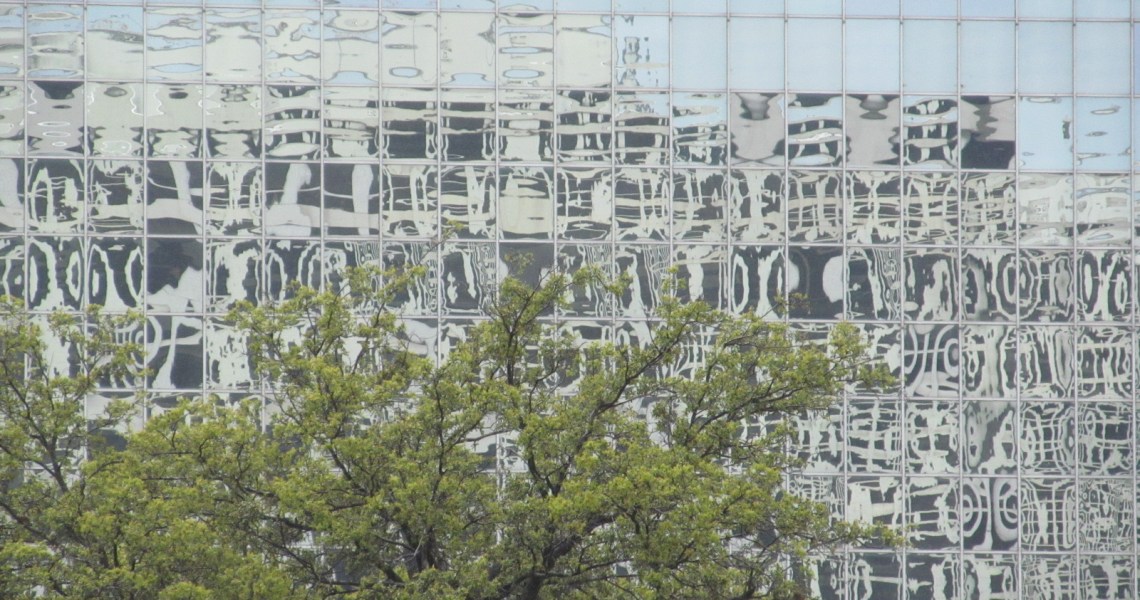
Three Way Mirror Vanity

I had three mothers.

There’s a photo of them together, sitting in a living room. Every time I look at it, I think of the witches—not the ones from Hocus Pocus, but the ones from Macbeth. Together, they conjured me: a daughter with a fragmented identity.

When we are young, we come to understand ourselves through interaction with our parents. We need to feel loved and accepted—especially by our mothers. Our survival depends on them. They become the foundation of who we are.

In my early childhood, my parents, grandmother, and aunt all lived under the same roof. My real mother was a nurse and gone during the day. My grandmother took care of me. She was a woman of few words, rarely expressive. She fed me, probably changed my diapers, and otherwise left me to my own devices. I was a free-range kid. She was always busy—tending to our small rice paddies, vegetable garden, and housework.

I followed her around, watching her do everything by hand or with simple tools. I saw her harvest soybeans, shell them, sort them, boil and mash them, and finally turn them into homemade miso paste. Everything was made from scratch. That’s just how small farmers lived.

She also took me on her regular visits—to the neighborhood Shinto shrine, and to my grandfather’s grave. From her, I learned ritual manners. She was more superstitious than religious. To this day, I still visit that same shrine when I go home. It’s deeply rooted in me. As long as I physically survived and followed her instructions, I was allowed to exist.

Sometimes, when my mother worked night shifts, my grandmother “let her rest” by handing me off to my single, childless aunt. I often slept beside her. Only much later—nearly half a century on—I learned that my aunt had once had a child out of wedlock, a daughter she gave up for adoption.

To her, I was a baby doll. She adored me and constantly told me I was cute. Whatever I did, I was “cute” to her. Naturally, I loved her. Looking back, I see now that I was her emotional support animal. A doll she could pour her love into. I was a blank screen, an empty vessel for her to project her longing and affection onto. As long as I accepted her version of “love,” I had a place in her world.

My actual mother? She’s almost completely absent from my childhood memories—except when I was sick. As a nurse, she took care of my body when it broke down. But emotionally, there was no connection. With her, I felt like a utility animal—fed and maintained for function, not love.

Her “love” was always conditional. I was a “good enough” daughter only when I served some purpose for her. Most of the time, that purpose was to be strong-willed, fearless, and short-tempered—a stand-in, a surrogate warrior she used to push back against her verbally and psychologically abusive husband. I was her avatar, not her child.

As I grew up, I developed three distinct clusters of identity traits—not like someone with dissociative identity disorder, but more like someone sitting in front of a three-way mirror vanity, where each angled mirror is distorted and reflects a different version of her. And those warped reflections bounce back and forth endlessly, deepening the distortion.

It was deeply confusing, to say the least.

It took me decades—more than half a lifetime—to even begin to feel the original me. I spent so many hours trying to reconcile those mirrored fragments. Now, I no longer need the mirror.

As for my father—he hated that I was a girl. The only time he acknowledged me as his child was when I got good grades. Otherwise, I was worthless.

A Skeleton in the Closet

I grew up believing my family was an ordinary one.  Nobody was particularly out of ordinary, so I thought.  My father was not an alcoholic nor an addict.  My mother was not a chain-smoking suicidal woman.  My brother didn’t smoke pot nor join a band.  I didn’t have an eccentric spinster aunt.  It was a quotidian kind of dysfunctional family.  Then I saw a play,  August, Osage County.  After the curtain, I turned to my friend and said, “That’s a terrible family.” And then I added, “That’s my family.”

Every dysfunctional family I saw on stage had a secret everybody knew about.  They lock it up in the closet and pretend it is not there.  Children born into the family can’t do anything but inherit it.  Adults may think kids don’t know about the skeleton in the closet.  We know. We see the ghosts lurking in the hallway, hear them whisper, and feel the cold air when they pass through us.  We grow up with the ghosts and adults tell us again and again that there is no such thing.  Silly child.  So we start to believe it’s us.  The dark shadows and crazy voices are inside of us.  We become the ghost of the family secret.

So I started to drink early, chain-smoked, cut myself, ate and vomited.  I started to live by myself when I was 18 and moved further and further from my hometown until I reached to the other side of the globe.  I’ve become an eccentric divorcee.

After several decades, funerals started to happen.  Older generation was dying out and they wanted to talk about the skeleton.

The irony is that I knew about it.  Nobody told me but I just knew it.  It’s silly to believe you can keep secrets from a highly sensitive child.  They just didn’t know I knew.  Once they knew I knew, they talked, and talked, and talked.  He said, she said, he said she said, and she said he said.  Everybody told a different version of the story.

So I found out that my family was not an ordinary family.  It could be the one in Yoknapatawpha County, could be in Tennessee Williams’ play, and definitely August, Osage County worthy.

Nothing was wrong with me.  It wasn’t me.

Fortunately, after decades of therapy I was able to be the shaman who could navigate between the worlds of the living and ghosts.  I listened to the stories they told, and returned them a story with a new and much gentler narrative, transformed it into a story where there was no skeleton in the closet.   Adults could talk about their feelings, how they loved and hated, how they got hurt and survived.  The mistake they made and how it affected their lives, lives which are running out ever so quickly.

I am not a ghost anymore.