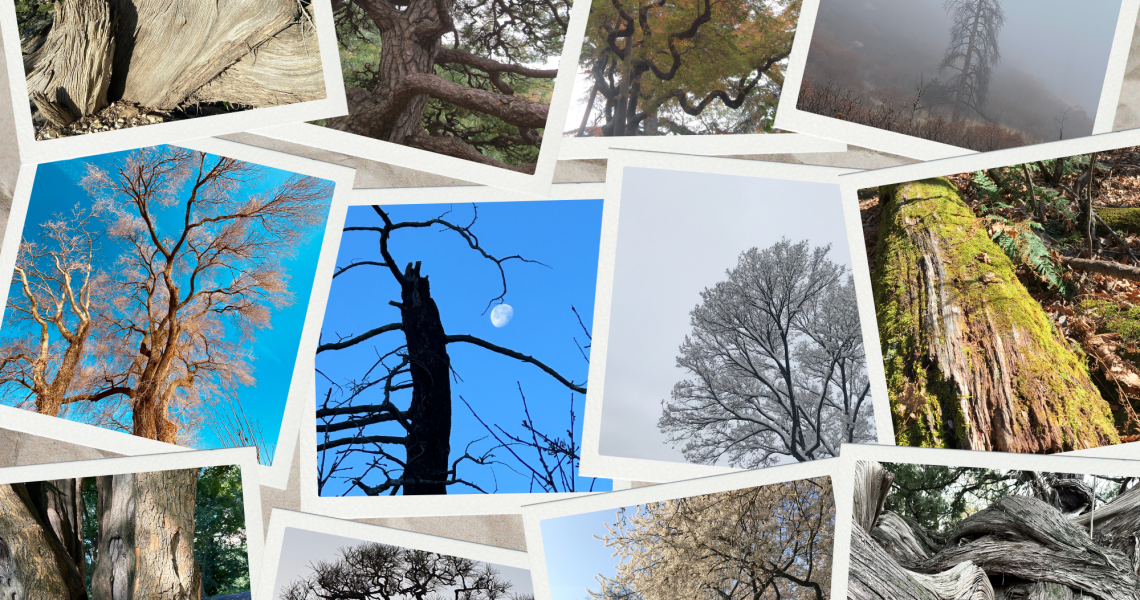
There was a grandmother who had no grandchildren. She loved woods and forests and traveled all over the world. When she was younger, she went abroad in search of unusual trees in strange forests, in strange countries.
When she got a little older, she could no longer endure the cold of Iceland in winter or the boiling heat of India in summer. So she began to look for trees in her own country. She went to the Green Mountains, the White Mountains, the Blue Mountains, the Red Mountains, the Yellow Mountains—name any mountains in this country, and she had been there. Not only mountains, but swamps and bayous in the South, to see cypress trees with Spanish moss hanging from their branches. She took pictures of trees and drew maps so she could visit them again.
When she got older, she could no longer fly across the country or drive over the great plains. So she began to visit mountains and forests nearby. She drove to national parks and forests in the region and walked the trails until she found a tree that quietly drew her in. She still took pictures and made maps. The walls of her house were covered with trees.
When she got older and could no longer drive, her nephews and nieces took turns bringing her to the lake, where she sat in a chair and looked at the forest beyond.
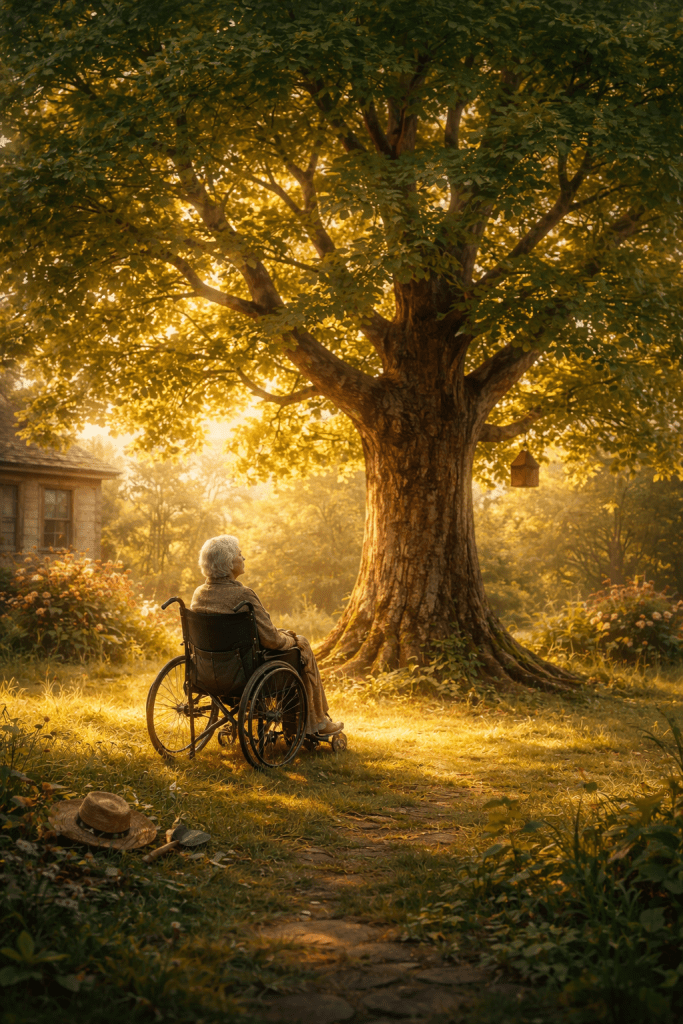
Finally, she became too old to travel and sat in a wheelchair. The children of her nephews and nieces sometimes pushed her to a nearby park. She no longer took pictures or drew maps. She simply sat under a tree and spent one or two hours looking at the trees.
One of her nephews understood why she had traveled all over the world taking pictures of trees. She had never told anyone, but to the boy it was obvious. She had been searching for a tree to die under, so that her spirit could enter the tree and live on.
He was eager to know which tree it would be. Whenever he visited her house, he studied the photographs on the walls. Was it that grand sequoia, or that mighty oak? Or the bristlecone pine in the desert? He promised himself that whatever tree she chose, he would take her there. He would bring her back to it.
Whenever he asked her, she only smiled and said, “I will let you know when the time comes.”
The grandmother grew older still, until she could no longer leave her bed. She still had not told the boy which tree she had chosen, and he began to worry she would not be able to make the journey.
Then one morning, the time came.
She called the boy and asked him to take her to the backyard.
There stood a tree with nothing particular about it. In fact, no one had really noticed it before. It was not young, nor old. It was simply a tree no one paid attention to. The boy pushed her wheelchair to it. She stayed there for a while and died quietly.
The boy could not understand why she had chosen this ordinary tree. Even if she could not travel far, there were still many dignified trees in the nearby forest that would have suited her better. He had promised to take her anywhere. And after thousands of photographs of thousands of trees all over the world, she had chosen this unmarked tree in her own backyard—a tree she had never once taken a picture of.
After her funeral, the boy entered his grandmother’s room. He took the photographs down from the wall one by one. On the back of each photo, the name of the tree, the date, and the place were carefully written—except for one.
It was a picture of an unremarkable tree in a deep and remarkable forest.
On the back it only read:
Kiquawa tree.
No place. No date.
“I will find it,” the boy said. “I will visit them all and find that tree. Then I will understand why.”
Author’s note: This story is about a lifelong search that slowly turns inward. The grandmother’s journey is a necessary wandering until the difference between one tree and another begins to dissolve. It’s the search of identity, which is only found in yourself and each person needs their own journey.
© 1994
 Somatic Awareness