Home

When Michelle’s sister, Norma, was diagnosed with cancer, she called their mom to tell her the news. Norma is strong-willed—not the type to break down easily. Her mom just listened quietly, nodding along. Then, at the end of the conversation, she simply said,
“You may come home if you want.”

And that’s when Norma broke down, sobbing.

“Wow. That was the perfect response,” I said to Michelle. “Your mom is really good.”
She didn’t try to fix anything. She just held space for Norma, offered her a safe place, and gave her a choice.

This would never happen in my family.

From what I’ve heard over the years, Michelle’s family runs on love. We’ve been friends for decades, and in the beginning, we didn’t really understand each other’s “normal.”
But as we’ve continued to exchange stories about our families, the contrast has only become clearer—how we think, how we move through the world, how we relate to others, and ultimately, who we are.

For Michelle, every relationship begins with love.
For me, every relationship begins with a transaction.

What would my mother say if I were in Norma’s shoes?
She’d say, “Come home.”
But not because I’d be welcome if I wanted to come home. It would mean I should come home—whether I wanted to or not—so she could step into the role of the devoted caretaker. My mom was a nurse, after all. She would turn the story into hers. She always does.
She dictates the narrative of my life.

And I would say, “No.”
Because for me, “home” isn’t a safe place.
The only safe place I know is the one I’ve made for myself, where I live alone.
The only safe relationship I have is with my dog—whose love comes without conditions.

We all carry different meanings for the same words.
What “home” means depends on who you ask.
So does “love.”
So does “safe.”

Three Way Mirror Vanity

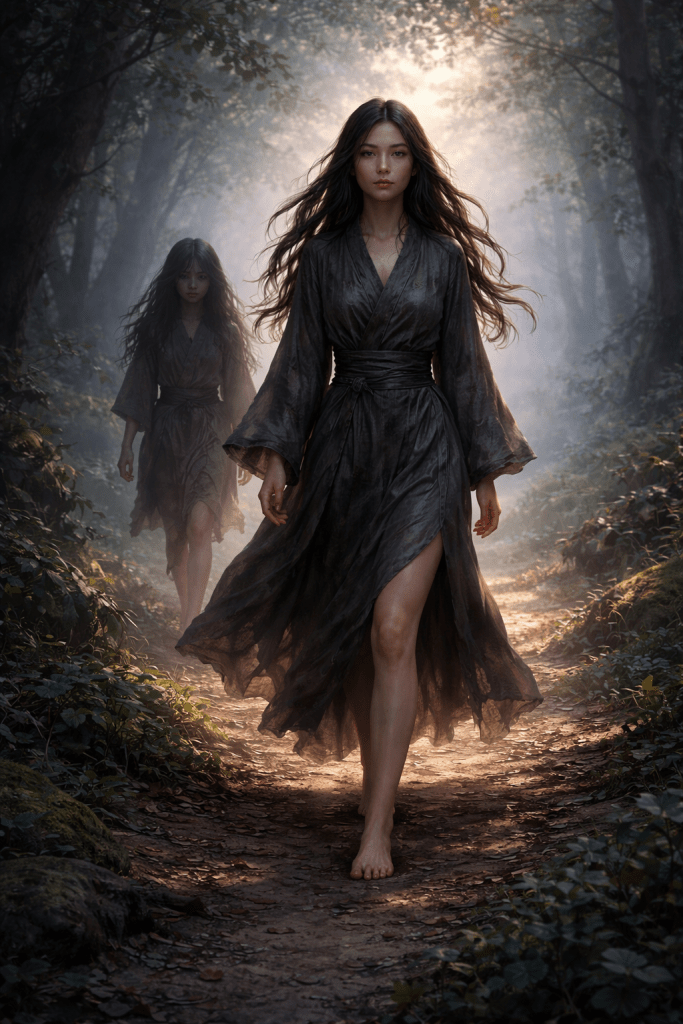
I had three mothers.

There’s a photo of them together, sitting in a living room. Every time I look at it, I think of the witches—not the ones from Hocus Pocus, but the ones from Macbeth. Together, they conjured me: a daughter with a fragmented identity.

When we are young, we come to understand ourselves through interaction with our parents. We need to feel loved and accepted—especially by our mothers. Our survival depends on them. They become the foundation of who we are.

In my early childhood, my parents, grandmother, and aunt all lived under the same roof. My real mother was a nurse and gone during the day. My grandmother took care of me. She was a woman of few words, rarely expressive. She fed me, probably changed my diapers, and otherwise left me to my own devices. I was a free-range kid. She was always busy—tending to our small rice paddies, vegetable garden, and housework.

I followed her around, watching her do everything by hand or with simple tools. I saw her harvest soybeans, shell them, sort them, boil and mash them, and finally turn them into homemade miso paste. Everything was made from scratch. That’s just how small farmers lived.

She also took me on her regular visits—to the neighborhood Shinto shrine, and to my grandfather’s grave. From her, I learned ritual manners. She was more superstitious than religious. To this day, I still visit that same shrine when I go home. It’s deeply rooted in me. As long as I physically survived and followed her instructions, I was allowed to exist.

Sometimes, when my mother worked night shifts, my grandmother “let her rest” by handing me off to my single, childless aunt. I often slept beside her. Only much later—nearly half a century on—I learned that my aunt had once had a child out of wedlock, a daughter she gave up for adoption.

To her, I was a baby doll. She adored me and constantly told me I was cute. Whatever I did, I was “cute” to her. Naturally, I loved her. Looking back, I see now that I was her emotional support animal. A doll she could pour her love into. I was a blank screen, an empty vessel for her to project her longing and affection onto. As long as I accepted her version of “love,” I had a place in her world.

My actual mother? She’s almost completely absent from my childhood memories—except when I was sick. As a nurse, she took care of my body when it broke down. But emotionally, there was no connection. With her, I felt like a utility animal—fed and maintained for function, not love.

Her “love” was always conditional. I was a “good enough” daughter only when I served some purpose for her. Most of the time, that purpose was to be strong-willed, fearless, and short-tempered—a stand-in, a surrogate warrior she used to push back against her verbally and psychologically abusive husband. I was her avatar, not her child.

As I grew up, I developed three distinct clusters of identity traits—not like someone with dissociative identity disorder, but more like someone sitting in front of a three-way mirror vanity, where each angled mirror is distorted and reflects a different version of her. And those warped reflections bounce back and forth endlessly, deepening the distortion.

It was deeply confusing, to say the least.

It took me decades—more than half a lifetime—to even begin to feel the original me. I spent so many hours trying to reconcile those mirrored fragments. Now, I no longer need the mirror.

As for my father—he hated that I was a girl. The only time he acknowledged me as his child was when I got good grades. Otherwise, I was worthless.

Mother

After all, my choice was right,” my mother said, and I froze.

Since I was a little girl, she had made up her mind that I was destined to become a physician. She brainwashed me into believing it was my fate. Never mind that I loved reading and writing, hated math and science, and had terrible hand-eye coordination—she was convinced I was meant to be a doctor.

She had her reasons. My mother grew up poor and spent her early teenage years as a live-in nanny at her eldest brother’s house. He had been adopted out so he could get a better education and eventually became a physician. His wife was cruel and didn’t allow my mother to enroll in high school. But my mother, determined and stubborn, secretly applied to a nursing program and moved into a dormitory.

She became a nurse and later married—not to a doctor, but to an average city employee. So she shifted her dreams onto her children. She was going to be the proud mother of doctors. She believed this would elevate her status, allow her to join the elite “doctor’s family” club.

I never particularly wanted to become a physician, but I applied to a local medical school anyway. Thankfully, I wasn’t accepted. I could’ve tried again the next year, but by then, her focus had shifted to her new project: creating a physician son. She told me I was a bad influence on my younger brother and decided to “let me go.”

I had also applied to a liberal arts college in Tokyo, partly as an act of rebellion—and got in. She never asked what I wanted. She just decided I should go.

That was the “choice” she was referring to.

After college, I entered grad school and nearly earned a Ph.D. (Doctor!), but in my final year, I went to the U.S. to research my dissertation. There, I met an artist, fell in love, and got married. I stayed. Whatever plans she had for me, I repeatedly chose another path. At every fork in the road, she tried to map out my life, and I took the opposite turn.

She adapted. She became the mother of a daughter who lived in New York City. Her in-laws included a famous artist in Kyoto. She was no longer a poor country girl—she had graduated into the “cultured class.” She seemed to enjoy her new identity.

Meanwhile, my brother did become a surgeon, just as she’d dreamed. She didn’t need a physician daughter anymore.

Then I got divorced, and she lost that identity too. She wanted me to go back to my cheating husband.

For a time, she was the mother of a daughter who lived and worked in New York. She had no idea what I actually did for a living—a low-paid office secretary—but the title sounded impressive enough.

Since my father passed away about ten years ago, I’ve taken care of her, even from afar. I visit once or twice a year. I send gourmet meals every month. Compared to some of her friends, she realized she was lucky. She finally saw that it was possible because I didn’t have a demanding medical career or a family of my own to care for. And she said—without irony—that she was glad I was divorced.

And then, she said it again:
“After all, my choice was right.”

She took credit for all of my choices—every one I made against her wishes.

That’s my mother. I can’t recall a single time she ever asked me how I felt.

Ding Dong, the Witch is Dead

I got a call from my 92-year-old mother. She had just been informed by the nursing home that my 100-year-old aunt passed away in her sleep—her heart had stopped.

I had visited her just a month ago and sat with her, talking. She had stopped responding a long time ago, but her heart kept beating with the help of a pacemaker. She swallowed whatever mushy food her caregiver spooned into her mouth and wore diapers.

This is not how I want to spend the last years of my life.

I loved her when I was a child. She lived next door to my parents, and she spoiled me with sweets, cute dresses, dolls, and stuffed animals—whatever I wanted, she bought for me. Every day, I waited eagerly for her to come home and ran to give her a hug. Sometimes, her breath smelled of alcohol.

My father was emotionally abusive, and my mother was emotionally unavailable. In many ways, it was my single, childless, career-oriented aunt who “adopted” me. She even wanted to adopt me legally at one point, but my parents—outraged—refused. There was no reason for them to give me up; we weren’t poor. I suppose it was her desire to have a daughter of her own.

I used to say I wanted to be just like her. She was my role model: fashionable, independent, capable of doing anything perfectly. She was the first woman in the region to be promoted to regional manager at the national telephone company. She was also incredibly skilled with her hands—especially knitting and crocheting. I had so many beautiful sweaters she made, and people often complimented them.

I, on the other hand, am not crafty at all. I tried, but I could never do anything as well as she could. I’d get frustrated, give up, and she would finish my projects for me. I still sometimes try, but I almost always give up.

She kept her home neat and beautiful, always with fresh flowers from her garden. She adorned the house with lovely things. Though she didn’t cook elaborate meals, she arranged simple dishes with such care that they looked more appealing than my mother’s “here’s your food, eat” style.

I admired her and, as a little girl, I dreamed of being like her—working, unmarried, and childless. That was an unusual dream at the time, when most girls wanted to be brides in white gowns. My parents didn’t respond to my dream at all. They just ignored it.

Life didn’t turn out quite the way I envisioned. I moved to the U.S., got married, worked as an ordinary office assistant, got divorced, lost my job, became an independent contractor, and remained childless. Still, I returned to Japan once a year to visit my parents and my aunt.

Even as a child, I sensed something was off in my family. There was a ghost in the closet—a family secret. Children can feel these things. Even if it’s never spoken, it changes the air.

The closet opened after my father—my aunt’s younger brother—passed away at age 87. My mother began to talk.

It was the scandal everyone in the small town knew. My aunt had an affair with her married boss and got pregnant. At the time, having a child out of wedlock was a deep shame for a respectable family. But she refused to have an abortion. Her lover’s wife was infertile, and my aunt may have believed that having a child would lead him to divorce and marry her.

Instead, he and his wife adopted the baby girl. He secretly allowed my aunt to visit the child, pretending she was just a family friend. But my aunt, lacking boundaries, acted like a mother. As the child grew older and started asking questions, the visits ended. The wife eventually died, but the man never remarried. The girl grew up not knowing she was adopted until her teenage years.

Then I was born into the family. At the time, my parents lived with my grandmother and my aunt. In a sense, my grandmother gave me to my aunt as a substitute. I don’t remember my mother’s touch. I was always with my aunt. Four years later, my brother was born, and this time my mother clung tightly to him. He was always wrapped around her like a baby monkey.

Once the secret came out, the meaning of so many things shifted. When I used to say I wanted to be like my aunt, I meant I wanted to be an independent woman. But my parents may have heard something else—that I admired her for having an affair and bearing a child out of wedlock, bringing shame to the family. My father resented having a daughter—specifically me being a daughter. From him, I absorbed the belief that all men were predators, and I had to fend them off with claws and fangs.

My aunt loved me like a daughter until she lost her mind. Even in my fifties, she’d try to brush my hair and spoon-feed me. She never truly saw me for who I was—only the daughter she lost. I was her living doll.

After my father died, my aunt’s physical and mental health declined. No one in the family wanted to take care of her, and I was the only one who didn’t hate her. So, by default, I became the one responsible.

She lived in her own home for nearly ten years, with various caregivers as her condition worsened. Eventually, she needed 24-hour care.

That’s when her true nature came out. She was highly narcissistic and very demanding. She wanted everyone around her to serve her in exactly the way she expected. She went through so many caregivers. She never forgot who had crossed her.

“Everyone who spoke ill of me died of cancer,” she once said, as if she’d cursed them.

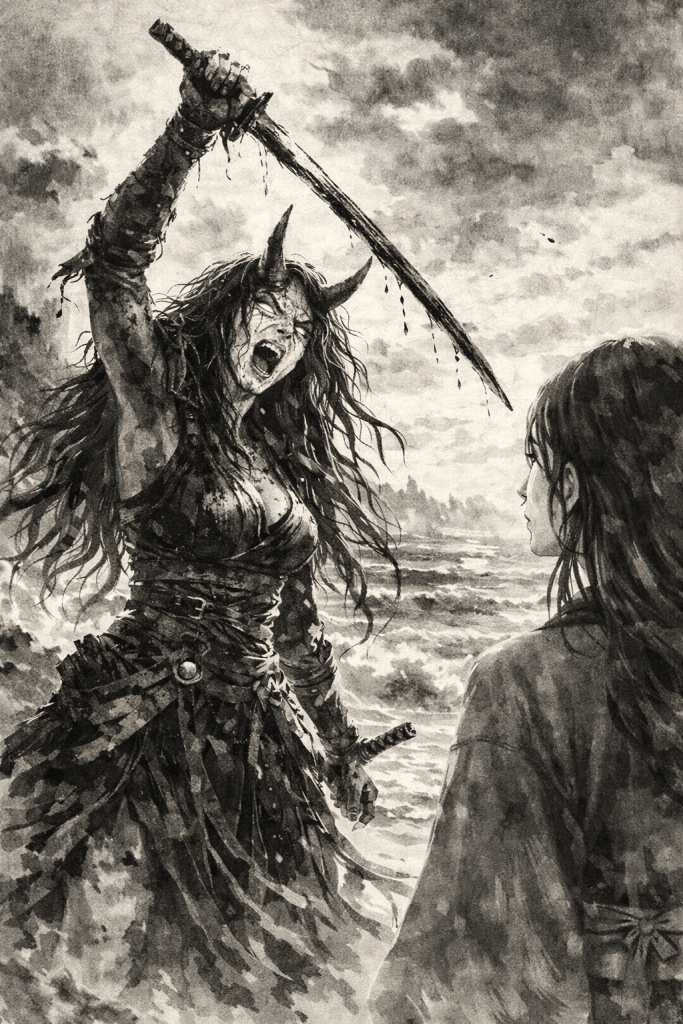
Yes, she cursed me with her projection. She cast me in a role she needed someone to play—and I played it well. I understand she had a hard life, and she endured it the only way she knew how: by casting her pain outward, cursing everyone around her.

After the phone call, I said to myself, “Ding dong, the witch is dead.”

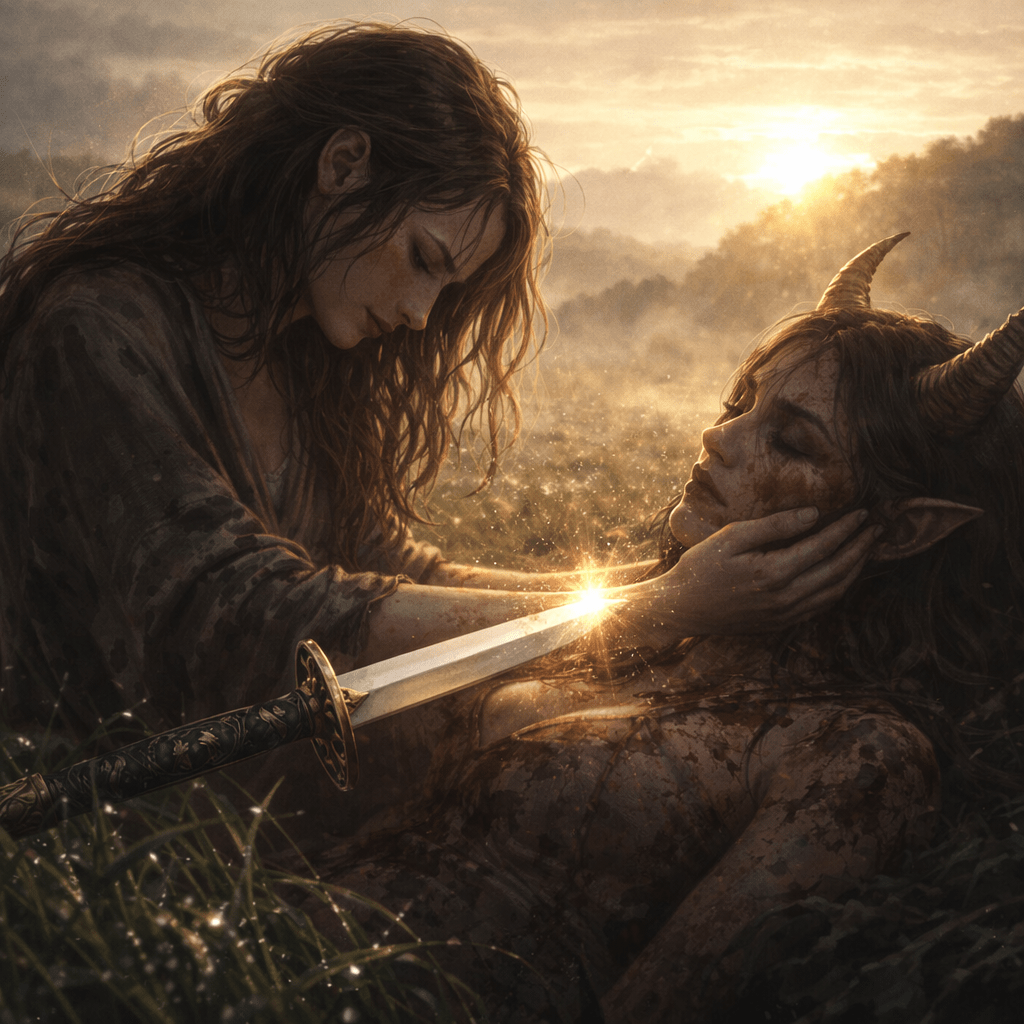
At least I’ve chosen not to curse anyone. That is my freedom.

Split

I watched Split and Glass on Netflix, where a fictional character with Dissociative Identity Disorder (DID) develops a personality with superhuman strength. James McAvoy was phenomenal, shifting seamlessly from one persona to another on screen. The story is a textbook case of severe childhood trauma: the psyche fractures to protect the vulnerable self. One of his identities, “The Beast,” punishes the undamaged—those who haven’t suffered.
[Spoiler Alert] The Beast sees the damaged as pure.

That’s what drew me in.

I have a friend with DID. Sarah is brilliant, cultured, well-read, and funny. She took many younger, “damaged” women under her wing. She was the one who introduced me to Broadway, gifting me tickets to Sondheim. We’d sit in cafes, visit restaurants, and talk about arthouse films and everything else. Her life sounded like a novel. She told me she was one of the first female TV producers—or something close. I’m not sure if Sarah is the original. I met two of her other selves: Tommy, a boy who constantly said, “Sorry,” and another, terrifying one—probably her internalized mother.

The switches weren’t as clean as in the movies. She once said she had a “Flat Earth Committee” in her head, which decided what she could or couldn’t do. That committee often said she wasn’t allowed to leave her apartment.

Before her DID diagnosis, she’d been given a charcuterie board of mental health labels: agoraphobia, depression, anxiety disorder. She’d been prescribed all kinds of medications. None of them helped.

Many friends tried to help her. After all, when she showed up as “Sarah,” she was wonderful. But over time, that became rarer.

I was the last one who tried hard. I had this urge to rescue someone else—maybe instead of rescuing myself. Her disorders were inflated versions of mine, so I could speak her language to a certain extent.

I don’t have DID. I’ve been dissociated, but not to that degree. I had dysthymia and episodes of major depression. Sometimes I wasn’t “allowed” to get out of bed. I had extremely low self-esteem and poor communication skills—unless I was in a professional setting. Then I became articulate, competent, impressive. I still have a voice inside that occasionally whispers, “Jump” or “Kill yourself.”

Over time, I realized that some of Sarah’s other personalities were sabotaging anything that might make her better. Whenever she admitted to feeling improvement, they lashed back—as if healing would erase them. As if their survival depended on her staying damaged. Ironically, their original role had been to protect her.

They exhausted me, as they had exhausted many before me.

I haven’t seen Sarah in years. She reaches out once in a blue moon—only in moments of desperation. The last time, it wasn’t even her. A mutual friend contacted me because no one had heard from her. Turned out she’d fallen and been hospitalized. She didn’t have her phone in the hospital room, so she couldn’t reach anyone. But she came up with an ingenious solution: she befriended the woman in the next bed and asked her husband to deliver a handwritten note to my building.

That’s Sarah—resourceful and fiercely capable when it matters. She once told me she’d made a deal with the “committee” to keep her alive. One of her friends with DID had died by suicide. Sarah wasn’t going to be one of them.

Eventually, I accepted Sarah as she is. There’s no “original” Sarah waiting to be recovered. She was already many when I met her. I just didn’t know it. She contains multitudes. Every piece of her is my friend. And I’ve let go of the childish fantasy that I could save her—or anyone else.

Everyone splits, to some degree.

There are incidents I don’t remember, but my body seems to. I don’t have a single, monstrous trauma, just layers: a verbally and emotionally—possibly sexually—abusive father; a manipulative, passive-aggressive mother; a narcissistic aunt; a silent, possibly borderline grandmother. Add to that a culture soaked in misogyny, inappropriate touches, and the absence of loving contact—and I was left scarred.

I didn’t split, but I did build personas: a tough bitch and an abrasive man—my internalized father—to protect the vulnerable child inside me.

I’ve spent decades re-parenting that little girl. I wanted her to grow up into who she could have been if she had been loved and left alone: a happy, loving, beautiful girl. A confident, capable woman who could love and be loved.

I didn’t become exactly what I hoped—but I like who I’ve become. I’m happy with this version of myself.

You can’t restore the original child. But you can hold your scars with tenderness. You can carry your pain gently, like something sacred. And in doing so, you become who you were always meant to be:

Clean and pure, with old scars.
Survive. Then thrive.

Giant Anteater

My high school best friend recommended me to watch a Japanese drama series, titled Brush Up Life. It is a story of a young woman, who suddenly died in a freak accident. She arrived at the reception desk of the “upstairs” office. A clerk at the desk told her she was assigned to re-incarnate as a giant anteater. She refused to be reborn as a giant anteater and asked the alternative option. The clerk told her that she could redo her life from the birth with her current knowledge and consciousness. The woman chose to start over and changed her life as she went. To make a long story short, every time she started over, something didn’t work and she died. So she kept going back to the start. Eventually she got the result she wanted (she saved her friends’ life).

My friend asked me if I could start over with current consciousness intact, what would I do. I thought about changing this and that. I would be on SSRI as soon as it’s available–I wasn’t diagnosed until in late 30s and I had developed a basketful of disorders. I would focus on physical fitness –I had eating disorder and was out of shape, a heavy smoker with alcohol dependency. I would move to the U.S. as soon as possible–I moved here in my late 20s and didn’t know my old country’s restrictive culture had traumatized me. I would study harder to get in a medical school –I applied for but wasn’t accepted and instead went to study liberal arts.

Then I realized I would be born into the same family and would have to do it all over again. The heroine of the drama has a “normal enough” and functional enough family. She tries to change things to save others. I can’t change my dysfunctional family. I can’t change how my parents deal with me. I would be born into the same family with all the pain, fear, shame, and anger. No. I would rather be a Giant Anteater. It would be much better.

My friend said she wanted to change one event, which traumatized and defined her life. Her parents moved from a metropolitan area to a rural city due to her father’s job and she was transferred from a private school in a large city to a local public middle school in a pretty tough district, where she was bullied as an outsider. She still can’t get over the trauma. She is now a professor of psychiatry at a local medical school, established and lives in a large house. She is married, has two sons, and they both are well-respected medical doctors. She has grandchildren, who live in the same city. I am freelancing, living in a small apartment with an old dog. I’m divorced with no children. From outside, she seems to have a good enough life. Still, she wanted to change.

I’ve been thinking about starting over, but every time I think of it, I end up choosing a giant anteater. I had a volatile life and I wish I could choose differently here and there, but if I changed any event I wouldn’t be able to be here. Every mistake I made, every bad choice I made, it was a ferry to carry me here and now. I have realized I am very content and happy with who I am now.

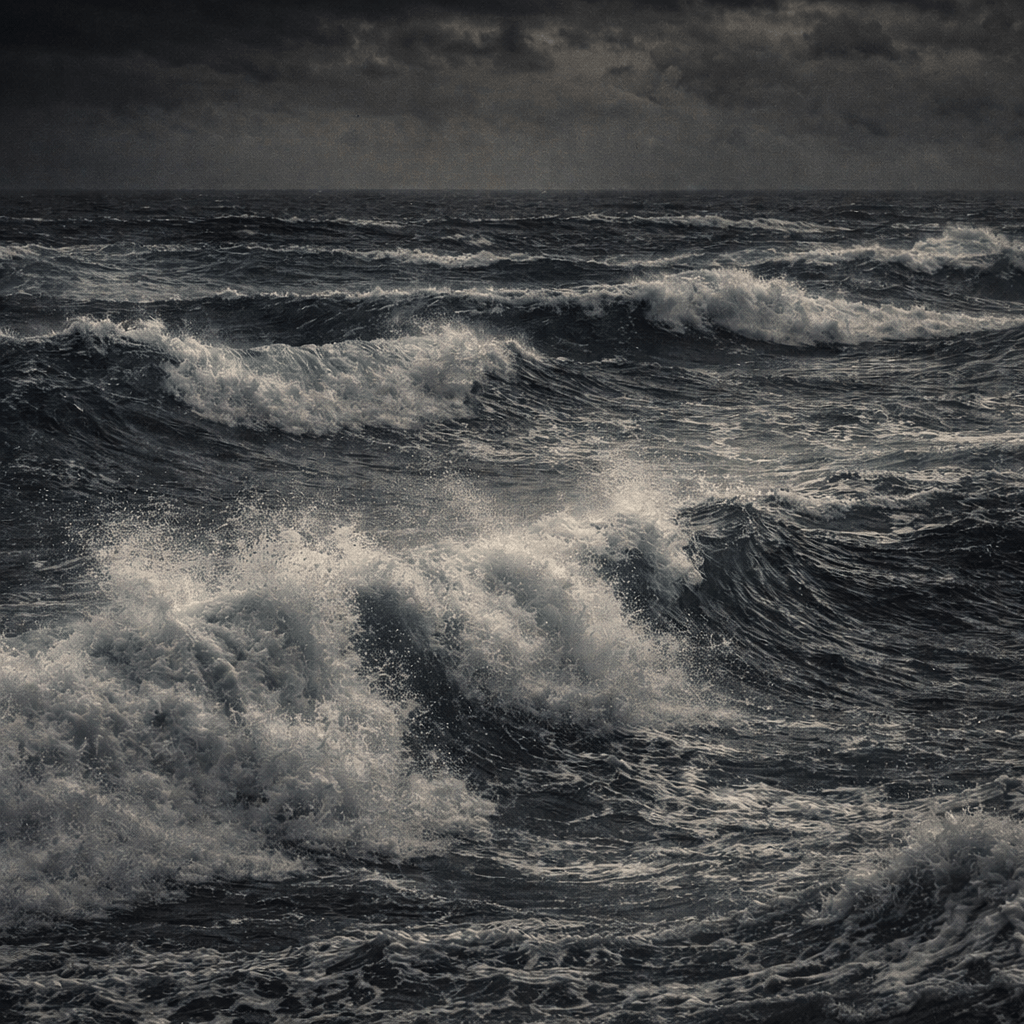
I just spend much of my life in constant stormy weather, hanging onto whatever I could to survive. And the deadly wind and current pushed the boats, ferry, or sometimes just a wooden lifesaver to where I am now.

So it’s possible to make peace with your life. I never expected to have this calm ordinary days at the end. (Of course, I spent large sum of money and time on this and that therapy.)

Father’s Daughter

If by chance I talk a little wild, forgive me; I had it from my father.

— HENRY VIII, ACT 1 SCENE 4

My childhood home was not a happy place. I didn’t know how being loved felt like. My younger brother told me once he made his presence as sparse as possible to avoid unpleasant encounters, well, mostly with our father. He also told me he had never felt loved by our father. When he was a pre-teen boy, he was always attached to our mother, like a baby monkey, while I don’t remember my mother’s touch. I had never felt loved by her, either.

My parents fed, clothed, and provided a bed and more than enough schooling. So I wasn’t neglected and was physically well cared for.

After multiple of failed relationships, I realized I didn’t know how love feels like. I didn’t have felt sense or reference point of being loved. I still don’t grasp the idea of being loved for just being me. I have to be needed and useful for the other person to be loved. That’s my false belief. Becoming aware of it was a great step.

My father passed away about 10 years ago after suffering Alzheimer’s disease. He was diagnosed with type 2 diabetes in early 30s and he was insulin dependent for most of my life. His father and his older sister died young from complication of diabetes. There are many diabetics in his family.

After more than half a century of dodging genetic bullets, I was diagnosed with type 2 diabetes and since I can’t take medications due to a severe and weird side effect from raised insulin level, I have been controlling it by diet and exercise only. Currently I wear CGM (continuous glucose monitor) and I finally understand what my father was going through.

I remember he said that he never enjoyed eating. He considered it as a bitter medicine. Even though he was on insulin, he was on tight calorie deficient diet. Our family never enjoyed dining out because of his diet restrictions. I always thought I didn’t want to be like him. So I enjoyed eating a lot. Now I am on a very strict diet. I can’t eat anything which I used to love–ice cream, cheesecakes, chocolates, sweet fruits, pasta, rice, pancakes… I don’t enjoy eating out with friends, because I can’t eat most of what they eat. I’ve learned that my blood glucose level dictates my moods. My father’s diet was not as scientific as mine. It was just a guess work and he was so disciplined. He needed to if he wanted to live. Now I am also disciplined regarding what I eat because I want to function.

It also dawned on me that my father must have experienced no felt sense of love. He used to say his mother, my grandmother, had loved his older brother, but never loved him. He didn’t know how love feels like. I had never felt sense of love from my grandmother, either. She cared for me when I was a little girl, but I didn’t get the sense of love. It didn’t start with me. And if you have not felt loved by your parents, it’s almost impossible to love yourself. I used to hate myself.

Fortunately my dogs taught me how loving and being loved feels like in my body. I remember my father used to take home a puppy and took care of it. The dog might have been the only thing he could feel love.

I don’t have children and it’s a good thing. Neither my brother. At least it stops with us.

If your family is loving, make sure to teach your daughters and sons to stay away from those who don’t know love. They could often be very attractive in a way only damaged people could be.

Throat Chakra Story: Voice

Voice

“If a tree falls in a forest and no one is around to hear it, does it make a sound?”

When the little voice learned that nobody would come running to give her hands when she fell, she stopped asking help. She stopped even crying. When she cried, they came running not to help. So she locked herself in a dark small cave and waited silently until they forgot about the little voice and left. In the cave her hurt turned into anger and the anger pulsed and grew into fury. The angry voice was big and strong. The little voice couldn’t speak up for herself, but the angry voice could scream and yell to protect others. When the angry voice spit a fire, it was always for the little voice in other unheard people.

In my original family I had never learned to make a conversation because nobody heard anybody and they just talked at each other. “Conversation” was like throwing rocks at each other. Uttering one word could start a full-blown war. I’ve learned to make a Molotov cocktail. The louder and the more violent your voice are, better chance of survival.

My brother took up a different strategy, learning from how I fought. He was a talkative child, but he stopped talking to his parents at all. When I was in 30s I confronted my father and told him what he did and what he said damaged me. It was not a conversation. I threw one Molotov cocktail after another at him. The next day, he didn’t come out of bed. My mom forced me to apologize for yelling at him.

“Did I say those things to her?” My mother said to me that he asked her. He didn’t remember. He didn’t remember his words, which denied me of having a normal teenage girl’s life. In his mind, he was a loving father. I learned unless I engaged the person in a conversation, throwing a Molotov cocktail at them wouldn’t work.

About 15 years ago I was on a subway train at night. A young black guy came into the car with a cart-full of stuff. A burly white guy started to harass him, calling him welfare thief and such. The young guy remained quiet and sat still. The white guy kept on harassing him. I felt a red hot anger bubbling up inside of me and burning my throat. I knew yelling at the burly guy would not help the situation. I could feel the young guys anger in my guts. I thought of standing up and sitting between them, but if I provoked the burly guy, it could have the young guy involved. That was not good. My station was coming next. I stood up and walked to the young guy and stood in front of him. “Sir, may I shake your hand?’ I said to him. He looked up at me with a puzzled expression and then he extended his hand. I shook his hand and he smiled. My station came and I got off. That was the most powerful voice I ever have had.

Heart Chakra Story

What does love mean?  What does love feel like?

When I was a little girl, I loved my aunt, who was the only source of goodies in my life.  She took me out for shopping and bought me cute outfits. She took me everywhere to show off her adorable little princess and told everybody how cute I was.  I loved when she took me to a milk bar on weekends and we had pancakes and milkshakes like a mother and a daughter.  They were fluffy and sweet with syrup. 

I followed her everywhere like a duckling.  I waited for her to come home and cried for her when she was late.  When I ran to hug her, I smelled alcohol in her breath.  She showered me with beautiful things.  She gave me money to buy beautiful things.  She even wanted to adopt me one time even though my parents had no reason to give me up.

She spoon-fed me sweets and snacks, regardless I wanted or not.  She dangled pieces of snacks in front of my face.  I automatically opened my mouth and ate whatever she fed me like a baby bird.  She was amused and she still tells me how cute I was.  She still tries to spoon-feed me.  She is 94 and I am 60.

She licked my face because she loved me so much.  It was yucky and I didn’t like it.  When I said no, she proposed to trade licking with goodie.  If I let her lick my face, she would give me a candy. 

Quid pro quo.

That was love I knew.  Love meant stomaching boundary violation from people who gave me something because they “loved” me.  And I had to accept it regardless I want or not because if I didn’t I could lose love.

As you might guess, I had eating problems.  When I felt unlovable, I filled the empty “stomach” with food, binge eating junks.  I always felt an insatiable hunger no food could fill and once physical stomach was full, I felt more unlovable and nauseous, and I forced my self to throw up.  (She could have fed me veges at least.  I wonder why nobody binges on veges…)  I still have difficulty to tell if I’m hungry physically or emotionally and feel anxious on the perceived prospect of going hungry.  The Covid-19 grocery situation was nerve wrecking. 

I always loved plants.  I asked my aunt to buy me a rose bush.  It was a red rose.  I loved her (the rose).  I was a disturbed and rebellious teenager and didn’t talk to my parents, but I went to talk to her every morning.  She was the only one who heard me.   My aunt was building her house in the property next to our house and one morning I found my rose plant was crashed under construction materials.  I hated her for that and cried and screamed that I would burn her house down.  It was the moment I learned that what I loved and cared for could be destroyed or taken away at a whim.  I learned that nobody cared how I felt.  Witnessing me in a murderous rage, my aunt replanted the rose bush somewhere safer.  I didn’t care about the rose after that.  My heart was crashed.  My heart stopped talking to the rose.  The rose bush was me.

My aunt sill “loves” me in her way.  She doesn’t see me or hear me.  She still sees a little princess.  Every time I visit Japan I spend some time with her as a physical form on which she could project her little girl.  It has been my role and I still play it because she is 94 and it is just several days a year.

After my father passed, I’ve learned that my aunt had an affair with a married man (in 1950s in Japan!) and had a daughter, and that the man and his infertile wife adopted the baby girl.  I realized that I had been a stand-in for her daughter.  Entire town knew about the scandal and still she showed me around as if I were her own daughter, in a matching outfit with her.  I remember people asked her if I was her daughter.  I am sure they knew I was not and still they asked, alluding to her illegitimate daughter.

I don’t feel love toward her.  I feel I owe her quasi-daughterly care.  Nobody loves her.  She is highly narcissistic and very caustic woman and I am the only one she “loves.”

BTW I just noticed I still react the same way when I am threatened to lose something I love.  I have this urge to destroy or walk away from the very thing I cared about so much, shutting down.  I don’t do that anymore, but I am aware that it’s still in me.

Yesterday I found somebody cut and stole a sunflower from the park garden I took care of.  It happens often.  Some people are assholes.  I felt the old rage bubbling up from my stomach and wanted to pull all the sunflowers from the garden, so that nobody would take my love away from me. 

Writing Your Own Birth Story

Most of us do not have much memory of the first several years of our life. What I remember is the stories my parents, my aunt, and my grandmother told me. It is not my memory. I doesn’t make sense that I have kept somebody else’s story as mine for my entire life. The story of my first years set a narrative of my life and colored every story I told myself.

“You were a scrawny little baby. You looked like a little monkey. You didn’t want to suck formula from the bottle. We had to squeeze formula into your mouth and when it was full you were forced to swallow. Your grandmother thought you wouldn’t survive.” It was the story I was told again and again by my aunt.

In that narrative I was a runt, who didn’t have a strong will to live and the story of my life was colored by it. I didn’t have strong attachment to life, or so I thought.

And it was not my story.

I took a workshop, “Write Your Way to Deeper Consciousness: A Guided Journey Through the Chakra” by my dear friend, Rev. Freddie Kluth. In the First Chakra class, I was told to write my birth story. So I called my mum. This is her story of my birth.

According to my mother, I was born around 10:00 ~11:00 pm on the day before the winter solstice. She started getting mild contractions. She left home to go to the dormitory for nurses by herself. The dormitory was close to the hospital she worked, and I guess she lived there before she married. She arrived there around 6:00 pm and rested in the dormitory until she was in labor. Nobody from the family was there. Only the matron of the dormitory accompanied her and stayed with her during the labor. It was a normal, rather easy birth, almost on the due date.

“Was there anything unordinary?” I asked. “No. You were normal. Your brother was small,” she said.

That’s all. Do you think it’s normal? I was the first baby she and her husband had. And there were two other women in the family with childbirth experiences. Why did she go to the hospital by herself? I understand that the hospital was like home for her. She spent most of her life working there. All the friends she has worked there as nurses. And it was in 1950s. We were poor and they didn’t have a telephone. There was no way to call a taxi. But my father had a bicycle. He could have biked.

My family is weird…

Freddie asked me to re-write the story to celebrate the birth of myself. This is my birth story I rewrote:

A young woman walked toward the woods. When the day started to wane, she heard the call of woods in her belly. In a hut she shared with a man and his kin, she dropped a bamboo sieve she was using to sort beans from husks. Some beans were spilt on the dirt floor, whispering cold dry words of …shame…shame… W omen folks working in silence looked up and gave a wry face. The fireplace held no fire to save firewood.

“I gotta go,” the woman said to herself and she rooted herself up from the silent cold hearth. The women folks went back to their chore. The woman put her straw boots on and picked up her straw coat.

The day was waning. “I gotta go,” she said and walked out of the hut her man’s kin lived. The night was reaching out for her. There was no daylight left to cast a shadow. The woman walked slowly but steadily toward the woods. “I know where to go,” the woman thought. The woods in her belly were calling.

When she saw a light in the woods, it was already dark. She knew who lived there and knocked at the door. An older woman greeted her. Warm air embraced her. The young woman rooted herself down and rested on a cot by the warmth of fire. The moon slid across the winter sky. It was the longest night of the year, when all the night’s spirits would come out and celebrate. Dead leaves danced with the wind, following the steps of the night spirits, whispering…she is coming, she is coming.

In the cabin on the cot by the hearth the woman moved. The call of woods were getting louder and stronger. The older woman came to her and said, “It’s time to go into the woods.” The young woman rooted herself deeper into the earth under the cot. Her roots ran beyond the boundary of the cabin and spread deeper and wider into the wood. Underground mycelium started to send signals all over the woods, to every tree, to every creature, and to every night spirits. The longest night was alive with full of spirits cerebrating the awakening. Before the midnight, the night spirits heard a baby cry. “I am … I am… I am…”

The next morning, a man came to the medicine woman’s cabin looking for his woman. There was no sign of the young woman. Instead he found a tree where the cabin used to stand. At the foot of the tree, a baby girl was sleeping wrapped in a straw coat. After the longest night of the year, the sun shined on the ground white with frost, warming everything it touched. He picked the baby up and walked out of the woods. The spirits of the woods whispered, “she’s ours… she’s ours… she’s ours.”

The man didn’t know the baby was marked by the spirits of the night woods. The baby is connected with the woods through luminous mycelium. She will be able to hear stories untold and to see spirits unseen. She will carry the luminous mycelium far away, spreading the whisper of the woods, spreading the life of the night sprits on everything she will touch.

She will be back.

We don’t have to accept the story we were told. We can rewrite and change the narrative. After all it’s your story. Not theirs.