Metta Meditation

Juno Üjiié's avatarThe Work of Healing

Image

For all those we have harmed, knowingly or unknowingly,

we are truely sorry.  Forgive us and set us free.

For all those who have harmed us,

knowingly or unknowingly, we forgive them

ane we set them free.

And for the harm we have done to ourselves,

knowingly or unknowingly,

we are truly sorry.  We forgive ourselves

and we set ouselves free.

Peace in my heart brings peace to my family.

Peace in my family brings peace to my community.

Peace in my community brings peace to my nation.

Peace in my nation brings peace to my world.

Let there be peace on earth,

And let it begin with me.


Quote from Meditation & Silence, Sacred Center of New York. Feb 6th, 2011 Sunday Celebration Service Program.

View original post

Letting Go

1-IMG_0012

Zen people say “Let go”.  Let go of what?  So I googled the phrase “let go of” and these are the suggestions I got.

  • Let go of anger.
  • Let go of control.
  • Let go of the past.
  • Let go of your ego.

I guess in a nutshell Zen people mean letting go of attachment to anything…everything.  My ideal zen life was to be able to move at a moment notice with one suitcase.  In reality, I probably need 5 guys with a truck and a warning months in advance.

When I had a dog, my worst nightmare was suddenly dying and leaving him behind without anybody taking care of him.   My dog passed at the ripe age of 14.  When he left, I let his body go.  The body was not him.  I felt pretty zen.  I used to have two cats.  When they died at 13 and 17 respectively, I had them individually cremated and held onto the ashes for years.  I didn’t know what to do with the ashes.  So they stayed on a shelf for a long time. I’ve learned a lesson.  Ashes were not my cats.

So what will I do with my body?

In my culture, cremation is the norm.  So it’s no brainer.  Unless I specify something else in my will, my body will be cremated.  I couldn’t care less.  I will be dead by then, won’t I?

I did think of donating my body for the advancement of science every time I learned about a cool research program, such as the forensic anthropology program at UT (University of Tennessee, I guess) aka the Body Farm.   I read a book by Mary Roach, Stiff, and learned that donated cadavers could be utilized for unimaginable variety of scientific and educational purposes.   I didn’t feel comfortable with many of them.

My gross anatomy teacher said that he often received inquiries from his dissection workshop participants for donating their body for his program.   He explained that logistically it was nearly impossible.  He advises them to donate through the local university’s program instead.

“But you can’t spefify how it is used, can you?”  a student asked.

“No, you can’t.  What do you care.  You are dead.  Let it go,” my teacher said.

It was the “Aha” moment.  Let go of control, let go of your ego, let go of the past, and let go of your body…


I admit I am not zen enough to let go of the idea of the ownership of my body after death.   Are you?

Another issue to contemplate.


Respect What Hits You in the Gut

Once in a while something hits you in the gut.  It could be anything.

I was in an Anatomy class.  Dissecting cadavers forces students to face the reality of life and death.  It might trigger something you didn’t know it was there.

Each person has their own trigger quietly waiting for them.   It could be the scar tissue left by triple bypass surgery brutally adhered to the ribcage.   It could be the massive adipose tissue in which the person’s life story was stored.   It could be just realizing being alive juxtaposed with the death.

I was aware that something could hit me.  After all, we were looking inside human bodies, our bodies.  Almost 3 weeks had passed and a couple of days were left till the end of the workshop.  So far I managed not to step on my trigger which I had no idea about.  Surprisingly nothing about cadavers really bothered me.  I felt I was in peace.

When I came back to the gross anatomy lab from the lunch break, there was something going on.   On a stainless steel dissection table, something unfamiliar to me were placed.  They were so red.  The sight slightly shocked me.  I couldn’t guess what they were.

They were placenta donated by happy new mothers.   Three of them lined up with umbilical cords attached.  They were massive and looked alive.

I was speechless.  Students started to gather for the presentation by the midwife.   One of the cord was in true knot.  “The baby did it,” the midwife said.  “The baby swam around in the placenta.  The baby was born fine.”  A male student realized his wife had an unusually large-sized afterbirth and wanted to know the reason behind it.  “A large placenta usually is compensating for the baby,” the midwife said.

And it hit me in the gut.

I couldn’t stay there anymore.  I quietly moved out of the crowd.  The male student asked me if I was O.K.  I realized I was crying.  I retreated to my cadaver.

And I have no idea what hit me.  I don’t have any trauma related to placenta or childbirth.

Later the midwife came to acknowledge my reaction.

“I have no idea,” I said with tears flowing from my eyes.  “See? Just talking about it does this to me.”

“It could be yours,” she said.

“Mine?  I’ve never been pregnant.”

“No, I mean the one you were in.”

“I don’t know.”

“You don’t have to know.  It’s important just to acknowledge that it’s there.”

“Damn.  I found another (issue to work on) when I thought I was well-done.”

“It sucks, doesn’t it.”

“Yes, it never ends.”

I still don’t know what hit me.  Every time I talk about my encounter with placenta, I still feel the tears running down my cheeks and I don’t have any emotional association with it.

So at this time of my life, I just respect what hit me in the gut, acknowledge it is there, and hold my psyche gently.  There will be the day we see each other again.

Skeleton Meditation

I don’t sit and meditate.  I have a monkey mind some might call ADD.  My friends with monkey minds don’t sit and meditate.  Some bike, others run.  One non-moving meditation I actually liked and practiced for a while is Skeleton Meditation.  I don’t remember where it came from.  Probably Tibet or somewhere in Asia.  I’ve read or heard about it and just liked it.

In Skeleton Meditation, I lay down as a corpse (Shavasana if you are yoga person) and observe my body decompose layer by layer, muscle by muscle, till my form becomes a skeleton.  It was peaceful experience.  I liked my clean dry white skeleton on the ground.  Then I imagine a bamboo shoot coming through my eye socket, reaching up and up to the sky.  And I fell asleep peacefully.

There was one major problem for me with this meditation.  At that time I didn’t have much awareness of my own body.  My perception about my body was something like a gingerbread man.  So the entire process to become a skeleton took only a few minutes.  Poof, my leg muscles were gone.

If you are fully plugged into your body, this meditation could take at least hours, maybe years.  This is an ultimate “let it go” meditation.  Then you may let the skeleton go, too. Or you may reconstruct a new body from the skeleton, adding layer by layer.

After decades of training of one kind or another, the latest of which is a full body dissection workshop, I’m much more plugged in.  Tonight, I might be able to meditate for maybe 10 minutes…

Have a happy meditation.

Teacher

We don’t have to go and look for teachers.  Open your heart and you will find yours walking with you.


Snow

An old dog and his old human, supporting each other.

Our footsteps have merged on the snow-covered path,

In the winter of our life.

He still teaches me how to walk the life,

As he has been doing so since he greeted me in his full youth

With his shiny black muzzle, now gray.

He loves snow, and this could be his last.


It’s important to have teachers when you are searching for your path, just as it’s handy to have a trail map when you are trekking an unfamiliar territory.   Some people look for THE teacher.  I don’t have THE teacher.  Many teachers guided me to be here and now.   Anybody who teaches me what I didn’t even know I needed to learn is my teacher and I appreciate and respect them.  My teachers include my martial art instructor, my therapists, my acting teacher, my dog, my trainer, my yoga teacher, and go on and on and on.  Yes, you could be my teacher one day and I’m looking forward to learning from you. A teacher does not necessarily give me an answer. My teacher said, “I learn in order to ask better questions.”

I learn in order to ask better questions. ~Gil Hedley


Layer of Touch

I wish I had a lover who would allow me to touch.

A quiet night in early summer I would lay you down on the slightly wet grass

My hands will follow the lead of your skin

To the superficial fascia that stores the sorrow and joy of your being and that

Forms your form you present to everybody else but to me.

Lead my hands, My Love, toward your deep fascia that holds

The strength and vulnerability of your physical being.

My hands travel over the ever-changing topology of your muscles

In awe of a wayfarer who has found the land of grace nobody ever touched.

My hands are a witness of the grace unfolding

Layer by layer you allow me to touch,

And then I hold your heart in my hands

And dance the heart dance to the beat of our heart.

Then I will let you go, My Love,

Your peaceful skelton to the waves of the ocean that caress the sands

Where our castles once were.


I had the most profound learning experience in Integral Anatomy Workshop.  This poem is dedicated to “Tony” and  Dr. Gil Hedley and Somanauts.

Mindfulness of Changing Blades

When you find yourself in a new group setting, it’s a great opportunity to learn about yourself.

In the first week, I assumed my usual role in a group.   I was that person who perform mundane tasks in silence.  During the first week, I changed hundreds of scalpel blades for the entire class at the instrument station.

Each table were supposed to be responsible for taking care of the instruments, but there are always some who do it for everybody, and there are always some who just like to pick up a scalpel with a new blade.  The first time I came up to the instrument station holding a scalpel with a dulled blade, I saw scalpels with new blades already there.  I thought “Sweet!” and grabbed some back to my work station. The second time around I tried to change the blades by myself and I couldn’t do it.   Somebody nearby showed me how to do it and still I had a great difficulty and struggled every time.

As a kinesthetic learner, the best way to learn is to do it.  I decided to be the blade person in the group.

Drawing by Tam Tran Valenti

Drawing by Tam Tran Valenti

It is my way of introspection, grounding, taking a refuge from the group dynamics, or just to standing up and walking away from the work station.  I create a safe place for me by assuming an unremarkable role.  It is a way of hiding and anchoring at the same time.

Every time I felt tired, frustrated, or just lost concentration, I left my table and went to the instrument station and placed new blades on scalpels.  My hand learned the subtle angle to slide a blade into the notch and the pressure needed to pull the blade out.  At the end of the week, I was a quick and deadly blade changer.

Then the familiar pattern emerged.

I took dozens of “dirty” scalpels left to the sink to rinse them and found one scalpel with a blade still attached.  The used blade was supposed to be removed and disposed into a medical waste container by the user.  One person failed to do so and tossed the scalpel with a dulled blade into a pile of scalpels.

I could have cut my hands rinsing it.

I felt the familiar rage rising up from my gut.   I felt disrespected and taken for granted.   My historical anger dating back to the old days started to bubble up along with this particular anger.  I’ve been there.

I caught it in time.

Nobody asked me to change the blades.  It was not my job.  I was doing because it served my purpose.  Did I do it because I wanted to be appreciated and loved, desperately trying to fit in the group by being useful?  Then it’s an old pattern.  It won’t work.

I reassessed the situation.  I’ve learned how to change blades expertly.  I’m already an integral part of the group and feeling safe.  I don’t need to hide.   It doesn’t serve me anymore.

By 10th day I stopped being a blade changer of the entire group and only took care of my work station.  When I came up to the instrument station to change MY blades, I saw one person struggling with the blade.  I showed her how to change blades and left for my work station.

Now somebody else is changing blades for the entire group.

Every day is a good day to learn something.

Integral Anatomy Workshop: Day 5

Today, we observed the variety of superficial fascia presentation in multiple forms.  Superficial fascia layer is mostly composed of adipose tissue.  i.e. your friendly loose connective tissue with fat.  It lies between the skin layer and the deep fascia layer.  It’s a matrix filled with adipose tissue.

What I learned today:

  • Slight or moderate kookiness is very good for the universe.
  • Being yourself and keep on pursuing whatever crazy idea that would keep you interested in is the source of the Great kookiness in a very positive way.
  • When I massage, I am not accessing muscles.  I am talking to the superficial fascia which is inseparable from the skin layer, just like the skin of an apple.  The skin is continuum of the flesh.

Gil Hedley’s Superficial Fascia Meditation

Integral Anatomy Workshop: Day 4

We freed Tony from the restriction of the skin.

What I learned today:

We can be respectful of and happy with the cadaver.

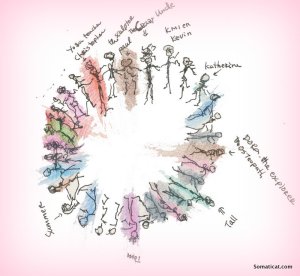
The Color Wheel of Somanauts.  Morning Healing Ritual.

workshop3

Dealing with cadavers requires us to embrace our own mortality. When uncomfortable, we tend to “check out” of the reality of our body and take a refuge in our mind.  It is important to stay grounded and connected to the physical reality of each other.   Unexpected emotions could bubble up to the surface.  We need a safe container for them during the workshop.  It is safe to let it speak and it is also safe not to share.  It’s O.K.   You process in your own way.  We just hold a safe space for ourselves, absolutely with no judgement.

Gil, the instructor,held a space for every one of us.

Gil Hedley’s Skin Meditation Audio

Here is a mp3 of Gil’s Skin Meditation.

Integral Anatomy Workshop: Day 3

We are still working to liberate Tony from the restriction of skin.

Since skin is the largest organ that covers entire what-is-us, we make the best effort to keep it intact.  It requires  a meticulous work.

What I learned today.

  1. How hemostat numb thumb feels like.
  2. Human forms vary significantly.  No standard form, no average form.  Nobody looks like the anatomy models in the text books.

barkpeeling