The Wayfarer: The Empty Chair

On life, death, and the illusion in between.

The Wayfarer walked into a grassland with no beginning and no end. Brown leaves rustled as he walked through the knee-high grasses. It was like autumn before winter, stood still for eternity. The sky was gray, with no sun in sight. He couldn’t tell the time of day.

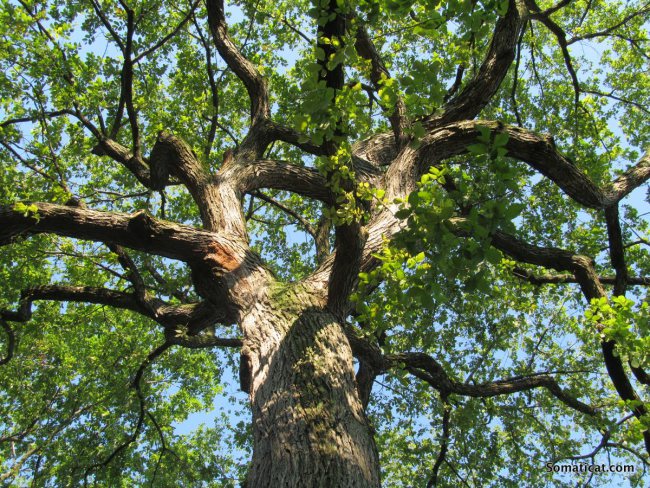
Like scattered drops of rain striking the surface of dried mud, he saw green spots far apart in the distance. They were trees, still alive. The brown grassland was sparsely marked with droplets of green.

The Wayfarer walked toward one of the trees, and he saw a man sitting under it. He looked as old as the grassland. His skin was dry, like the leaves of the grasses, almost peeling away from him.

“Hello,” the Wayfarer said.

The man did not move. His gaze was set toward the far end of the grassland, which seemed never to end. The tree was quiet. No birds nested in it. It simply stood there, without even casting a shadow on the earth.

Leaving the old man behind, he kept walking toward another tree far ahead. No insects leaped from the grasses. Only the sound of rustling leaves could be heard as he walked through them.

Under the second tree, the Wayfarer found a younger man sitting as well.

“Hello,” he said.

The man did not even look at him. He looked like a soldier after a defeated battle. Caked mud covered his legs, and his face was stained with soot. His gaze, too, was set toward the far end of the grassland.

The trees were far apart. Whenever he saw a faint green dot in the sea of grasses, like an island in a desert, he walked toward it, unhurried and steady. One after another, he saw a person, young or old, sitting under a tree, all gazing far away from here, into the beyond, in silence and stillness. He did not know how many trees he visited. He did not know how long he had been walking.

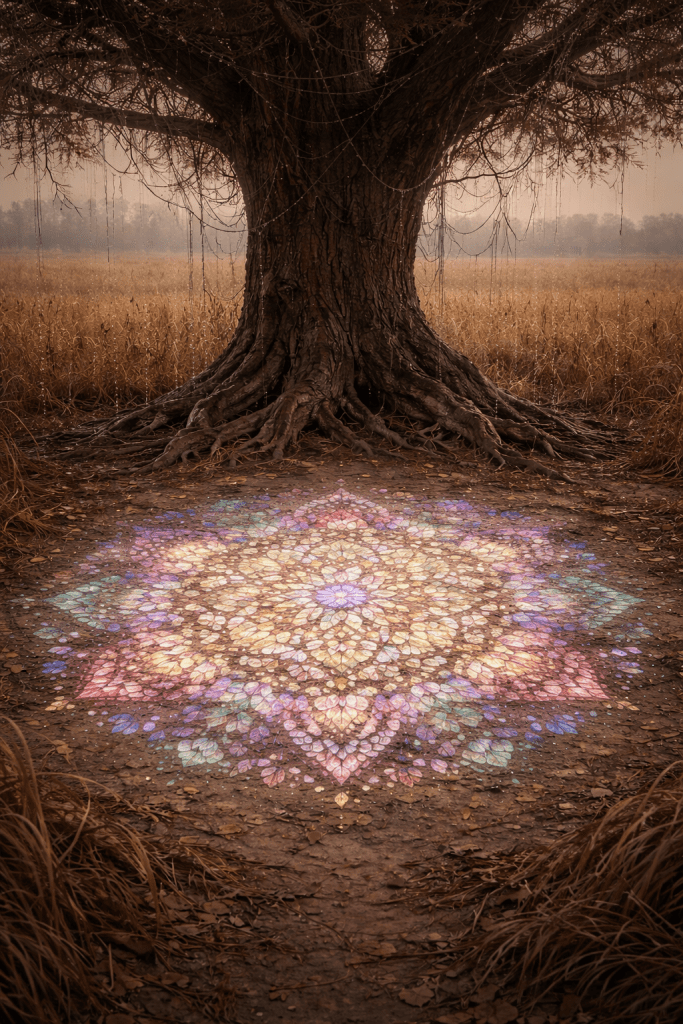
The Wayfarer came upon another tree and stopped in his tracks. After so many occupied chairs, all frozen in time, an absence felt like thunder in the silent sky. The chair was empty. Had the person who sat there just left? he wondered. Was it the beginning or the end? Then he noticed a beautiful mandala on the ground beneath the tree, glimmering and shimmering with many colors.

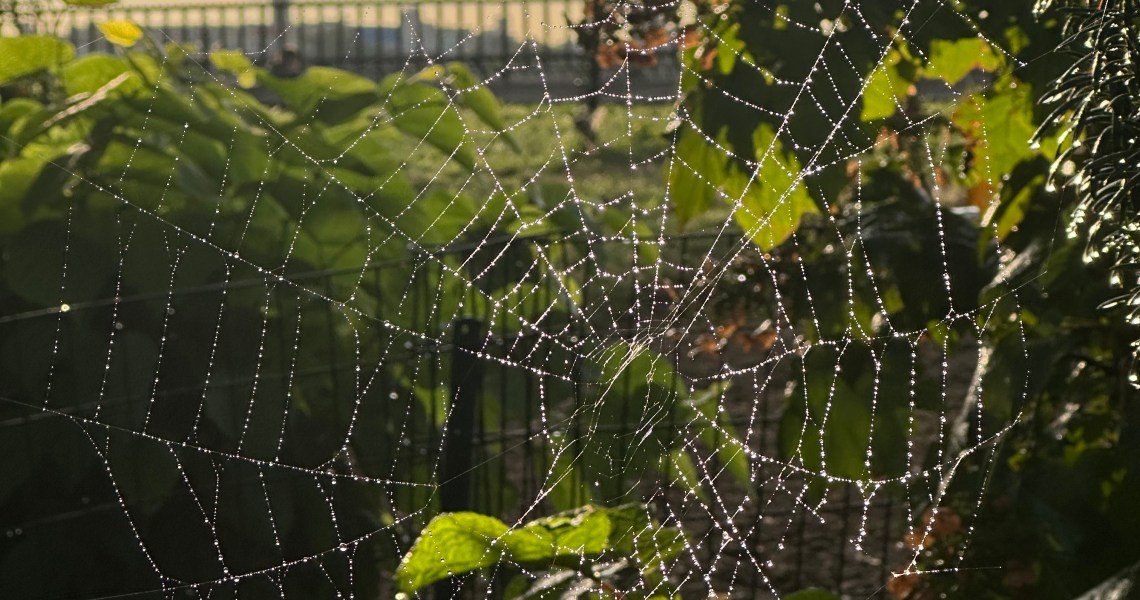
He suddenly felt tired and sat in the chair, his gaze set on the faraway horizon. Then he noticed a spider lowering itself from a branch on a strand of silk. As the Wayfarer watched, it spun its web between the branches. The intricate web overlapped his view of the never-ending grassland, and he did not know whether he was staring at the end or the beginning.

A butterfly came dancing on iridescent wings. It was like a light in the bleak landscape. Then it was caught in the spider’s web. The last fluttering of its wings sent waves through the silk. Another butterfly came and was trapped, and another. The spider wrapped them in silk, and their wings were torn free and fell to the ground like cherry blossom petals, glimmering and shimmering.

The Wayfarer realized that the mandala was made of thousands of butterfly wings, lives caught in the web and fallen there. It had been repeated from the beginning of time into its never-ending present.

He looked back to where he had come from and found that his tracks, too, had formed a spider’s web.

©2026 JU

Dead and Naked

At Fort Lauderdale Airport, there was a long line for baggage check-in and security screening. As a hub for cruise travelers, the airport gets especially busy at certain times of the day. I stood in line for over an hour.

Airport staff maneuvered wheelchair-bound passengers through the crowd, one after another, weaving between the lines. Most of the people waiting were elderly—older than me, likely returning home from their first or perhaps their last cruise.

A month ago, I lost my 13-year-old dog. Since then, every time I see someone walking a dog, I’m struck by a strange feeling—a bittersweet sadness, like a drop of water hitting the surface of a lake, sending ripples outward until they fade into the distance. The pain of loss is universal, something we all share. Every person here will, at some point, feel what I feel now—the grief of losing a beloved companion.

I looked around and imagined cadavers on dissection tables, standing in line now—dead and naked. Sooner or later, we all end up there, in one way or another. We share the same destination. I am among them.

Is that a relief? Perhaps. At the very least, the vision freed me, if only for a moment, from the vulnerability of being.

Dermis: The True Skin

The skin is often referred to as the largest organ in the human body. At the dissection table, we explore this remarkable organ in greater depth. The skin, along the dermis and its thin integument, tells the story of the person who once inhabited the form before us. How we interpret these stories is ultimately up to us.

Scars from surgeries, deep skin folds, stretch marks, tattoos and other markings frequently appear, each reflecting the years etched in the skin. Most cadavers are donated by elderly individuals who passed away in hospitals, and their stories are as distinctive and intricate as their wrinkles. Sometimes, internal conditions like jaundice manifest outwardly on the skin, altering its color and texture. 

Beyond the common surgical scars—hip and knee replacements, open-heart surgeries, rotator cuff reconstructions, and caesarean sections—we occasionally find evidence of accidents. While we can never know the exact stories behind these marks, we can imagine them. For instance, a scar on a man’s right thigh might be from a childhood bike accident during a carefree summer afternoon with friends— or perhaps from something more dramatic, like his wife discovering an affair and running him over in her fury. The truth could be anything. There are endless possibilities. 

I have a one-inch scar on my right breast from a biopsy. It never faded and serves as a constant reminder of a specific moment of my life. I remember waking up in the recovery room to the sudden commotion of EMS personal rushing in. The sliding door to the recovery room opened, and another door to the operating area followed. An old man in the waiting room looked panic-stricken as he tried to grasp what was happening on the other side.

A medical staff member explained that they didn’t have the equipment needed for the emergency his wife was experiencing and might need to transfer her to another hospital. My then-boyfriend, who had been waiting with the man, was in shock. “That man probably had coffee with his wife this morning, like usual,” he said. “He never thought it could be the last time.”

I don’t know what happened to the wife, but the experience stayed with me. Life is fragile. It could have been me who didn’t come back that day. My one-inch scar is a reminder of the delicate boundary between existence and nonexistence.

Skin: An Archive of Life

Our skin keeps records of life events. If you spend a lot of time outdoors, the sun will leave its mark on your skin. If you’ve had children, stretch marks may tell the story. If you smile or frown often, wrinkles will document those emotions. Skin is an archive of our lives.

Boundary: Skin as the First Line of Defense

For a manual therapist, an open cut on the skin is a nightmare. Any wound, no matter how small presents a potential danger—for both therapist and client. It’s an open door for pathogens. Something inside me could find its way onto someone else’s skin or vice versa. Cutting. in essence,  is an act of vulnerability.

Before the HIV pandemic, it wasn’t uncommon to see movies where characters cut their palms and held hands to mingle their blood as a gesture of ultimate trust and commitment. Sharing pathogens in this way was seen as a bond of loyalty. But cutting someone else’s skin is also a violation—a breach of boundaries.

Cutting one’s own skin is different. It’s an act that teeters on the edge of those boundaries. For some, it might be a way to reclaim control, to affirm that the boundary exists. By intentionally breaking the barrier of my own body, I can remind myself that I am alive. For those disconnected from their physical selves, self-harm might be a desperate attempt to feel real.

Skin as a Sensory Organ

As I lie on the ground, I feel the weight of my body pressing against it.  Heat transfers from my skin to the moist earth, and I sense coolness creeping back. Sunlight warms my exposed skin, while a gentle spring breeze takes some of the heat away. Grass brushes agains my arms, tingling lightly, and small pebbles beneath my back press into me with dull discomfort.

The skin is a vast sensory organ. Its receptors send signals of pressure, temperature, touch, and pain to the brain, which interprets these sensations. As a manual therapist, I must remember touching a client’s skin is a direct form of communication with their brain. Skin and nerves are inseparable; they form a continuous connection from receptors, through peripheral nerves and the spinal cord, to the brain itself.

When assisting with a nerve dissection project, I noticed how some nerves perforate into the skin. In typical gross anatomy dissections, we often overlook these structures, but they’re there, like delicate threads stitching the layers together. Touching one of these threads is, in essence, touching an extension of the brain itself.

Skin as Canvas for Expression

Occasionally, we encounter a cadaver with tattoos. One donor, “Z,” had multiple tattoos covering his body.  Z was a local donor, and one of the dissectors knew him personally—a rare occurrence. Z had lived a colorful life, full of adventures, rebellion, and humor. Before succumbing to cancer, he was a bulky, tough man.

When we uncovered his body, we saw an emaciated figure. A chemotherapy port protruded from his chest, and his gaunt face reflected the fierceness of his spirit. Though his body lay silent, his tattoos spoke volumes. They seemed to demand our attention: “Look at me. Read my life’s stories.”

Every piece—every image, every  word— told a story. As we began the dissection, we took care to preserve his tattoos, treating them as the storybook they were. Though they would eventually cremated with his body, the tattoos deserved our respect.

Tattoo ink remains permanently in the dermis, where macrophages engulf the pigment, making it a part of the person’s identity. Some pigments migrate to lymph nodes, where they can become trapped—sometimes visibly. Even in death, these marks persist, embodying the life they represent. 

copyright 2024

Meditation on Cadavers-Prologue

Savasana

I am not writing an anatomy book, nor a dissection manual, though I use nomencIature of anatomist when it is more clear than everyday language. This book/writing is not about scientific knowledge. If you want to learn detailed anatomical information, there are tons of great books you can choose from. This is just A story of my personal experience facing cadavers in dissection labs, and a story about how that experience has affected my perception of who I am, how I relate to everything, especially to my body, in this lifetime.

I once read about a meditation technique where you lie on your back and imagine your body gradually decomposing until it becomes a skeleton. I heard that in Buddhism there is a meditation method in which one observes one’s own body both from the inside and outside while observing an actual corpse decompose. I liked this meditation method because I interpreted it as a training to realize that all material existence in this world, including one’s own body, is a mere phenomenon, just like a decaying corpse. 

When we experience unbearable trauma, our body and consciousness may become dissociated in order to protect ourselves. The body becomes a thing that performs a specific function, and becomes separated from the ”I” consciousness.

Once I had sessions with a Zen psychology therapist. He often asked me, “What do you feel in your body?” I looked up at the ceiling, looked around the room and always looked for the answer outside of my body. “Can you feel your feet on the floor?” he asked. Of course I could feel my feet physically touching the floor, but that was completely disconnected from what I was feeling mentally. 

I didn’t have much knowledge about my own body. So even when I meditated on a corpse, I couldn’t visualize it very well, and I had no conscious connection to my body, so the corpse quickly turned into abstract bones. I couldn’t understand how complex and delicate the human body was, and how it was related to my very existence.

Through the gross anatomy training, I gradually recovered the connection between my self and my body. Every time I stood at the dissection table, I felt like I was slowly regaining my humanity. It has been more than 10 years since I was initiated into human dissection, and I have spent over 1,500 hours in dissection labs. Now attending an annual dissection workshop is like a Zen practitioner regularly practicing at a temple. 

I see it as my spiritual practice. It prepares me for the reality of death and dying, and reminds me of the meaning of living this moment. 

Savasana in yoga is said to be a pose where you lie on your back and imitate a dead body. When we go to a dissection table in a dissection lab, we face a donated body that is quietly in Savasana pose. It is the last pose we all will take.

copyright 2024

Metta Meditation

Juno Üjiié's avatarThe Work of Healing

Image

For all those we have harmed, knowingly or unknowingly,

we are truely sorry.  Forgive us and set us free.

For all those who have harmed us,

knowingly or unknowingly, we forgive them

ane we set them free.

And for the harm we have done to ourselves,

knowingly or unknowingly,

we are truly sorry.  We forgive ourselves

and we set ouselves free.

Peace in my heart brings peace to my family.

Peace in my family brings peace to my community.

Peace in my community brings peace to my nation.

Peace in my nation brings peace to my world.

Let there be peace on earth,

And let it begin with me.


Quote from Meditation & Silence, Sacred Center of New York. Feb 6th, 2011 Sunday Celebration Service Program.

View original post

Skeleton Meditation

I don’t sit and meditate.  I have a monkey mind some might call ADD.  My friends with monkey minds don’t sit and meditate.  Some bike, others run.  One non-moving meditation I actually liked and practiced for a while is Skeleton Meditation.  I don’t remember where it came from.  Probably Tibet or somewhere in Asia.  I’ve read or heard about it and just liked it.

In Skeleton Meditation, I lay down as a corpse (Shavasana if you are yoga person) and observe my body decompose layer by layer, muscle by muscle, till my form becomes a skeleton.  It was peaceful experience.  I liked my clean dry white skeleton on the ground.  Then I imagine a bamboo shoot coming through my eye socket, reaching up and up to the sky.  And I fell asleep peacefully.

There was one major problem for me with this meditation.  At that time I didn’t have much awareness of my own body.  My perception about my body was something like a gingerbread man.  So the entire process to become a skeleton took only a few minutes.  Poof, my leg muscles were gone.

If you are fully plugged into your body, this meditation could take at least hours, maybe years.  This is an ultimate “let it go” meditation.  Then you may let the skeleton go, too. Or you may reconstruct a new body from the skeleton, adding layer by layer.

After decades of training of one kind or another, the latest of which is a full body dissection workshop, I’m much more plugged in.  Tonight, I might be able to meditate for maybe 10 minutes…

Have a happy meditation.