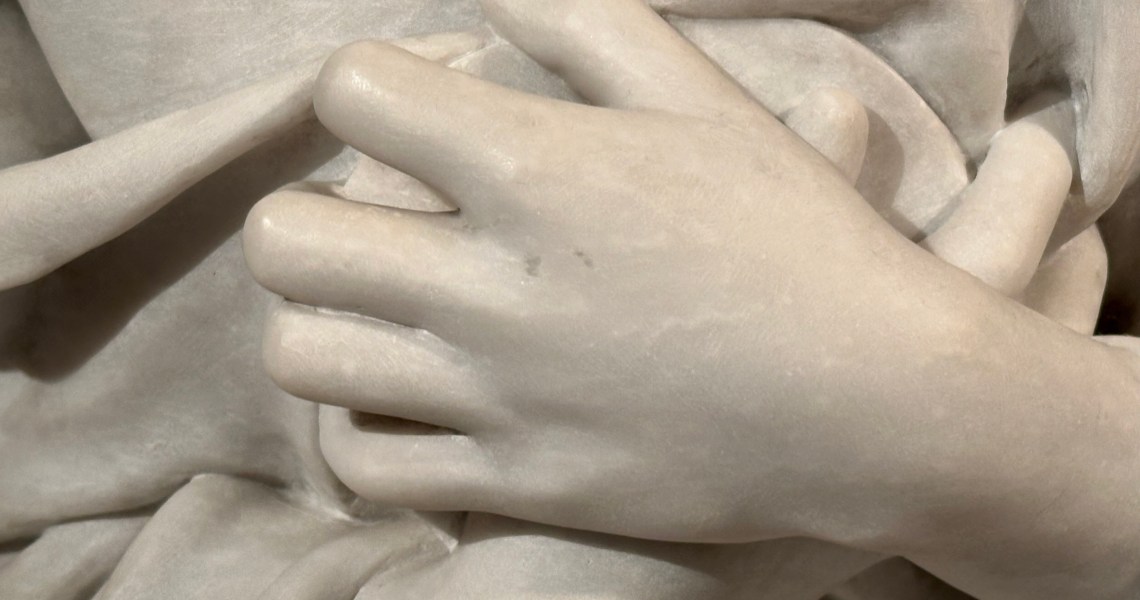
HAND Reveals

Surprisingly, hands retain a sense of personhood almost as much as the face. They are often left untouched until later stage of dissection because working on their small and intricate surfaces requires skills and anatomical knowledge. Hands are another major interface with the outside world—not much socially but physically and emotionally. They are our probes into the physical world, our means of acting on intent, and a way to express emotions.  

When we are born, we are held with hands, fed with hands. The first contact with the outside world is through hands of our caregivers. Hands have a high concentration of nerve endings, and we navigate the world by touching. Our first instinct when we encountering something new is to reach out and touch it. If it is unpleasant, we learn to withdraw our hands. The more we touch, the more intricate our understanding of our environment becomes. 

What would happen when a naturally curious child exploring their word hear their parents say “Don’t touch it” again and again. It may be the child is about to touch hot surface and the adult intends to keep them from harm and injury. It may be the child is about to touch an expensive fragile object and the parent is afraid that they would break it. Every time a child hear “Don’t touch it” their world gets smaller and more dangerous. Their energetic reach out to the world is cut short. 

Imagine being a child at the dinner table with all the adult guests. You’re hungry, you reach for the breadbasket, and suddenly—“Don’t touch it!” your mother snaps, slapping your hand, or worse. What do you think that child would feel in their body the next time they reached out for something?

I was that child.

Now imagine if that child happens to be a kinesthetic, tactile learner. I learned to pull back, to contract, to shrink away from the outside world. After decades of living in that confined state, I realized I had to retrain my inner child. So, I took her to the zoo and the aquarium. I let her push every interactive button, touch everything that was allowed to be touched. For once, I gave her permission.

We interact with others and express our emotions using our hands. Hugging and holding of hands are physical expressions of affection. We lend a hand when somebody needs help. When we are safe, we are in good hands. We work together, hand in hand. We stay involved by keeping a hand in, even getting our hands dirty. But when we can’t act, our hands are tied, and the matter is out of our hands. Hands, in many ways, represent our life in action. 

We touch others with our hands, but have you ever thought about what information your hands are conveying? I used to be a teaching assistant for a body awareness class at an acting school. When the students were in odd numbers I would step in as a partner for pair exercises. Once I partnered with an attractive young man, and I gave him the assigned bodywork. Then we switched roles. The moment he touched me, I felt sorry for his girlfriend—or boyfriend. It was like being poked with an inanimate object, like a piece of wood. He wasn’t really there. Did my hands feel as inanimate to him as his did to me? I couldn’t help but wonder if he had never been touched properly by his family. What kind of childhood would leave a person so absent in their hands? 

I grew up in a family  where the sense of boundaries was unclear. I don’t remember my mother’s touch, except when I was sick. I experienced inappropriate touches from family members. Even so, I can be present in my hands. Being present in your hands is crucial for manual therapists—and for actors. Your hands tell a lot about you. 

When you’ve experienced inappropriate touches in early in life, you can become very sensitive to the intent behind others’ hands. Trust your feelings and quietly walk away. The other person might be unaware of their underlining intent, or it could just be your interpretation. Either way, what you felt is real. So walk away.

I once trained with a master of martial arts. He was also an energy healer with quite a following. After a year of training, one day he offered me hands-on healing session. He laid his hands on my upper chest. I had paid for sessions with him before and never felt threatened. He didn’t do anything inappropriate; he just laid hands on my chest. But unpleasant memory resurfaced. 

I thought about it for a while. Was it just my imagination? The master, this guru, was probably doing me a favor with this treatment, and I shouldn’t doubt his good intentions, right?  (I was younger then and perhaps more attractive than the older disciples.)  But then it hit me—this might be exactly what happened in those yoga guru sexual abuse incidents. I trusted my instincts and left the group. Otherwise, I would have allowed the past repeat itself, again and again. 

With a high concentration of nerve endings, your hands are both receivers and transmitters. Use them mindfully. In the anatomy lab I held the hand of a cadaver and contemplated what he might have touched, throughout his life—from birth to death. I wondered how he touched, how he navigated the world and how he interacted with others. Was his touch loving and caring? What was the last thing he touched before his death? What did he reach for, and what did he recoil from?  This hand held his child, caressed his lover, petted his dog, wiped tears, and waved goodbye…

The only time I saw the skin of a living human slip away was in a drawing depicting the aftermath of the atomic bombing in Hiroshima. The skin of the hand slipped off like a glove, caught at nails, hanging from the fingertips. Otherwise, while not impossible, it’s very difficult to remove the skin of hands in one piece. The skin of the hands is intimately bonded.  

copyright 2025

Touch: Your Brain’s Interpretation

Even though the sensory receptors in the skin are mechanoreceptors, it is your brain that interprets the signals they send. Since the brain remembers past experiences and the emotions associated with them, touch is never merely a  touch. Even the same mechanical touch can be felt differently—it can be loving, caring, comforting, or healing; sensual or sexual; cold, abusive or invasive. Even when you think your touch is neutral, it’s up to the receiver’s brain to interpret it.

When I was in my late thirties, I went through infertility treatment. To check if my fallopian tubes were open, I underwent a very uncomfortable test. The pressure I felt inside my body was so invasive that I instinctively contracted my entire body, bracing myself. Then the technician’s assistant gently placed her hand on my arm. I melted. Her touch was neutral, and I don’t think she was consciously trying to comfort me. I felt it came from her spontaneous empathy. 

I have Meniere’s disease. One day, I had a Meniere’s attack in a gross anatomy lab and had to lie on a cold linoleum floor for some time, clutching a barf bag. I told everybody that nothing could be done to relieve my suffering and asked them to keep me safe and leave me alone until the symptoms resolved. I threw up in the bag and was hyperventilating in a fetal position. Some people can’t tolerate witnessing suffering without doing anything; it might make them feel powerless. A few of them placed their hands on me, perhaps to soothe or heal. I just had to endure the unwanted touch. They were mechanically the same kind of touch, but my brain interpreted them differently. One was comforting and the other was annoying.

As a child, I experienced improper touches, which were a violation of boundaries. This experience made me sensitive to the intent behind a touch. I don’t remember receiving loving touches from adults in my family during my childhood. My nervous system used to react to every touch as if it were a danger. Sometimes, a touch triggered tremendous rage, while other times, it made me feel nauseous. It took me a long time to learn to discern a safe touch from an unwanted one. I’ve learned to set boundaries and to choose how to respond, not just to react. 

copyright 2024

Everybody wants to have a Jedi Power

In the last Star Wars film, I saw the heroine lay her hand on a wounded creature and heal it. It was an “aha” moment. “That’s what everybody wants to do. They want to have Jedi powers,” I said to my friend.

I often spend time with those in hands-on healing professions. I am also a licensed massage therapist, driven by a strong urge to lay hands on people who are suffering. When someone was hurting, I wanted to stop it, heal them, and make them feel better. My hands would ache—craving to touch the pain, eager to give what I imagined was “healing energy.”

Then I developed a chronic, “incurable” illness. For about a year, I suffered from debilitating symptoms. Fortunately, I am currently in remission. I also stopped offering unsolicited healing work to others suffering from chronic “incurable” conditions.

If you have a cluster headache, I know I can’t help you. I’m happy to give you a foot massage if it helps you relax—but I can’t heal a cluster headache.

Yet “healers” still offer to lay their hands on others, as if unable to accept their own powerlessness. It is difficult to be present in the face of pain and suffering without being able to change it.

During the period I experienced severe symptoms of Meniere’s disease, many people laid hands on me, hoping to heal. None eased my suffering. I simply had to endure until the Meniere’s attacks subsided. People who had never treated the disease offered various treatments. Others gave me unsolicited advice, as if I didn’t know how to use Google. When people offered energy healing, I felt obligated to pretend it made a difference. I didn’t feel better. Meniere’s is hell—only the sufferer knows how bad it can be.

I believe those people had good intentions. However, when I offer a “healing” touch, I’m not sure if it is truly for the sufferer or to fulfill my own Jedi fantasy.

So I pause and consider whether I truly know how to help someone feel better—even if only by witnessing their suffering—before offering to lay hands.

I don’t have Jedi powers—and I don’t need them to be compassionate.

Silver Bullets

My friend, who is a professor of psychiatry, believes in the art of psychopharmacology.  It is not a cure.  She believes that the right combination and dosage of medications will alleviate the suffering of patients and their caretakers.  Her patients are not the standard dose SSRI consumers like myself.  Her art is to find optimal combination for the individual patient afflicted with deep sufferings.  She is not a drug dispenser like my shrink, who writes prescriptions away.  She is deeply compassionate.

A pharmaceutical company tweaked inactive ingredients of the drug her schizophrenic patient was taking.  As the active ingredient was the same, she kept him on that medication.  On the next visit, the patient begged her to make “them” stop staring from the air-conditioning unit.  “He was so scared,” she said.  “I was so sorry for him.  Who would know the inactive ingredients had an effect on his condition.  I changed his prescription to the one with that ingredient and no more staring eyes.”

There is no silver bullet that works for everybody.  If there were, there would be no suffering.  That’s why we keep on seeking for the right combination of measures for the particular condition for the particular individual at the particular time.

Meds won’t cure personality disorders, though.  My “difficult” 93 year old aunt is a patient of my friend.  She put my aunt on standard dose of SSRI.  My aunt stopped seeing creatures in the middle of night.  She doesn’t scream and wake up her aid anymore.  Now she is manageable for her caretakers.  “But Doctor S., she is still mean,” the caretaker and my mother, who accompanied her, said to my friend.  “Unfortunately, medication won’t change personality,” my friend said.  I believe my aunt, who loved me like a precious doll, has narcissistic personality disorder.  In her mind, everything is somebody else’s faults.

Because of complicated and fucked up family dynamics, I was diagnosed with a personality disorder unspecified (mainly for insurance coverage of therapy sessions.)   While I saw therapists for 20 years on and off, I explored and sought for the silver bullet.  I befriended my inner child.  My soul was retrieved, (oops I didn’t know I had lost one).  Death arrow was burnt at a fire ceremony.  I drummed and journeyed many times.  I was saged and cleansed.  I had my chakra balanced.  An entity was extracted.  I was gestalted and talked to a chair. I meditated and vipassanaed.  I saw channelers, a sound healer, psychic healers and energy healers.  While each worked in some way, there were no silver bullet.

It is the process of seeking, which led me where I am.

I’m still seeking, not for a silver bullet, but for something that would free my soul at this particular stage of my life, so that I could keep on seeking.

Beware of a healer bearing a gift of silver bullets, claiming it is the cure.  

My friend, who was diagnosed with ALS, told me that she bought “miracle healing water” from a random guy, who claimed it would cure her illness.  It was obvious that she was fooled.  I doubt that the guy even knew what ALS is.  But what can I say?  She was desperately seeking for the cure of one of the most cruel illnesses.

Since I was diagnosed with Ménière’s Disease and joined support groups, I’ve learned that everybody with this affliction is seeking for the silver bullet desperately.   However, a “cure” of one Ménière’s sufferer not necessarily works for others.  So we start to look for the right combination and dosage of whatever works for that particular individual sufferer at that particular stage of illness.

Also I realized when people found somebody had a chronic or incurable illness, they wanted to offer the silver bullet.  I happen to know many practitioners of physical and/or spiritual healing, and they offered to treat me.  It seems that people believe or want to believe they have some control over my condition, or at least they wish to mitigate my suffering.  Each of them did something and probably affected something, but nobody has “cured” my condition.   Then a woman with Hashimoto disease recommended me to use “Hydrogen Water.”   For a moment I thought of buying it.  Then I felt for my friend’s desperation.

I would say if it works for you, placebo or not, good for you.  But I don't believe in silver bullets.