Dead and Naked

At Fort Lauderdale Airport, there was a long line for baggage check-in and security screening. As a hub for cruise travelers, the airport gets especially busy at certain times of the day. I stood in line for over an hour.

Airport staff maneuvered wheelchair-bound passengers through the crowd, one after another, weaving between the lines. Most of the people waiting were elderly—older than me, likely returning home from their first or perhaps their last cruise.

A month ago, I lost my 13-year-old dog. Since then, every time I see someone walking a dog, I’m struck by a strange feeling—a bittersweet sadness, like a drop of water hitting the surface of a lake, sending ripples outward until they fade into the distance. The pain of loss is universal, something we all share. Every person here will, at some point, feel what I feel now—the grief of losing a beloved companion.

I looked around and imagined cadavers on dissection tables, standing in line now—dead and naked. Sooner or later, we all end up there, in one way or another. We share the same destination. I am among them.

Is that a relief? Perhaps. At the very least, the vision freed me, if only for a moment, from the vulnerability of being.

Quietude

When she saw me taking my dog, Angel, in a wagon to help him to be released from his suffering, she understood. When I came home without Angel, I found an arrangement of cactus with a sympathy card in front of my door. She had a little blind senior dog, and she understood.

Once in a while, we understand and act with compassion without any expectation. As a buddhist, I call it a buddha moment.

I didn’t know her well. We lived in the same building and see each other in elevator cars. We had small talks about dogs. Eventually, I got a new dog. When I saw her in a laundry room, she told me she lost her little dog. I gave her a hug. She also told me that she had got officially married with her live-in partner, and I hugged her again.

She was a little older than me, but looked robust and energetic.

I attended her funeral service a couple days ago.

It was a simple, short service in a funeral home. She seemed to be childless. Relatives and friends talked about her. Her husband talked about how they met and how was her last days. She seemed to enjoy her life at full, then suffer a lot, and finally be released from the suffering from her health condition.

I’ve been living in an apartment building for about 15 years. Younger people move as their life’s situation changes. Older people won’t move. They disappear. My building has less than 100 units and babies are born, and people die. It contains all the life stages.

Our past and our future are contained in our presence. Life is fragile, evanescent, and fleeting, but all-embracing. Live your present fully.

The service ended with kaddish. And I felt deep yearning for the quietude she was in, looking at the simple casket.

Savasana

I am not writing an anatomy book, nor a dissection manual, though I do use anatomical terms when they’re clearer than everyday language. This isn’t a book about scientific knowledge. If you’re looking for detailed anatomical information, there are plenty of great books to choose from. This is simply the story of my personal experience in dissection lab, facing cadaver, and how that experience has shaped my perception of who I am and how I relate to everything—especially my body, in this lifetime.

I once read about a meditation technique where you lie on your back and imagine your body gradually decomposing until it becomes a skeleton. I also learned that in Buddhism there is a practice called  Charnel Ground meditation, where you observes your body from the inside and outside while watching a real corpse decay. I found it intriguing, interpreting it as training to recognize that all material existence—including our own bodies—is just a mere fleeting phenomenon—no different from a decaying corpse. 

In Japan, we have kusozu, a traditional set of painting depicting nine stages of a body’s decomposition. It’s our version of memento mori. The paintings show the slow decay of a beautiful woman’s body, eaten by animals, reclaimed by nature, until it’s reduced to dry, white bones scattered on the ground. It’s a reminder that my body, too, is impermanent and transient.

When we experience unbearable trauma, our consciousness may dissociate from our body to protect us. The body becomes an object that performs a specific function, separated from the ”I” consciousness.  When I had sessions with a Zen psychology therapist, he often asked, “What do you feel in your body?”  Each time, I would look up at the ceiling, glance around the room, and search for the answer outside of myself. “Can you feel your feet on the floor?” he asked. While I could physically sense my feet touching the ground, that sensation felt completely disconnected from what I was feeling mentally.

I had little understanding of my own body. Even when I meditated on a corpse, I struggled to visualize it clearly.  With no conscious connection to my body, the corpse quickly became a mere abstraction of bones. I couldn’t grasp how complex and delicate the human body was, nor how it was related to my very existence.

Through gross anatomy training, I gradually restored the connection between myself and my body. Each time I stood at the dissection table, it felt as though I was slowly reclaiming my humanity. It has been more than ten years since I was initiated into human dissection, and I’ve spent over 1,500 hours in dissection labs. Now attending an annual dissection workshop feels like a Zen practitioner returning to the temple—a form of spiritual practice. It prepares me for the reality of death and dying, and reminds me of the importance of living fully in the present moment. 

In yoga, Savasana is the pose where you lie on your back, imitating a corpse. When we approach a dissection table in the lab, we face a donated body quietly resting in Savasana pose—the final posture we will all eventually take. 

Evanescent

“Count to 20,” the anesthetist said. One, two, three, four and I was out. After several hours, I guess, I slowly came back in the recovery room.

It was the most peaceful moment of my life. I was not there.

It is not accurate. The subject, “I,” wasn’t there for several hours. And I recognized the fact that I didn’t exist. No dream, no nightmare, no nothing.

My then boyfriend was waiting for me to wake up in the recovery room. The subject, “I,” slowly started to focus, still feeling groggy and peaceful. I wanted to stay there longer, where no subject “I” was. It was just a simple biopsy operation for breast cancer.

Then, sudden commotion was heard. The door to the recovery room slide open and EMS personnels rushed in. Another door to the operation area slide open.

An old man in the waiting room was panic-stricken and was trying to figure out what was happening on the other side of the door. A medical personnel was explaining why EMS was called in. They didn’t have the equipments to deal with the specific kind of medical emergency the man’s wife was in.

My then boyfriend was in shock. He had been waiting in the same room with the old man for the last couple of hours. “That man must have had coffee as usual this morning with his wife before they came to the hospital. He didn’t think it could be the last time…,” he said. I don’t know what happened to the wife.

Life is evanescent. It could have been me, who didn’t come back. And it’s not bad not to be. I am not afraid of dying and I want to live fully while I am here, until there comes the time of no dream, no nightmare, no “I.”

It’s not bad at all.

Change of State of Being

Once in a blue moon, we encounter a situation that changes our state of being. Who I think I am won’t fit who I actually am now. The familiar labels ceases to describe what I am. It is disorienting.

Two versions of me are walking overlapping each other, with slight dissonance, which gradually becomes noticeable, as if we were a ghost of each other, trying to head to different direction, further and further apart from each other, while not being sure who is the past and who is the present. And most importantly, who is the future to be.

So I sit and stay still for a while to bring the present to the center. It’s not easy. My everyday routine is constructed based on who I was. My friends know me as a “powerhouse,” which I might not be anymore. The lifestyle I expected to pursue based on who I was might not be feasible.

I think of my friends who were forced to change their state of being. My once highly functional friend developed DID (Dissociative Identity Disorder) and has become immensely dysfunctional. It was a drastic change to her state of being. However, I became friends with her long after she had developed DID and for me it is how she always is. I couldn’t fathom her sense of loss. Another highly active friend developed ALS and was immobilized. I don’t have a word to describe her loss. Everyday, she had to adjust her expectation according to the function she lost that day. Time and time again she had lost her grasp of the present state of being and believed she could dance again.

I developed Ménière’s disease and had multiple attacks while I was working out of state. Lying in fetal position in the cold bathtub alone, vomiting, gagging and shaking, not knowing if I could go to work in the morning, I was afraid. I was afraid to be on board to go home. Then I was afraid to leave home. Several of my options for the future course of life were eliminated in that bathtub in a motel room in a strange city.

The highly functional, reliable powerhouse is no more. If the attack comes, I will become a puddle of vomit on the random floor.

The friend with DID and I exchange the notes over lunch and mourned for who we were together. She said my story was very familiar. She looked like she was comforted by the fact that I finally got at least part of how she felt. “I am not a kind of person who cancels appointment at the last minute,” I said. “Now, I have to if I have an attack.” “Neither did I,” she said. After the illness stroke, she, afflicted with multiple disorders, has been a constant no-show. That’s always been who she was to me.

While ALS, DID, Ménière’s, etc. induce drastic changes, aren’t we always changing? Probably I need to adjust my idea of who I am to my state of being every moment.

Sometimes, I see men and women walking with their ghosts. Old women dressed up in teenager appropriate garbs. I don’t judge how they dress. It’s their frozen look trapped in the ghost of who they were that gets me.

Our state of being is fluid. Let it flow and dance with life.

P.S. My dog, Simon, loves to play fetch. One day he broke his toes and had to walk on three legs while the broken one was in splints. After a couple of days, he was running on three legs as happy as he had been. Dogs adjust to the present reality so fluidly without dwelling on the loss. Dogs are amazing. They are my Zen teachers.

I will never see you again

1-IMG_0036Some occupations require us to remain on the bank and see the current of river flow. Teachers are the obvious one.  Kids come and go, come and go, never the same kid, but the life flows in front of their eyes continuously.  And the teacher him/herself never stays the same. Therapist might be another such occupation.
Whenever you are the one who remains on the bank, you will see the flow of the current.  One leaves, another comes, and leaves.  Seeing off people helps me to be aware that it was once a life time encounter with that particular person.  And it was once a life time encounter with that particular person I was.

The current of the flowing river does not cease, and yet the water is not the same water as before. The foam that floats on stagnant pools, now vanishing, now forming, never stays the same for long. So, too, it is with the people and dwellings of the world.   (Hojoki, Circa 1212)

I’ve been going to the same gym everyday for the last 2 and half years.  Trainers know me well.  It’s like a family.  I realized younger trainers were nomads. They come and they go.  I am the one who remains on the bank seeing them come and go.  It makes me feel sad when one of my favorite coaches leaves.  And I realize that I also was the one who came and went.

For the Boys

I am sad because I know I will never see you again.  I already miss you because I know I have missed the opportunity to know who you are and who you will be.

You say you might drop by when in the city.  I might happen to be there to see you coming down the stairs.

But I will never see you again in the way I see you today.

I see you moving out of the country as I did long time ago, with emotional devastation leaving behind, with anxiety and excitement in front of you.   Then, Young Man, you will be who you will be there in the land you have chosen even before I saw you for the first time.

Thinking about your youth and the path you are about to take fills my heart with a painfully raw love of life,  cruelty and grace of time, and preciousness of the moment: any single moment of my transient presence in your life.

You are not my child or my love.   You are one of the beautiful young men I happened to know.  (All young men are beautiful as all young women are.)  And I love you all as I love my child.

And I love who I was and who I could be at your age, leaving everything behind and flying out to the country to be my home.  I didn’t know I would never see her again.

Impermanence

forest

The current of the flowing river does not cease, and yet the water is not the same water as before. The foam that floats on stagnant pools, now vanishing, now forming, never stays the same for long. So, too, it is with the people and dwellings of the world.

Excerpt from Hojoki: The Ten Foot Square Hut by Kamo No Chomei.  Translated by Anthony Chambers 2007

I learned this old prose in high school in my old country.  It’s like a Shakespeare monologue.  You need to know by heart.  It’s all about Impermanence.  Impermanence was embedded in my old country’s collective unconscious.  It was a norm.   It is how it is.

Recently I was watching a kid’s educational TV program of my country.  It’s like Sesame Street, to teach children how to read, count, and have fun in the language.  And I heard kids reciting this prose.   My jaw dropped.  They teach preschool kids Impermanence?   Wow…

As born and brought up in a Buddhist culture, I’ve never questioned Impermanence.   It is how it is.  And still I often wander away, falsely believing otherwise, believing it is the same water as before.  And again the universe reminds me that I am the foam that floats on backwaters.

The truth will set us free.

Living in the Present Moment

August1

One’s Journey often starts before one knows it. My friend, Maria, became aware of weakness in her abdominal muscles in the summer of 2010. She didn’t know it was going to be her last summer. She was diagnosed with ALS, aka Lou Gehrig’s disease, in December 2010. Every summer, I think about how she lived the last year of her life and contemplate on the meaning of living in the present moment.

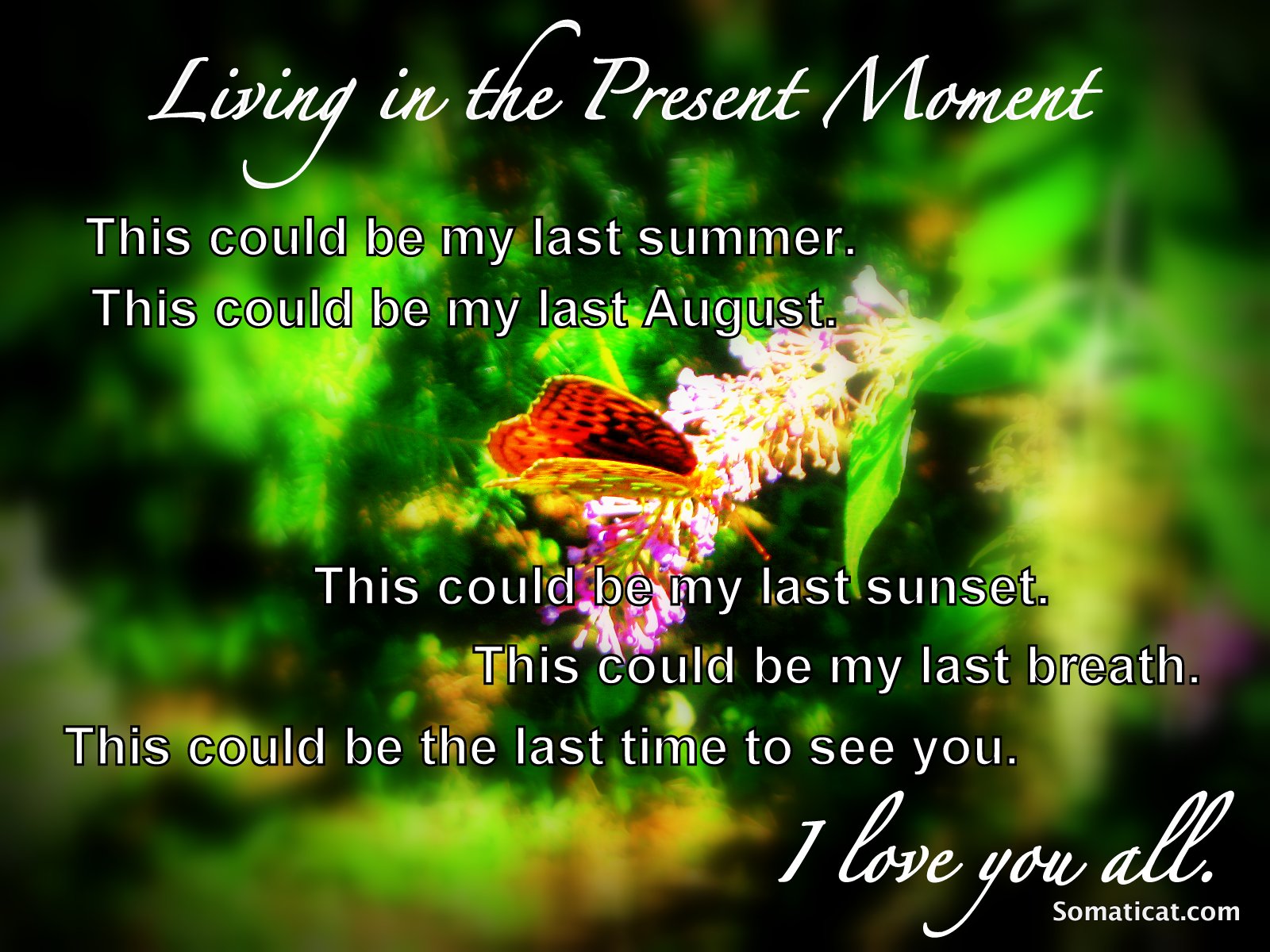
This could be my last summer.
This could be my last August.
This could be my last sunset.
This could be my last breath.
This could be the last time to see you.
I love you all.

Join me, if you would like, to be fully present in this moment of our life, in this summer, in this August, on this day, at this time of the day… It only takes a moment. And Breathe for my friend. Thank you… I love you all.

Zen of Cherry Blossom

The falling cherry blossoms,

The remaining cherry blossoms are also

The cherry blossoms to fall.

 Haiku by Ryokan Osho

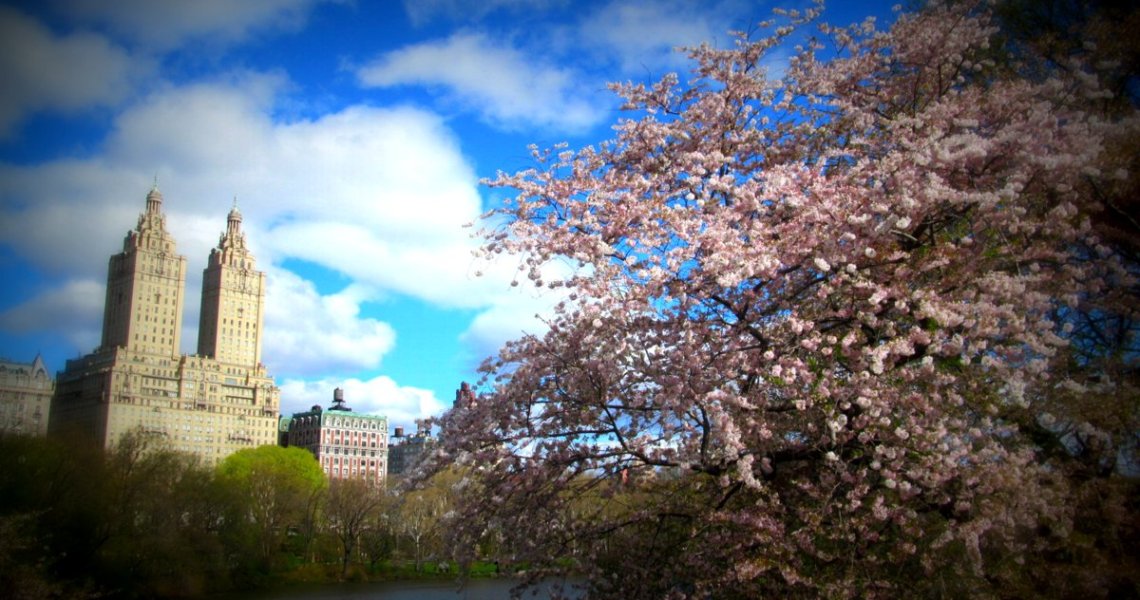
Every year I think this might be the last time to see the cherry blossoms fall.  This particular type of cherry trees only blossom for a week in the spring.  They open and will be gone in a week. If you miss it, you won’t see it till the next year.  And who could be sure that you will be there to see the cherry blossom fall next year.

So I breathe in the almost colorless color of petals, listen to the sound of silently falling petals, and watch the air tinted with millions of white grey pink petals.

This could be the last time.

It’s about

Mortality.

impermanence.

The transient nature of our existence.

That’s exactly why it’s precious.

Love and appreciate your life now.  It could be the last time you see it.

The dog enjoyed the spring day with his full existence.  He is not with us anymore.

Sand Castle

From Zen perspective, every moment contains birth and death.

There is nothing to be afraid of because I’m already dead. Who I think I am now is already in the past at this moment. It was such a relief to realize the simple truth. I just need to keep on reminding myself of the truth.