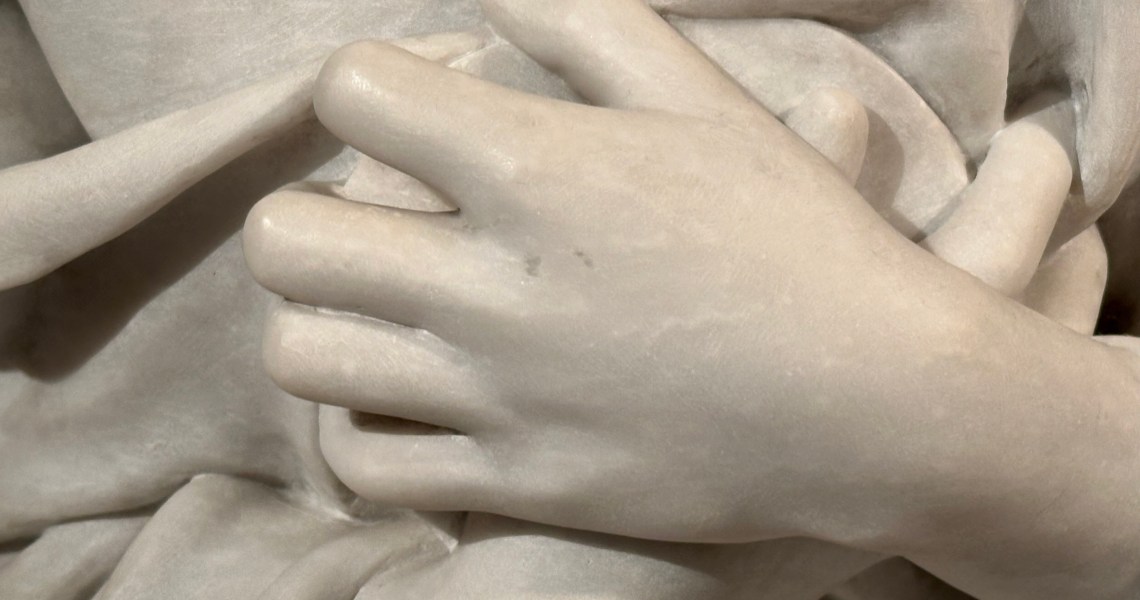
We were standing in the lab, looking at three cadavers on dissection tables. As workshop participants, we were to choose a body to work on.
One was a slender woman with unnaturally perky breasts. Her nails were impeccably manicured, her hair full and glossy. She was beautiful.
Another was a heavily boned woman with a muscular build. “She must have been an avid hiker,” someone said.
The third was a woman of significant size.
She looked exactly like a good friend I had—someone who suffered from psychological and mental health issues and who had steadily gained weight until she was nearly immobile.
I felt a pang of sadness when I saw her body on the dissection table, and I experienced a slight aversion to standing at her station. No, I didn’t want to dissect her. I already knew it would be physically harder to remove her superficial fascia.
And yet, somehow, I ended up at her table.
As I began releasing her from the bounds of skin, I couldn’t help but project. I imagined the subcutaneous adipose tissue as emotional baggage she had accumulated over a lifetime, or maybe as a thick armor she wore to shield her psyche from the outside world. Under the tremendous weight, it felt like she had been collapsing inward.
The layer of superficial fascia we freed from her dermis was sizable—just as she had been with her skin on. We began removing the adipose tissue, as if freeing her from the tortured existence of living in a large body. It was hard work. The layer was easily three inches thick in her midsection.
As I worked, I thought about all the nerve endings embedded in that adipose tissue. She probably had ten times more nerve length than I do. This was a hypersentient state of being.
And then, beneath the adipose, her muscular structure appeared—and we were all astounded.
What had been hidden under that armor of fascia was not a collapsed, atrophied frame. She was robust. I had never seen an elderly female cadaver with such powerful muscles. Her legs were so strong she looked like she could’ve squeezed the life out of a big, bad cowboy. Her gracilis was not slender at all; it was substantial. None of us had ever seen gracilis muscles like that.
Her musculature had supported the weight of her adipose armor. She had the body of an Amazon warrior. There was no trace of wasting. She must have remained mobile and active until quite recently, carrying her physical existence bravely.
Internally, too, she was robust.
Her organs were intact. No calcified arteries, no arteriosclerosis. Her colon was six feet long, padded with a healthy amount of visceral fat. No fatty liver. No damaged kidneys. No fibrosis in the uterus. Her heart was beautiful. Her lungs were slightly darkened, but free of adhesions.
She was healthy. Much healthier than I am.
The slender, model-like woman, on the other hand, had gone through hell. Once her skin and minimal adipose were removed, her body appeared almost transparent. Cancer had riddled her form—metastatic, likely starting from the breast. A chemotherapy port protruded from her chest.
She was a fighter, too.
I find myself reflecting on my projections.
You can’t tell who someone is just by looking from the outside. The story you tell about them might not be their real story.
You may have heard the famous Eastern philosophical parable about a man who dreams he is a butterfly, only to awaken and wonder: is he a man who dreamed he was a butterfly, or a butterfly now dreaming he is a man?
Doctor Strange in the Multiverse of Madness reminded me of that parable. In the film, dreams are portrayed as stories unfolding in alternate universes. Interestingly, the only person who can travel through the multiverse is the one who has never dreamed.
Have you ever had the same dream over and over? Not exactly the same, but different variations on a single theme? I used to have dreams like that.
One of the recurring dreams I had after a messy divorce was about my ex-husband. In those dreams, he had remarried and had a daughter and a son. They were some of my worst nightmares. He had cheated on me while I was undergoing infertility treatment, and by the time we divorced, I was too old to conceive. I had lost my chance to become a mother.
I dreamed this scenario again and again. The emotional anguish felt so real, it lingered even after I woke up. His betrayal stained the landscape of my inner world with grief and suffering. In waking life, I felt mostly anger—but underneath it, I carried a deep well of loss and sorrow.
In these dreams, I always lived in some kind of apartment. Each one felt strangely familiar. Sometimes I would find myself in the exact same apartment I had dreamed of before—with the same landscaping outside, the same scent in the air, the same humidity in the walls. I knew that place.
It’s been twenty-five years since the divorce, and I’ve finally stopped having that dream. Still, it feels as if I once lived in that apartment—in this life.
Then I began to wonder: maybe that was my life in an alternate universe. It’s about the inner choices we make—who we decide to become. Every decision spins off another timeline, another universe where a different version of you lives out the consequences of that choice.
If I had clung to the anger and suffering, maybe that nightmare would have been my reality.
These days, I rarely dream. Maybe my life has finally settled into this reality.
P.S. My ex-husband did remarry, but he never had kids. As for me, I’ve made peace with the fact that motherhood and I were probably never meant to be. Crisis averted—for the children.
My dog was my tether to reality, to this life. He was undeniably real. He lived entirely in the moment. When I woke in the middle of the night, lost in the vast nothingness—confusion and darkness pressing in—I would reach out and place my hand on him. He was warm, solid, breathing. Alive. And in his version of reality, if he was alive, then so was I. I felt safe in the world he held for me. It was as if I were drifting in a night ocean of existential anxiety, and he was my life raft.
With his passing, I lost my favorite version of reality.
I don’t have to protect anyone. I don’t have to take care of anyone. I don’t have anyone to come home to. I don’t have to worry about losing him anymore.
What remains is my own version of reality.
Every morning, I wake up and start my routine. I make coffee, brush my teeth, check emails. I function well. I smile. I chat with neighbors. I act normal. But I am not here. I’m floating an inch above the ground, like a plastic bag caught in the wind, weightless and directionless.
Once in a while, I do feel real. On a recent trip, I went to a shooting range and practiced pistol shooting for the first time. In that moment, I was completely focused. The weight of the gun in my hands, the shock waves reverberating through my body, the hot shells grazing my skin—burning, tangible—I felt alive. For that brief moment, the act of shooting was my anchor. (Don’t worry, I won’t shoot any living being, including myself.)
Then I came home, and my fragmented reality returned.
Fortunately, I can hold it together. I don’t have the affliction my cousin does—the one that warps reality beyond repair. I can pretend. I can fit in. I just don’t feel alive.
So I go to the gym. I work out on one of those torture machines. The intense contraction in my quads pulls me back into my body, back into the present.
At Fort Lauderdale Airport, there was a long line for baggage check-in and security screening. As a hub for cruise travelers, the airport gets especially busy at certain times of the day. I stood in line for over an hour.
Airport staff maneuvered wheelchair-bound passengers through the crowd, one after another, weaving between the lines. Most of the people waiting were elderly—older than me, likely returning home from their first or perhaps their last cruise.
A month ago, I lost my 13-year-old dog. Since then, every time I see someone walking a dog, I’m struck by a strange feeling—a bittersweet sadness, like a drop of water hitting the surface of a lake, sending ripples outward until they fade into the distance. The pain of loss is universal, something we all share. Every person here will, at some point, feel what I feel now—the grief of losing a beloved companion.
I looked around and imagined cadavers on dissection tables, standing in line now—dead and naked. Sooner or later, we all end up there, in one way or another. We share the same destination. I am among them.
Is that a relief? Perhaps. At the very least, the vision freed me, if only for a moment, from the vulnerability of being.
I recently sent my beloved dog, Simon, across the rainbow bridge. With the injection of a tranquilizer, he was asleep but alive. The moment the last injection was administrated, his being shifted. It was obvious that he was no longer there. What remained was just a body–a form of my beloved dog. It was no longer Simon. I left his form with the vet for cremation.
I might have a different reaction to human forms. I witnessed my grandmother’s death. Her heart was medically kept beating until her son arrived to witness her ultimate crossing. I stayed with her body overnight as a part of the Buddhist ritual of wake. Since then, I have experienced three more death in my family. In my old country, family members of the deceased accompany the body to the crematorium and wait for it to become bones. We pick up pieces of the bones with long chopsticks to place them in a small urn. For family members the death is not considered complete until this ritual is performed.
Whether it was Simon’s peaceful passing, my grandmother’s ritualized journey to ashes, or the cadaver I stand before, each moment reminds me of the fragile threshold between life and death–how quickly being gives way to form.
Standing at the dissection table, holding a scalpel with a fresh blade, most first-time dissectors hesitate to make the first cut. I did. Unless you are a surgeon, or other specific medical professional, you have not intentionally cut another person’s skin. A cadaver with the skin intact is closed off from and protected against the outside world. However vulnerable it may look, it maintains its integrity as a whole human being. The hesitancy comes from the violation of the personal boundary that the skin represents—the ultimate “Authorized Personnel Only” sign. It is the line of demarcation between the dead and the living. I still remember my first cut. It was on a cadaver named “Tony.” I watched other experienced dissectors make their first cuts, then followed nervously, as if I might be reprimanded for my act of violation. The tip of the scalpel scratched the surface, creating a paper-cut thin, shallow pale line. No blood. With a little more pressure, the skin/dermis began to separate. The surface tension that had kept the entire body whole lost its hold, and the boundary broke. The cadaver opened itself up to the dissectors. I crossed the boundary. After that, in my perception, it was not a person but a human form in which a person used to reside. A cadaver has no boundary, though deserves due respect. With a long incision in the skin, I felt as if the human form released all the tension with a sigh of relief, saying, “It’s over. No more need to hold this form.”
You have only one chance to experience the first cut. So better be mindful.
I sent my beloved dog across the rainbow bridge one month ago, and I’ve been depressed ever since. I still cry and feel his absence deeply. The sharp pain and heaviness in my chest have lessened, but they’re still there.
I go out every day—talking to neighbors, having lunch with friends, attending events I’m invited to, and spending hours at the gym. I’ve been working out daily.
Without the need to walk my 80+ pound dog three times a day, I suddenly have more uninterrupted time. I’ve been channeling that into my writing project, which is progressing well.
I also have two trips planned, something that would’ve been impossible when I was caring for a 13-year-old large dog. I’m doing everything I can to avoid spending days in bed, mindlessly watching Netflix all day and night. I’ve been there before. I know how it happens, and I know how to prevent it.
At the same time, multiple changes have happened in my life—not particularly happy ones.
From the outside, I probably look fine. I’m functioning well. But I’m not okay. I don’t feel alive.
Even when I laugh, enjoy conversations with friends, or run on a treadmill for an hour, I feel… hollow. Like a cow, grazing mindlessly on grass, waiting to be slaughtered, unaware of its fate.
And I ask myself: Am I depressed? Or is this just how most people feel, going through the motions of everyday life?
On Facebook, everyone presents their happy, vibrant lives. But are they really alive, or do they just think they are?
As the old Chinese parable says: Am I a monk dreaming of being a butterfly, or a butterfly dreaming of being a monk?
Even though the sensory receptors in the skin are mechanoreceptors, it is your brain that interprets the signals they send. Since the brain remembers past experiences and the emotions associated with them, touch is never merely a touch. Even the same mechanical touch can be felt differently—it can be loving, caring, comforting, or healing; sensual or sexual; cold, abusive or invasive. Even when you think your touch is neutral, it’s up to the receiver’s brain to interpret it.
When I was in my late thirties, I went through infertility treatment. To check if my fallopian tubes were open, I underwent a very uncomfortable test. The pressure I felt inside my body was so invasive that I instinctively contracted my entire body, bracing myself. Then the technician’s assistant gently placed her hand on my arm. I melted. Her touch was neutral, and I don’t think she was consciously trying to comfort me. I felt it came from her spontaneous empathy.
I have Meniere’s disease. One day, I had a Meniere’s attack in a gross anatomy lab and had to lie on a cold linoleum floor for some time, clutching a barf bag. I told everybody that nothing could be done to relieve my suffering and asked them to keep me safe and leave me alone until the symptoms resolved. I threw up in the bag and was hyperventilating in a fetal position. Some people can’t tolerate witnessing suffering without doing anything; it might make them feel powerless. A few of them placed their hands on me, perhaps to soothe or heal. I just had to endure the unwanted touch. They were mechanically the same kind of touch, but my brain interpreted them differently. One was comforting and the other was annoying.
As a child, I experienced improper touches, which were a violation of boundaries. This experience made me sensitive to the intent behind a touch. I don’t remember receiving loving touches from adults in my family during my childhood. My nervous system used to react to every touch as if it were a danger. Sometimes, a touch triggered tremendous rage, while other times, it made me feel nauseous. It took me a long time to learn to discern a safe touch from an unwanted one. I’ve learned to set boundaries and to choose how to respond, not just to react.
When she saw me taking my dog, Angel, in a wagon to help him to be released from his suffering, she understood. When I came home without Angel, I found an arrangement of cactus with a sympathy card in front of my door. She had a little blind senior dog, and she understood.
Once in a while, we understand and act with compassion without any expectation. As a buddhist, I call it a buddha moment.
I didn’t know her well. We lived in the same building and see each other in elevator cars. We had small talks about dogs. Eventually, I got a new dog. When I saw her in a laundry room, she told me she lost her little dog. I gave her a hug. She also told me that she had got officially married with her live-in partner, and I hugged her again.
She was a little older than me, but looked robust and energetic.
I attended her funeral service a couple days ago.
It was a simple, short service in a funeral home. She seemed to be childless. Relatives and friends talked about her. Her husband talked about how they met and how was her last days. She seemed to enjoy her life at full, then suffer a lot, and finally be released from the suffering from her health condition.
I’ve been living in an apartment building for about 15 years. Younger people move as their life’s situation changes. Older people won’t move. They disappear. My building has less than 100 units and babies are born, and people die. It contains all the life stages.
Our past and our future are contained in our presence. Life is fragile, evanescent, and fleeting, but all-embracing. Live your present fully.
The service ended with kaddish. And I felt deep yearning for the quietude she was in, looking at the simple casket.
When you get hit with incurable, degenerative, and progressive diseases, you would probably say, “Why me?”. The life you believed you would have ends with the diagnosis. The person you have been dies with the diagnosis. You don’t know what you could expect for the future, except for the fact you would lose everything you thought you would have.
Why me? We don’t have any answer to that question. My friend, Maria, was diagnosed with ALS and passed away within a year. Every day she lost some of her function. She said that somebody told her that the Universe/God had chosen her because she was strong enough to handle it. “I didn’t want to be chosen for this,” she said. It was the most cruel answer to the question.
I have a friend who was diagnosed with Parkinson’s disease. Once an epitome of fitness, he had worked in the fitness industry for the entire life, training diligently. He is losing his physical function. He didn’t do anything wrong to deserve it. “Why me?” he must have asked.
I have a friend with scleroderma. Her physical movements are limited and is constantly fighting against its progression. Mundane issues of life, such as dentistry treatment, become huge challenges. She must have asked, “Why me?”
All of them are strong and facing the challenges. They are wonderful people. Why them? There are no answers.
If you don’t have any of these disease, you would never think, “Why not me?”
When I was hit with Meniere’s Disease, I cried out, “Why me?” Meniere’s Disease is incurable and degenerative. It is rather unpredictable than progressive. I couldn’t leave home without the fear of severe attacks, which would render me incapacitated. I lost the life I expected to have, bedridden most of days. I am tenacious by nature, so I fought to regain my function with teeth and claws. Did I do anything to deserve it? Actually I did. Eventually I figured out the trigger. It was my genetics and lifestyle that triggered it. Even though Meniere’s Disease is incurable, I am managing it with very strict lifestyle change and am currently in remission.
Now when I think about my friends with ALS, Parkinson’s, Scleroderma and other incurable, degenerative, progressive diseases, I think, “Why not me?”
I am dodging the bullet every day, every moment, as they are stealing every single day from the illness.
So, if you don’t have these illness, you are blessed. Be grateful and savor every moment of your life. You are probably dodging bullets without knowing it.
I walked into the gross anatomy lab at a medical school, wearing a brand-new white lab coat, and stood at one of the dissection tables. The steady hum of the air purifier filled the room. Under the gleaming florescent lights, the lab appeared sterile and lifeless. It held multiple tables, each with a cadaver lying upon it. It was my first human dissection class, and I was nervous. Unless you are a medical student, funeral director, coroner, forensic examiner, or some kind of specialist, you rarely have the chance to see naked dead bodies quietly resting on stainless steel tables. The cadavers were embalmed for preservation, giving their skin somewhat foreign texture.
In my old country, we don’t have the custom of embalming. When my grandmother passed away, she was laid on a futon in her home, as if she were sleeping, and family members took turns staying beside her body through the night. It is an old tradition for family members to spend the last night with a loved one—a way to familiarize the living with death. I stayed with her body for several hours, keeping incense burning. Her skin was yellowish, wrinkled, and dry but otherwise intact. The cold air from the dry ice, used to slow the body’s decomposition, seeped through the futon, carrying with a faint, distinct whiff of death.
In the lab, the cadavers’ skin was unnaturally moist due to the embalming fluid saturating their tissue. We carefully observed the artifacts of death and embalming process to distinguish them from the inherent characteristics of the deceased. The outer layer of skin was peeling in patches, similar to sunburned skin but slightly deeper. This is a decomposition process where the bond between dermis and epidermis begins to break down. One of the cadavers was a dark-skinned man, and we were startled to see the pale skin layer beneath. We realized the skin color is only epidermis deep. Beneath the epidermis layer, we are all same color: pale and fair.
The epidermis, the outermost layer of skin, is only 0.05mm (on the eyelids) to 1.5mm (on the palm and sole) in thickness. It defines our social identity, being the first aspect others notice. It is a social organ. As a person of east Asian origin, my skin has an olive tint. When I was a child, I spent most of my time outdoors and became tanned in the areas exposed to the sun. Naturally I was darker than adults who spent most of their time indoors. My father used to tell me I was too dark to be considered pretty. In my old country, at least at that time, fair skin was idealized as a standard of beauty for women; the lighter, the better. My skin is still tanned, though not as much as when I was younger. In fact, the parts of my body that rarely see sunlight are as fair as those of my friends with natural light skin. I simply don’t burn as easily as they do. Being labeled as an “Asian girl too dark to be pretty” haunted my self-image, even though it was just an epidermis-deep judgement, easily shed like a snake’s slough when it no longer fits. Today, I am a proud woman of a certain advanced age with beautifully tanned skin, less sun-damaged than that of some fair-skinned friends.
Melanocytes, located in the bottom layer of epidermis, produce melanin, which determines skin color. Without the epidermis, you would be pale. Defining people by skin color is absurd. Melanin protects the skin from UV damages caused by sunlight. A darker skin color simply means your skin is more tolerant to UV exposure.
In the living body, the deepest layer of the epidermis, where melanocytes reside, is firmly attached to the dermis and does not peel away easily. Since the epidermis lacks sensory nerve endings — except for vibration-sensing Merkel cells, which are found in the bottom layer— touching the epidermis itself does not produce sensations. However, there is a rare genetic disorder in which the bond between the dermis and epidermis is very weak, causing the epidermis to peel away with the slightest contact, exposing nerve endings. Individual with this condition are vulnerable to UV damage, infections, and other external threats. Imagine being without an epidermis. Every slightest touch would cause excruciating pain, and your existence would become a constant agony. When I studied psychology in a post-graduate psycho-spiritual counseling program, the instructor described a person with borderline personality disorder as “being without skin.” The analogy might be more accurately described as a condition of being without an epidermis.
The epidermis forms the boundary between what is me and what is not me, serving as the first line of defense by protecting what is inside from the external environment. Despite its crucial role, it is less than 1mm thick. Our physical existence is remarkably vulnerable in this way.
When I get a temporary henna tattoo, the “tattoo” fades away in a week or two because the pigment only penetrates the epidermis. The outermost layer of the epidermis, the stratum corneum, consists of dead cells that are constantly flaking away. The cells in the outer layer of epidermis are replaced every thirty to forty days. Part of us is constantly dying from birth. Our physical existence is not as separate as we might believe. When I step into a subway car, I sometimes encounter a distinct smell associated with a particular human state. Even if the source is no longer present, the oder lingers as if the ghost of its presence remains. Occasionally, we find ourselves in someone else’s personal space, and as I inadvertently breathe in tiny molecules of oder, I also realize I am inhaling minuscule flakes of dead epidermis.
As a manual therapist, when I touch a client, I make contact with their epidermis. I would never touch their dermis, the true skin, directly. Between “them” and “me,” the epidermis stands guard, keeping “not me” out. Every caress of lovers passes through the layer of dead cells. Flaked-off dead cells mingle with other minute substances, floating away in the air or settling on the floor. This thin, evanescent boundary keeps us safe from one another.
The first difference between a living person and a cadaver lies in the skin. In the dissection lab, we stood around a table with a cadaver. No one touched it until the instructor encouraged us to do so. Initially, most of us hesitated, but soon we began to touch the cadaver quite aggressively. The cadaver allowed us to explore in whatever way necessary for study. A person has boundaries; a cadaver does not. When somebody violates your boundaries through inappropriate touching, they are treating you as if you were a cadaver.
Imagine yourself as a corpse lying on the ground. Focus on the outermost layer of your skin. Peeling away in patches, this interface with society falls off. It becomes desiccated and papery—light and fragile. Part of your identity sheds away, your boundary dissipating with a mere whiff.