Touch: Your Brain’s Interpretation

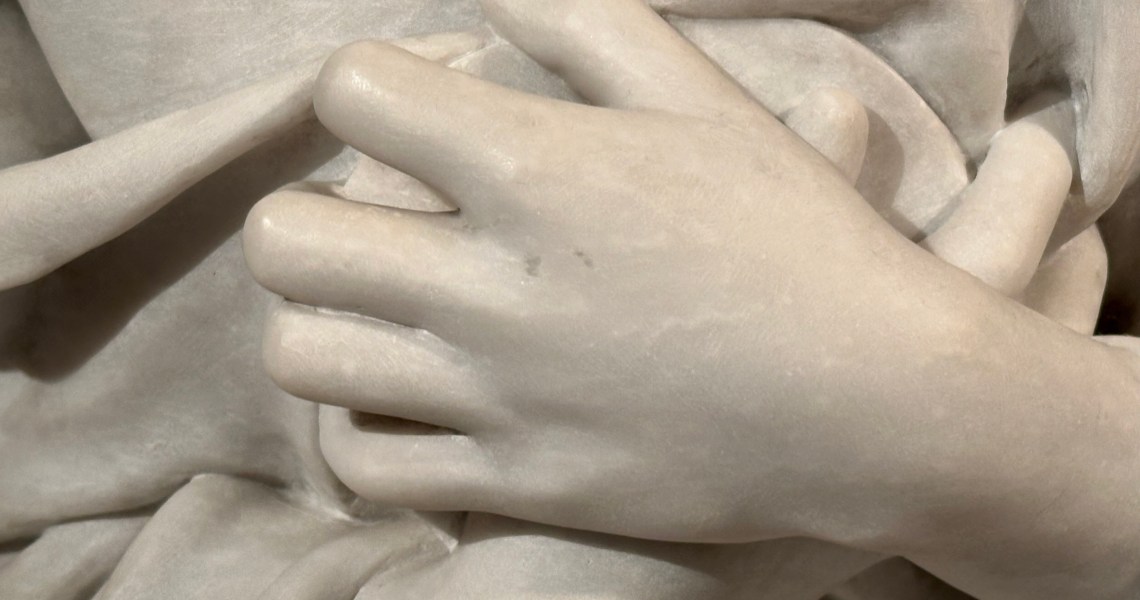
Even though the sensory receptors in the skin are mechanoreceptors, it is your brain that interprets the signals they send. Since the brain remembers past experiences and the emotions associated with them, touch is never merely a  touch. Even the same mechanical touch can be felt differently—it can be loving, caring, comforting, or healing; sensual or sexual; cold, abusive or invasive. Even when you think your touch is neutral, it’s up to the receiver’s brain to interpret it.

When I was in my late thirties, I went through infertility treatment. To check if my fallopian tubes were open, I underwent a very uncomfortable test. The pressure I felt inside my body was so invasive that I instinctively contracted my entire body, bracing myself. Then the technician’s assistant gently placed her hand on my arm. I melted. Her touch was neutral, and I don’t think she was consciously trying to comfort me. I felt it came from her spontaneous empathy. 

I have Meniere’s disease. One day, I had a Meniere’s attack in a gross anatomy lab and had to lie on a cold linoleum floor for some time, clutching a barf bag. I told everybody that nothing could be done to relieve my suffering and asked them to keep me safe and leave me alone until the symptoms resolved. I threw up in the bag and was hyperventilating in a fetal position. Some people can’t tolerate witnessing suffering without doing anything; it might make them feel powerless. A few of them placed their hands on me, perhaps to soothe or heal. I just had to endure the unwanted touch. They were mechanically the same kind of touch, but my brain interpreted them differently. One was comforting and the other was annoying.

As a child, I experienced improper touches, which were a violation of boundaries. This experience made me sensitive to the intent behind a touch. I don’t remember receiving loving touches from adults in my family during my childhood. My nervous system used to react to every touch as if it were a danger. Sometimes, a touch triggered tremendous rage, while other times, it made me feel nauseous. It took me a long time to learn to discern a safe touch from an unwanted one. I’ve learned to set boundaries and to choose how to respond, not just to react. 

copyright 2024

Dermis: The True Skin

The skin is often referred to as the largest organ in the human body. At the dissection table, we explore this remarkable organ in greater depth. The skin, along the dermis and its thin integument, tells the story of the person who once inhabited the form before us. How we interpret these stories is ultimately up to us.

Scars from surgeries, deep skin folds, stretch marks, tattoos and other markings frequently appear, each reflecting the years etched in the skin. Most cadavers are donated by elderly individuals who passed away in hospitals, and their stories are as distinctive and intricate as their wrinkles. Sometimes, internal conditions like jaundice manifest outwardly on the skin, altering its color and texture. 

Beyond the common surgical scars—hip and knee replacements, open-heart surgeries, rotator cuff reconstructions, and caesarean sections—we occasionally find evidence of accidents. While we can never know the exact stories behind these marks, we can imagine them. For instance, a scar on a man’s right thigh might be from a childhood bike accident during a carefree summer afternoon with friends— or perhaps from something more dramatic, like his wife discovering an affair and running him over in her fury. The truth could be anything. There are endless possibilities. 

I have a one-inch scar on my right breast from a biopsy. It never faded and serves as a constant reminder of a specific moment of my life. I remember waking up in the recovery room to the sudden commotion of EMS personal rushing in. The sliding door to the recovery room opened, and another door to the operating area followed. An old man in the waiting room looked panic-stricken as he tried to grasp what was happening on the other side.

A medical staff member explained that they didn’t have the equipment needed for the emergency his wife was experiencing and might need to transfer her to another hospital. My then-boyfriend, who had been waiting with the man, was in shock. “That man probably had coffee with his wife this morning, like usual,” he said. “He never thought it could be the last time.”

I don’t know what happened to the wife, but the experience stayed with me. Life is fragile. It could have been me who didn’t come back that day. My one-inch scar is a reminder of the delicate boundary between existence and nonexistence.

Skin: An Archive of Life

Our skin keeps records of life events. If you spend a lot of time outdoors, the sun will leave its mark on your skin. If you’ve had children, stretch marks may tell the story. If you smile or frown often, wrinkles will document those emotions. Skin is an archive of our lives.

Boundary: Skin as the First Line of Defense

For a manual therapist, an open cut on the skin is a nightmare. Any wound, no matter how small presents a potential danger—for both therapist and client. It’s an open door for pathogens. Something inside me could find its way onto someone else’s skin or vice versa. Cutting. in essence,  is an act of vulnerability.

Before the HIV pandemic, it wasn’t uncommon to see movies where characters cut their palms and held hands to mingle their blood as a gesture of ultimate trust and commitment. Sharing pathogens in this way was seen as a bond of loyalty. But cutting someone else’s skin is also a violation—a breach of boundaries.

Cutting one’s own skin is different. It’s an act that teeters on the edge of those boundaries. For some, it might be a way to reclaim control, to affirm that the boundary exists. By intentionally breaking the barrier of my own body, I can remind myself that I am alive. For those disconnected from their physical selves, self-harm might be a desperate attempt to feel real.

Skin as a Sensory Organ

As I lie on the ground, I feel the weight of my body pressing against it.  Heat transfers from my skin to the moist earth, and I sense coolness creeping back. Sunlight warms my exposed skin, while a gentle spring breeze takes some of the heat away. Grass brushes agains my arms, tingling lightly, and small pebbles beneath my back press into me with dull discomfort.

The skin is a vast sensory organ. Its receptors send signals of pressure, temperature, touch, and pain to the brain, which interprets these sensations. As a manual therapist, I must remember touching a client’s skin is a direct form of communication with their brain. Skin and nerves are inseparable; they form a continuous connection from receptors, through peripheral nerves and the spinal cord, to the brain itself.

When assisting with a nerve dissection project, I noticed how some nerves perforate into the skin. In typical gross anatomy dissections, we often overlook these structures, but they’re there, like delicate threads stitching the layers together. Touching one of these threads is, in essence, touching an extension of the brain itself.

Skin as Canvas for Expression

Occasionally, we encounter a cadaver with tattoos. One donor, “Z,” had multiple tattoos covering his body.  Z was a local donor, and one of the dissectors knew him personally—a rare occurrence. Z had lived a colorful life, full of adventures, rebellion, and humor. Before succumbing to cancer, he was a bulky, tough man.

When we uncovered his body, we saw an emaciated figure. A chemotherapy port protruded from his chest, and his gaunt face reflected the fierceness of his spirit. Though his body lay silent, his tattoos spoke volumes. They seemed to demand our attention: “Look at me. Read my life’s stories.”

Every piece—every image, every  word— told a story. As we began the dissection, we took care to preserve his tattoos, treating them as the storybook they were. Though they would eventually cremated with his body, the tattoos deserved our respect.

Tattoo ink remains permanently in the dermis, where macrophages engulf the pigment, making it a part of the person’s identity. Some pigments migrate to lymph nodes, where they can become trapped—sometimes visibly. Even in death, these marks persist, embodying the life they represent. 

copyright 2024

Quietude

When she saw me taking my dog, Angel, in a wagon to help him to be released from his suffering, she understood. When I came home without Angel, I found an arrangement of cactus with a sympathy card in front of my door. She had a little blind senior dog, and she understood.

Once in a while, we understand and act with compassion without any expectation. As a buddhist, I call it a buddha moment.

I didn’t know her well. We lived in the same building and see each other in elevator cars. We had small talks about dogs. Eventually, I got a new dog. When I saw her in a laundry room, she told me she lost her little dog. I gave her a hug. She also told me that she had got officially married with her live-in partner, and I hugged her again.

She was a little older than me, but looked robust and energetic.

I attended her funeral service a couple days ago.

It was a simple, short service in a funeral home. She seemed to be childless. Relatives and friends talked about her. Her husband talked about how they met and how was her last days. She seemed to enjoy her life at full, then suffer a lot, and finally be released from the suffering from her health condition.

I’ve been living in an apartment building for about 15 years. Younger people move as their life’s situation changes. Older people won’t move. They disappear. My building has less than 100 units and babies are born, and people die. It contains all the life stages.

Our past and our future are contained in our presence. Life is fragile, evanescent, and fleeting, but all-embracing. Live your present fully.

The service ended with kaddish. And I felt deep yearning for the quietude she was in, looking at the simple casket.

Why Me?

When you get hit with incurable, degenerative, and progressive diseases, you would probably say, “Why me?”. The life you believed you would have ends with the diagnosis. The person you have been dies with the diagnosis. You don’t know what you could expect for the future, except for the fact you would lose everything you thought you would have.

Why me? We don’t have any answer to that question. My friend, Maria, was diagnosed with ALS and passed away within a year. Every day she lost some of her function. She said that somebody told her that the Universe/God had chosen her because she was strong enough to handle it. “I didn’t want to be chosen for this,” she said. It was the most cruel answer to the question.

I have a friend who was diagnosed with Parkinson’s disease. Once an epitome of fitness, he had worked in the fitness industry for the entire life, training diligently. He is losing his physical function. He didn’t do anything wrong to deserve it. “Why me?” he must have asked.

I have a friend with scleroderma. Her physical movements are limited and is constantly fighting against its progression. Mundane issues of life, such as dentistry treatment, become huge challenges. She must have asked, “Why me?”

All of them are strong and facing the challenges. They are wonderful people. Why them? There are no answers.

If you don’t have any of these disease, you would never think, “Why not me?”

When I was hit with Meniere’s Disease, I cried out, “Why me?” Meniere’s Disease is incurable and degenerative. It is rather unpredictable than progressive. I couldn’t leave home without the fear of severe attacks, which would render me incapacitated. I lost the life I expected to have, bedridden most of days. I am tenacious by nature, so I fought to regain my function with teeth and claws. Did I do anything to deserve it? Actually I did. Eventually I figured out the trigger. It was my genetics and lifestyle that triggered it. Even though Meniere’s Disease is incurable, I am managing it with very strict lifestyle change and am currently in remission.

Now when I think about my friends with ALS, Parkinson’s, Scleroderma and other incurable, degenerative, progressive diseases, I think, “Why not me?”

I am dodging the bullet every day, every moment, as they are stealing every single day from the illness.

So, if you don’t have these illness, you are blessed. Be grateful and savor every moment of your life. You are probably dodging bullets without knowing it.

Skin

Where body meets air we are all cadavers

The Body: A guide for Occupants by Bill Bryson

Epidermis

Epidermis

I walked into the gross anatomy lab at a medical school, wearing a brand-new white lab coat, and stood at one of the dissection tables. The steady hum of  the air purifier filled the room. Under the gleaming florescent lights, the lab appeared sterile and lifeless. It held multiple tables, each with a cadaver lying upon it. It was my first human dissection class, and I was nervous. Unless you are a medical student, funeral director, coroner, forensic examiner, or some kind of specialist, you rarely have the chance to see naked dead bodies quietly resting on stainless steel tables. The cadavers were embalmed for preservation, giving their skin somewhat foreign texture.

In my old country, we don’t have the custom of embalming. When my grandmother passed away, she was laid on a futon in her home, as if she were sleeping, and family members took turns staying beside her body through the night. It is an old tradition for family members to spend the last night with a loved one—a way to familiarize the living with death. I stayed with her body for several hours, keeping incense burning. Her skin was yellowish, wrinkled, and dry but otherwise intact. The cold air from the dry ice, used to slow the body’s decomposition, seeped through the futon, carrying with a faint, distinct whiff of death.

In the lab, the cadavers’ skin was unnaturally moist due to the embalming fluid saturating their tissue. We carefully observed the artifacts of death and embalming process to distinguish them from the inherent characteristics of the deceased. The outer layer of skin was peeling in patches, similar to sunburned skin but slightly deeper. This is a decomposition process where the bond between dermis and epidermis begins to break down. One of the cadavers was a dark-skinned man, and we were startled to see the pale skin layer beneath. We realized the skin color is only epidermis deep. Beneath the epidermis layer, we are all same color: pale and fair.

The epidermis, the outermost layer of skin, is only 0.05mm (on the eyelids) to 1.5mm (on the palm and sole) in thickness. It defines our social identity, being the first aspect others notice. It is a social organ. As a person of east Asian origin, my skin has an olive tint.  When I was a child, I spent most of my time outdoors and became tanned in the areas exposed to the sun.  Naturally I was darker than adults who spent most of their time indoors. My father used to tell me I was too dark to be considered pretty. In my old country, at least at that time, fair skin was idealized as a standard of beauty for women; the lighter, the better.  My skin is still tanned, though not as much as when I was younger. In fact, the parts of my body that rarely see sunlight are as fair as those of my friends with natural light skin. I simply don’t burn as easily as they do. Being labeled as an “Asian girl too dark to be pretty” haunted my self-image, even though it was just an epidermis-deep judgement, easily shed like a snake’s slough when it no longer fits. Today, I am a proud woman of a certain advanced age with beautifully tanned skin, less sun-damaged than that of some fair-skinned friends.

Melanocytes, located in the bottom layer of epidermis, produce melanin, which determines skin color. Without the epidermis, you would be pale. Defining people by skin color is absurd. Melanin protects the skin from UV damages caused by sunlight. A darker skin color simply means your skin is more tolerant to UV exposure. 

In the living body, the deepest layer of the epidermis, where melanocytes reside, is firmly attached to the dermis and does not peel away easily. Since the epidermis lacks sensory nerve endings — except for vibration-sensing Merkel cells, which are found in the bottom layer— touching the epidermis itself does not produce sensations. However, there is a rare genetic disorder in which the bond between the dermis and epidermis is very weak, causing the epidermis to peel away with the slightest contact, exposing nerve endings. Individual with this condition are vulnerable to UV damage, infections, and other external threats. Imagine being without an epidermis. Every slightest touch would cause excruciating pain, and your existence would become a constant agony. When I studied psychology in a post-graduate psycho-spiritual counseling program, the instructor described a person with borderline personality disorder as “being without skin.”  The analogy might be more accurately described as a condition of being without an epidermis.

The epidermis forms the boundary between what is me and what is not me, serving as the first line of defense by protecting what is inside from the external environment. Despite its crucial role, it is less than 1mm thick. Our physical existence is remarkably vulnerable in this way.

When I get a temporary henna tattoo, the “tattoo” fades away in a week or two because the pigment only penetrates the epidermis.  The outermost layer of the epidermis, the stratum corneum, consists of dead cells that are constantly flaking away. The cells in the outer layer of epidermis are replaced every thirty to forty days. Part of us is constantly dying from birth. Our physical existence is not as separate as we might believe. When I step into a subway car, I sometimes encounter a distinct smell associated with a particular human state. Even if the source is no longer present, the oder lingers as if the ghost of its presence remains. Occasionally, we find ourselves in someone else’s personal space, and as I inadvertently breathe in tiny molecules of oder, I also realize I am inhaling minuscule flakes of dead epidermis. 

As a manual therapist, when I touch a client, I make contact with their epidermis. I would never touch their dermis, the true skin, directly. Between “them” and “me,” the epidermis stands guard, keeping “not me” out.  Every caress of lovers passes through the layer of dead cells. Flaked-off dead cells mingle with other minute substances, floating away in the air or settling on the floor. This thin, evanescent boundary keeps us safe from one another.

The first difference between a living person and a cadaver lies in the skin. In the dissection lab, we stood around a table with a cadaver. No one touched it until the instructor encouraged us to do so. Initially, most of us hesitated, but soon we began to touch the cadaver quite aggressively. The cadaver allowed us to explore in whatever way necessary for study. A person has boundaries; a cadaver does not. When somebody violates your boundaries through inappropriate touching, they are treating you as if you were a cadaver.

Imagine yourself as a corpse lying on the ground. Focus on the outermost layer of your skin. Peeling away in patches, this interface with society falls off. It becomes desiccated and papery—light and fragile. Part of your identity sheds away, your boundary dissipating with a mere whiff.

copyright 2024

Meditation on Cadavers-Prologue

Savasana

I am not writing an anatomy book, nor a dissection manual, though I use nomencIature of anatomist when it is more clear than everyday language. This book/writing is not about scientific knowledge. If you want to learn detailed anatomical information, there are tons of great books you can choose from. This is just A story of my personal experience facing cadavers in dissection labs, and a story about how that experience has affected my perception of who I am, how I relate to everything, especially to my body, in this lifetime.

I once read about a meditation technique where you lie on your back and imagine your body gradually decomposing until it becomes a skeleton. I heard that in Buddhism there is a meditation method in which one observes one’s own body both from the inside and outside while observing an actual corpse decompose. I liked this meditation method because I interpreted it as a training to realize that all material existence in this world, including one’s own body, is a mere phenomenon, just like a decaying corpse. 

When we experience unbearable trauma, our body and consciousness may become dissociated in order to protect ourselves. The body becomes a thing that performs a specific function, and becomes separated from the ”I” consciousness.

Once I had sessions with a Zen psychology therapist. He often asked me, “What do you feel in your body?” I looked up at the ceiling, looked around the room and always looked for the answer outside of my body. “Can you feel your feet on the floor?” he asked. Of course I could feel my feet physically touching the floor, but that was completely disconnected from what I was feeling mentally. 

I didn’t have much knowledge about my own body. So even when I meditated on a corpse, I couldn’t visualize it very well, and I had no conscious connection to my body, so the corpse quickly turned into abstract bones. I couldn’t understand how complex and delicate the human body was, and how it was related to my very existence.

Through the gross anatomy training, I gradually recovered the connection between my self and my body. Every time I stood at the dissection table, I felt like I was slowly regaining my humanity. It has been more than 10 years since I was initiated into human dissection, and I have spent over 1,500 hours in dissection labs. Now attending an annual dissection workshop is like a Zen practitioner regularly practicing at a temple. 

I see it as my spiritual practice. It prepares me for the reality of death and dying, and reminds me of the meaning of living this moment. 

Savasana in yoga is said to be a pose where you lie on your back and imitate a dead body. When we go to a dissection table in a dissection lab, we face a donated body that is quietly in Savasana pose. It is the last pose we all will take.

copyright 2024

Split

I watched Split and Glass on Netflix, where a fictional character with Dissociative Identity Disorder (DID) develops a personality with superhuman strength. James McAvoy was phenomenal, shifting seamlessly from one persona to another on screen. The story is a textbook case of severe childhood trauma: the psyche fractures to protect the vulnerable self. One of his identities, “The Beast,” punishes the undamaged—those who haven’t suffered.
[Spoiler Alert] The Beast sees the damaged as pure.

That’s what drew me in.

I have a friend with DID. Sarah is brilliant, cultured, well-read, and funny. She took many younger, “damaged” women under her wing. She was the one who introduced me to Broadway, gifting me tickets to Sondheim. We’d sit in cafes, visit restaurants, and talk about arthouse films and everything else. Her life sounded like a novel. She told me she was one of the first female TV producers—or something close. I’m not sure if Sarah is the original. I met two of her other selves: Tommy, a boy who constantly said, “Sorry,” and another, terrifying one—probably her internalized mother.

The switches weren’t as clean as in the movies. She once said she had a “Flat Earth Committee” in her head, which decided what she could or couldn’t do. That committee often said she wasn’t allowed to leave her apartment.

Before her DID diagnosis, she’d been given a charcuterie board of mental health labels: agoraphobia, depression, anxiety disorder. She’d been prescribed all kinds of medications. None of them helped.

Many friends tried to help her. After all, when she showed up as “Sarah,” she was wonderful. But over time, that became rarer.

I was the last one who tried hard. I had this urge to rescue someone else—maybe instead of rescuing myself. Her disorders were inflated versions of mine, so I could speak her language to a certain extent.

I don’t have DID. I’ve been dissociated, but not to that degree. I had dysthymia and episodes of major depression. Sometimes I wasn’t “allowed” to get out of bed. I had extremely low self-esteem and poor communication skills—unless I was in a professional setting. Then I became articulate, competent, impressive. I still have a voice inside that occasionally whispers, “Jump” or “Kill yourself.”

Over time, I realized that some of Sarah’s other personalities were sabotaging anything that might make her better. Whenever she admitted to feeling improvement, they lashed back—as if healing would erase them. As if their survival depended on her staying damaged. Ironically, their original role had been to protect her.

They exhausted me, as they had exhausted many before me.

I haven’t seen Sarah in years. She reaches out once in a blue moon—only in moments of desperation. The last time, it wasn’t even her. A mutual friend contacted me because no one had heard from her. Turned out she’d fallen and been hospitalized. She didn’t have her phone in the hospital room, so she couldn’t reach anyone. But she came up with an ingenious solution: she befriended the woman in the next bed and asked her husband to deliver a handwritten note to my building.

That’s Sarah—resourceful and fiercely capable when it matters. She once told me she’d made a deal with the “committee” to keep her alive. One of her friends with DID had died by suicide. Sarah wasn’t going to be one of them.

Eventually, I accepted Sarah as she is. There’s no “original” Sarah waiting to be recovered. She was already many when I met her. I just didn’t know it. She contains multitudes. Every piece of her is my friend. And I’ve let go of the childish fantasy that I could save her—or anyone else.

Everyone splits, to some degree.

There are incidents I don’t remember, but my body seems to. I don’t have a single, monstrous trauma, just layers: a verbally and emotionally—possibly sexually—abusive father; a manipulative, passive-aggressive mother; a narcissistic aunt; a silent, possibly borderline grandmother. Add to that a culture soaked in misogyny, inappropriate touches, and the absence of loving contact—and I was left scarred.

I didn’t split, but I did build personas: a tough bitch and an abrasive man—my internalized father—to protect the vulnerable child inside me.

I’ve spent decades re-parenting that little girl. I wanted her to grow up into who she could have been if she had been loved and left alone: a happy, loving, beautiful girl. A confident, capable woman who could love and be loved.

I didn’t become exactly what I hoped—but I like who I’ve become. I’m happy with this version of myself.

You can’t restore the original child. But you can hold your scars with tenderness. You can carry your pain gently, like something sacred. And in doing so, you become who you were always meant to be:

Clean and pure, with old scars.
Survive. Then thrive.

Giant Anteater

My high school best friend recommended me to watch a Japanese drama series, titled Brush Up Life. It is a story of a young woman, who suddenly died in a freak accident. She arrived at the reception desk of the “upstairs” office. A clerk at the desk told her she was assigned to re-incarnate as a giant anteater. She refused to be reborn as a giant anteater and asked the alternative option. The clerk told her that she could redo her life from the birth with her current knowledge and consciousness. The woman chose to start over and changed her life as she went. To make a long story short, every time she started over, something didn’t work and she died. So she kept going back to the start. Eventually she got the result she wanted (she saved her friends’ life).

My friend asked me if I could start over with current consciousness intact, what would I do. I thought about changing this and that. I would be on SSRI as soon as it’s available–I wasn’t diagnosed until in late 30s and I had developed a basketful of disorders. I would focus on physical fitness –I had eating disorder and was out of shape, a heavy smoker with alcohol dependency. I would move to the U.S. as soon as possible–I moved here in my late 20s and didn’t know my old country’s restrictive culture had traumatized me. I would study harder to get in a medical school –I applied for but wasn’t accepted and instead went to study liberal arts.

Then I realized I would be born into the same family and would have to do it all over again. The heroine of the drama has a “normal enough” and functional enough family. She tries to change things to save others. I can’t change my dysfunctional family. I can’t change how my parents deal with me. I would be born into the same family with all the pain, fear, shame, and anger. No. I would rather be a Giant Anteater. It would be much better.

My friend said she wanted to change one event, which traumatized and defined her life. Her parents moved from a metropolitan area to a rural city due to her father’s job and she was transferred from a private school in a large city to a local public middle school in a pretty tough district, where she was bullied as an outsider. She still can’t get over the trauma. She is now a professor of psychiatry at a local medical school, established and lives in a large house. She is married, has two sons, and they both are well-respected medical doctors. She has grandchildren, who live in the same city. I am freelancing, living in a small apartment with an old dog. I’m divorced with no children. From outside, she seems to have a good enough life. Still, she wanted to change.

I’ve been thinking about starting over, but every time I think of it, I end up choosing a giant anteater. I had a volatile life and I wish I could choose differently here and there, but if I changed any event I wouldn’t be able to be here. Every mistake I made, every bad choice I made, it was a ferry to carry me here and now. I have realized I am very content and happy with who I am now.

I just spend much of my life in constant stormy weather, hanging onto whatever I could to survive. And the deadly wind and current pushed the boats, ferry, or sometimes just a wooden lifesaver to where I am now.

So it’s possible to make peace with your life. I never expected to have this calm ordinary days at the end. (Of course, I spent large sum of money and time on this and that therapy.)

Father’s Daughter

If by chance I talk a little wild, forgive me; I had it from my father.

— HENRY VIII, ACT 1 SCENE 4

My childhood home was not a happy place. I didn’t know how being loved felt like. My younger brother told me once he made his presence as sparse as possible to avoid unpleasant encounters, well, mostly with our father. He also told me he had never felt loved by our father. When he was a pre-teen boy, he was always attached to our mother, like a baby monkey, while I don’t remember my mother’s touch. I had never felt loved by her, either.

My parents fed, clothed, and provided a bed and more than enough schooling. So I wasn’t neglected and was physically well cared for.

After multiple of failed relationships, I realized I didn’t know how love feels like. I didn’t have felt sense or reference point of being loved. I still don’t grasp the idea of being loved for just being me. I have to be needed and useful for the other person to be loved. That’s my false belief. Becoming aware of it was a great step.

My father passed away about 10 years ago after suffering Alzheimer’s disease. He was diagnosed with type 2 diabetes in early 30s and he was insulin dependent for most of my life. His father and his older sister died young from complication of diabetes. There are many diabetics in his family.

After more than half a century of dodging genetic bullets, I was diagnosed with type 2 diabetes and since I can’t take medications due to a severe and weird side effect from raised insulin level, I have been controlling it by diet and exercise only. Currently I wear CGM (continuous glucose monitor) and I finally understand what my father was going through.

I remember he said that he never enjoyed eating. He considered it as a bitter medicine. Even though he was on insulin, he was on tight calorie deficient diet. Our family never enjoyed dining out because of his diet restrictions. I always thought I didn’t want to be like him. So I enjoyed eating a lot. Now I am on a very strict diet. I can’t eat anything which I used to love–ice cream, cheesecakes, chocolates, sweet fruits, pasta, rice, pancakes… I don’t enjoy eating out with friends, because I can’t eat most of what they eat. I’ve learned that my blood glucose level dictates my moods. My father’s diet was not as scientific as mine. It was just a guess work and he was so disciplined. He needed to if he wanted to live. Now I am also disciplined regarding what I eat because I want to function.

It also dawned on me that my father must have experienced no felt sense of love. He used to say his mother, my grandmother, had loved his older brother, but never loved him. He didn’t know how love feels like. I had never felt sense of love from my grandmother, either. She cared for me when I was a little girl, but I didn’t get the sense of love. It didn’t start with me. And if you have not felt loved by your parents, it’s almost impossible to love yourself. I used to hate myself.

Fortunately my dogs taught me how loving and being loved feels like in my body. I remember my father used to take home a puppy and took care of it. The dog might have been the only thing he could feel love.

I don’t have children and it’s a good thing. Neither my brother. At least it stops with us.

If your family is loving, make sure to teach your daughters and sons to stay away from those who don’t know love. They could often be very attractive in a way only damaged people could be.

Savasana

I am not writing an anatomy book, nor a dissection manual, though I do use anatomical terms when they’re clearer than everyday language. This isn’t a book about scientific knowledge. If you’re looking for detailed anatomical information, there are plenty of great books to choose from. This is simply the story of my personal experience in dissection lab, facing cadaver, and how that experience has shaped my perception of who I am and how I relate to everything—especially my body, in this lifetime.

I once read about a meditation technique where you lie on your back and imagine your body gradually decomposing until it becomes a skeleton. I also learned that in Buddhism there is a practice called  Charnel Ground meditation, where you observes your body from the inside and outside while watching a real corpse decay. I found it intriguing, interpreting it as training to recognize that all material existence—including our own bodies—is just a mere fleeting phenomenon—no different from a decaying corpse. 

In Japan, we have kusozu, a traditional set of painting depicting nine stages of a body’s decomposition. It’s our version of memento mori. The paintings show the slow decay of a beautiful woman’s body, eaten by animals, reclaimed by nature, until it’s reduced to dry, white bones scattered on the ground. It’s a reminder that my body, too, is impermanent and transient.

When we experience unbearable trauma, our consciousness may dissociate from our body to protect us. The body becomes an object that performs a specific function, separated from the ”I” consciousness.  When I had sessions with a Zen psychology therapist, he often asked, “What do you feel in your body?”  Each time, I would look up at the ceiling, glance around the room, and search for the answer outside of myself. “Can you feel your feet on the floor?” he asked. While I could physically sense my feet touching the ground, that sensation felt completely disconnected from what I was feeling mentally.

I had little understanding of my own body. Even when I meditated on a corpse, I struggled to visualize it clearly.  With no conscious connection to my body, the corpse quickly became a mere abstraction of bones. I couldn’t grasp how complex and delicate the human body was, nor how it was related to my very existence.

Through gross anatomy training, I gradually restored the connection between myself and my body. Each time I stood at the dissection table, it felt as though I was slowly reclaiming my humanity. It has been more than ten years since I was initiated into human dissection, and I’ve spent over 1,500 hours in dissection labs. Now attending an annual dissection workshop feels like a Zen practitioner returning to the temple—a form of spiritual practice. It prepares me for the reality of death and dying, and reminds me of the importance of living fully in the present moment. 

In yoga, Savasana is the pose where you lie on your back, imitating a corpse. When we approach a dissection table in the lab, we face a donated body quietly resting in Savasana pose—the final posture we will all eventually take.