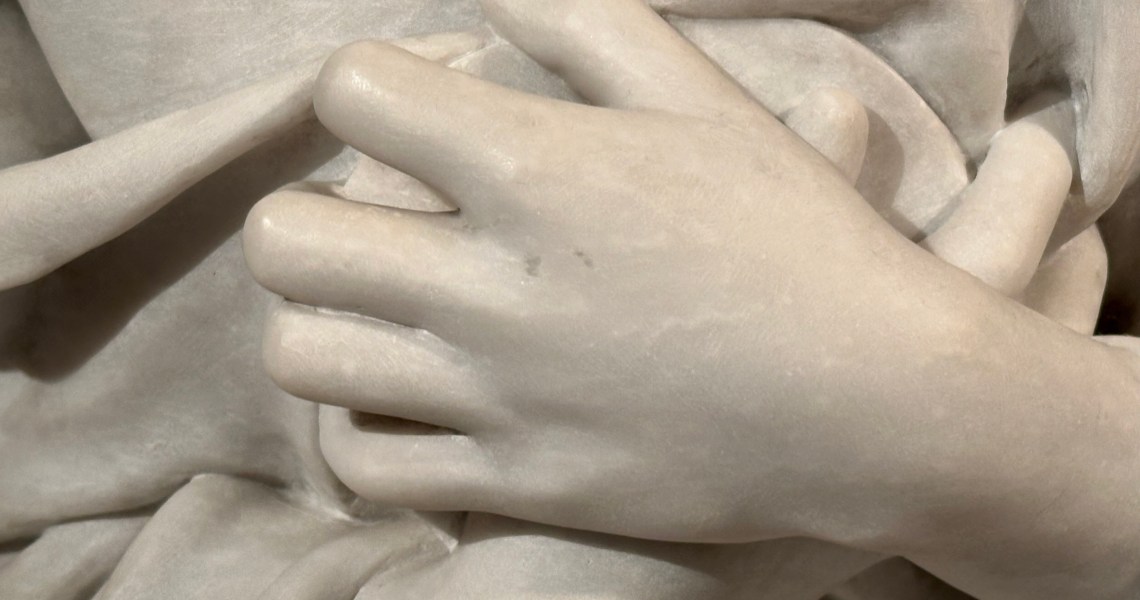
HAND Reveals

Surprisingly, hands retain a sense of personhood almost as much as the face. They are often left untouched until later stage of dissection because working on their small and intricate surfaces requires skills and anatomical knowledge. Hands are another major interface with the outside world—not much socially but physically and emotionally. They are our probes into the physical world, our means of acting on intent, and a way to express emotions.  

When we are born, we are held with hands, fed with hands. The first contact with the outside world is through hands of our caregivers. Hands have a high concentration of nerve endings, and we navigate the world by touching. Our first instinct when we encountering something new is to reach out and touch it. If it is unpleasant, we learn to withdraw our hands. The more we touch, the more intricate our understanding of our environment becomes. 

What would happen when a naturally curious child exploring their word hear their parents say “Don’t touch it” again and again. It may be the child is about to touch hot surface and the adult intends to keep them from harm and injury. It may be the child is about to touch an expensive fragile object and the parent is afraid that they would break it. Every time a child hear “Don’t touch it” their world gets smaller and more dangerous. Their energetic reach out to the world is cut short. 

Imagine being a child at the dinner table with all the adult guests. You’re hungry, you reach for the breadbasket, and suddenly—“Don’t touch it!” your mother snaps, slapping your hand, or worse. What do you think that child would feel in their body the next time they reached out for something?

I was that child.

Now imagine if that child happens to be a kinesthetic, tactile learner. I learned to pull back, to contract, to shrink away from the outside world. After decades of living in that confined state, I realized I had to retrain my inner child. So, I took her to the zoo and the aquarium. I let her push every interactive button, touch everything that was allowed to be touched. For once, I gave her permission.

We interact with others and express our emotions using our hands. Hugging and holding of hands are physical expressions of affection. We lend a hand when somebody needs help. When we are safe, we are in good hands. We work together, hand in hand. We stay involved by keeping a hand in, even getting our hands dirty. But when we can’t act, our hands are tied, and the matter is out of our hands. Hands, in many ways, represent our life in action. 

We touch others with our hands, but have you ever thought about what information your hands are conveying? I used to be a teaching assistant for a body awareness class at an acting school. When the students were in odd numbers I would step in as a partner for pair exercises. Once I partnered with an attractive young man, and I gave him the assigned bodywork. Then we switched roles. The moment he touched me, I felt sorry for his girlfriend—or boyfriend. It was like being poked with an inanimate object, like a piece of wood. He wasn’t really there. Did my hands feel as inanimate to him as his did to me? I couldn’t help but wonder if he had never been touched properly by his family. What kind of childhood would leave a person so absent in their hands? 

I grew up in a family  where the sense of boundaries was unclear. I don’t remember my mother’s touch, except when I was sick. I experienced inappropriate touches from family members. Even so, I can be present in my hands. Being present in your hands is crucial for manual therapists—and for actors. Your hands tell a lot about you. 

When you’ve experienced inappropriate touches in early in life, you can become very sensitive to the intent behind others’ hands. Trust your feelings and quietly walk away. The other person might be unaware of their underlining intent, or it could just be your interpretation. Either way, what you felt is real. So walk away.

I once trained with a master of martial arts. He was also an energy healer with quite a following. After a year of training, one day he offered me hands-on healing session. He laid his hands on my upper chest. I had paid for sessions with him before and never felt threatened. He didn’t do anything inappropriate; he just laid hands on my chest. But unpleasant memory resurfaced. 

I thought about it for a while. Was it just my imagination? The master, this guru, was probably doing me a favor with this treatment, and I shouldn’t doubt his good intentions, right?  (I was younger then and perhaps more attractive than the older disciples.)  But then it hit me—this might be exactly what happened in those yoga guru sexual abuse incidents. I trusted my instincts and left the group. Otherwise, I would have allowed the past repeat itself, again and again. 

With a high concentration of nerve endings, your hands are both receivers and transmitters. Use them mindfully. In the anatomy lab I held the hand of a cadaver and contemplated what he might have touched, throughout his life—from birth to death. I wondered how he touched, how he navigated the world and how he interacted with others. Was his touch loving and caring? What was the last thing he touched before his death? What did he reach for, and what did he recoil from?  This hand held his child, caressed his lover, petted his dog, wiped tears, and waved goodbye…

The only time I saw the skin of a living human slip away was in a drawing depicting the aftermath of the atomic bombing in Hiroshima. The skin of the hand slipped off like a glove, caught at nails, hanging from the fingertips. Otherwise, while not impossible, it’s very difficult to remove the skin of hands in one piece. The skin of the hands is intimately bonded.  

copyright 2025

Home

When Michelle’s sister, Norma, was diagnosed with cancer, she called their mom to tell her the news. Norma is strong-willed—not the type to break down easily. Her mom just listened quietly, nodding along. Then, at the end of the conversation, she simply said,
“You may come home if you want.”

And that’s when Norma broke down, sobbing.

“Wow. That was the perfect response,” I said to Michelle. “Your mom is really good.”
She didn’t try to fix anything. She just held space for Norma, offered her a safe place, and gave her a choice.

This would never happen in my family.

From what I’ve heard over the years, Michelle’s family runs on love. We’ve been friends for decades, and in the beginning, we didn’t really understand each other’s “normal.”
But as we’ve continued to exchange stories about our families, the contrast has only become clearer—how we think, how we move through the world, how we relate to others, and ultimately, who we are.

For Michelle, every relationship begins with love.
For me, every relationship begins with a transaction.

What would my mother say if I were in Norma’s shoes?
She’d say, “Come home.”
But not because I’d be welcome if I wanted to come home. It would mean I should come home—whether I wanted to or not—so she could step into the role of the devoted caretaker. My mom was a nurse, after all. She would turn the story into hers. She always does.
She dictates the narrative of my life.

And I would say, “No.”
Because for me, “home” isn’t a safe place.
The only safe place I know is the one I’ve made for myself, where I live alone.
The only safe relationship I have is with my dog—whose love comes without conditions.

We all carry different meanings for the same words.
What “home” means depends on who you ask.
So does “love.”
So does “safe.”

Three Way Mirror Vanity

I had three mothers.

There’s a photo of them together, sitting in a living room. Every time I look at it, I think of the witches—not the ones from Hocus Pocus, but the ones from Macbeth. Together, they conjured me: a daughter with a fragmented identity.

When we are young, we come to understand ourselves through interaction with our parents. We need to feel loved and accepted—especially by our mothers. Our survival depends on them. They become the foundation of who we are.

In my early childhood, my parents, grandmother, and aunt all lived under the same roof. My real mother was a nurse and gone during the day. My grandmother took care of me. She was a woman of few words, rarely expressive. She fed me, probably changed my diapers, and otherwise left me to my own devices. I was a free-range kid. She was always busy—tending to our small rice paddies, vegetable garden, and housework.

I followed her around, watching her do everything by hand or with simple tools. I saw her harvest soybeans, shell them, sort them, boil and mash them, and finally turn them into homemade miso paste. Everything was made from scratch. That’s just how small farmers lived.

She also took me on her regular visits—to the neighborhood Shinto shrine, and to my grandfather’s grave. From her, I learned ritual manners. She was more superstitious than religious. To this day, I still visit that same shrine when I go home. It’s deeply rooted in me. As long as I physically survived and followed her instructions, I was allowed to exist.

Sometimes, when my mother worked night shifts, my grandmother “let her rest” by handing me off to my single, childless aunt. I often slept beside her. Only much later—nearly half a century on—I learned that my aunt had once had a child out of wedlock, a daughter she gave up for adoption.

To her, I was a baby doll. She adored me and constantly told me I was cute. Whatever I did, I was “cute” to her. Naturally, I loved her. Looking back, I see now that I was her emotional support animal. A doll she could pour her love into. I was a blank screen, an empty vessel for her to project her longing and affection onto. As long as I accepted her version of “love,” I had a place in her world.

My actual mother? She’s almost completely absent from my childhood memories—except when I was sick. As a nurse, she took care of my body when it broke down. But emotionally, there was no connection. With her, I felt like a utility animal—fed and maintained for function, not love.

Her “love” was always conditional. I was a “good enough” daughter only when I served some purpose for her. Most of the time, that purpose was to be strong-willed, fearless, and short-tempered—a stand-in, a surrogate warrior she used to push back against her verbally and psychologically abusive husband. I was her avatar, not her child.

As I grew up, I developed three distinct clusters of identity traits—not like someone with dissociative identity disorder, but more like someone sitting in front of a three-way mirror vanity, where each angled mirror is distorted and reflects a different version of her. And those warped reflections bounce back and forth endlessly, deepening the distortion.

It was deeply confusing, to say the least.

It took me decades—more than half a lifetime—to even begin to feel the original me. I spent so many hours trying to reconcile those mirrored fragments. Now, I no longer need the mirror.

As for my father—he hated that I was a girl. The only time he acknowledged me as his child was when I got good grades. Otherwise, I was worthless.

Mother

After all, my choice was right,” my mother said, and I froze.

Since I was a little girl, she had made up her mind that I was destined to become a physician. She brainwashed me into believing it was my fate. Never mind that I loved reading and writing, hated math and science, and had terrible hand-eye coordination—she was convinced I was meant to be a doctor.

She had her reasons. My mother grew up poor and spent her early teenage years as a live-in nanny at her eldest brother’s house. He had been adopted out so he could get a better education and eventually became a physician. His wife was cruel and didn’t allow my mother to enroll in high school. But my mother, determined and stubborn, secretly applied to a nursing program and moved into a dormitory.

She became a nurse and later married—not to a doctor, but to an average city employee. So she shifted her dreams onto her children. She was going to be the proud mother of doctors. She believed this would elevate her status, allow her to join the elite “doctor’s family” club.

I never particularly wanted to become a physician, but I applied to a local medical school anyway. Thankfully, I wasn’t accepted. I could’ve tried again the next year, but by then, her focus had shifted to her new project: creating a physician son. She told me I was a bad influence on my younger brother and decided to “let me go.”

I had also applied to a liberal arts college in Tokyo, partly as an act of rebellion—and got in. She never asked what I wanted. She just decided I should go.

That was the “choice” she was referring to.

After college, I entered grad school and nearly earned a Ph.D. (Doctor!), but in my final year, I went to the U.S. to research my dissertation. There, I met an artist, fell in love, and got married. I stayed. Whatever plans she had for me, I repeatedly chose another path. At every fork in the road, she tried to map out my life, and I took the opposite turn.

She adapted. She became the mother of a daughter who lived in New York City. Her in-laws included a famous artist in Kyoto. She was no longer a poor country girl—she had graduated into the “cultured class.” She seemed to enjoy her new identity.

Meanwhile, my brother did become a surgeon, just as she’d dreamed. She didn’t need a physician daughter anymore.

Then I got divorced, and she lost that identity too. She wanted me to go back to my cheating husband.

For a time, she was the mother of a daughter who lived and worked in New York. She had no idea what I actually did for a living—a low-paid office secretary—but the title sounded impressive enough.

Since my father passed away about ten years ago, I’ve taken care of her, even from afar. I visit once or twice a year. I send gourmet meals every month. Compared to some of her friends, she realized she was lucky. She finally saw that it was possible because I didn’t have a demanding medical career or a family of my own to care for. And she said—without irony—that she was glad I was divorced.

And then, she said it again:
“After all, my choice was right.”

She took credit for all of my choices—every one I made against her wishes.

That’s my mother. I can’t recall a single time she ever asked me how I felt.

Father’s Day

Probably fortunately, I only ever had one father—so I assumed all fathers were like mine. I didn’t understand why Father’s Day was such a big deal.

He passed away long ago at the ripe age of 87. From the outside, he looked like a “good enough” father. He provided for us and supported my brother and me through much higher education than he ever had. And yet—I hated him. As far as I know, my younger brother felt the same.

He never hit us. But he was emotionally and verbally abusive, especially toward my mother and me. When I visited my parents, I stopped talking to him. My brother wouldn’t even set foot in the house. Later, when Alzheimer’s took hold, he was admitted to a nursing home. I didn’t love him, but as a “good enough” daughter, I visited him every day while I was in town. He didn’t recognize me. I sat beside him, spoke gently, massaged his shoulders. He wasn’t as nasty as before—maybe because he no longer knew I was his daughter. Still, from time to time, he shouted cruel things at the other residents. The staff would smile and say, “That’s the dementia talking, not him.”

But I turned to my mom and said, “That’s exactly how he always was.”

Since childhood, I’d been the main target of his emotional outbursts. In a nutshell, having a daughter was, to him, a waste. He made it clear he wished I hadn’t been born a girl. He told me I was too ugly to be loved by anyone. That became the foundation of my identity.

I grew up believing I wasn’t lovable as I was. That I would never be good enough for anyone. I didn’t trust men. I hated him.

Still, I did what I could out of duty. He died alone. I made it to his wake and funeral. No one cried.

I have a friend I’ve known for 30 years. Her worldview is completely different. She loves her parents deeply, and they love her. Her father lives in assisted living and is adored by the staff. He always told his three daughters they were cute and pretty, just as they were. Being his daughter was reason enough to be loved. Her older sister treats her own daughters and granddaughters the same way. My friend says love flows naturally in her family. She believes in love. She knows she is beautiful, and she knows she deserves love from men.

I once told her, “I don’t understand love.” She didn’t understand what I meant—until we shared our stories.

Not all fathers are the same. Not all families are the same. Not everyone’s idea of love is the same.

I can understand, at least partly, what made my father the way he was. I can feel compassion for him. But I still don’t love him. I never felt loved by him. That kind of feeling, I reserve only for my dogs.

So on Father’s Day, while many people celebrate, please remember:
Some of us can’t.

Multiverse Madness

You may have heard the famous Eastern philosophical parable about a man who dreams he is a butterfly, only to awaken and wonder: is he a man who dreamed he was a butterfly, or a butterfly now dreaming he is a man?

Doctor Strange in the Multiverse of Madness reminded me of that parable. In the film, dreams are portrayed as stories unfolding in alternate universes. Interestingly, the only person who can travel through the multiverse is the one who has never dreamed.

Have you ever had the same dream over and over? Not exactly the same, but different variations on a single theme? I used to have dreams like that.

One of the recurring dreams I had after a messy divorce was about my ex-husband. In those dreams, he had remarried and had a daughter and a son. They were some of my worst nightmares. He had cheated on me while I was undergoing infertility treatment, and by the time we divorced, I was too old to conceive. I had lost my chance to become a mother.

I dreamed this scenario again and again. The emotional anguish felt so real, it lingered even after I woke up. His betrayal stained the landscape of my inner world with grief and suffering. In waking life, I felt mostly anger—but underneath it, I carried a deep well of loss and sorrow.

In these dreams, I always lived in some kind of apartment. Each one felt strangely familiar. Sometimes I would find myself in the exact same apartment I had dreamed of before—with the same landscaping outside, the same scent in the air, the same humidity in the walls. I knew that place.

It’s been twenty-five years since the divorce, and I’ve finally stopped having that dream. Still, it feels as if I once lived in that apartment—in this life.

Then I began to wonder: maybe that was my life in an alternate universe. It’s about the inner choices we make—who we decide to become. Every decision spins off another timeline, another universe where a different version of you lives out the consequences of that choice.

If I had clung to the anger and suffering, maybe that nightmare would have been my reality.

These days, I rarely dream. Maybe my life has finally settled into this reality.

P.S. My ex-husband did remarry, but he never had kids. As for me, I’ve made peace with the fact that motherhood and I were probably never meant to be. Crisis averted—for the children.

Ding Dong, the Witch is Dead

I got a call from my 92-year-old mother. She had just been informed by the nursing home that my 100-year-old aunt passed away in her sleep—her heart had stopped.

I had visited her just a month ago and sat with her, talking. She had stopped responding a long time ago, but her heart kept beating with the help of a pacemaker. She swallowed whatever mushy food her caregiver spooned into her mouth and wore diapers.

This is not how I want to spend the last years of my life.

I loved her when I was a child. She lived next door to my parents, and she spoiled me with sweets, cute dresses, dolls, and stuffed animals—whatever I wanted, she bought for me. Every day, I waited eagerly for her to come home and ran to give her a hug. Sometimes, her breath smelled of alcohol.

My father was emotionally abusive, and my mother was emotionally unavailable. In many ways, it was my single, childless, career-oriented aunt who “adopted” me. She even wanted to adopt me legally at one point, but my parents—outraged—refused. There was no reason for them to give me up; we weren’t poor. I suppose it was her desire to have a daughter of her own.

I used to say I wanted to be just like her. She was my role model: fashionable, independent, capable of doing anything perfectly. She was the first woman in the region to be promoted to regional manager at the national telephone company. She was also incredibly skilled with her hands—especially knitting and crocheting. I had so many beautiful sweaters she made, and people often complimented them.

I, on the other hand, am not crafty at all. I tried, but I could never do anything as well as she could. I’d get frustrated, give up, and she would finish my projects for me. I still sometimes try, but I almost always give up.

She kept her home neat and beautiful, always with fresh flowers from her garden. She adorned the house with lovely things. Though she didn’t cook elaborate meals, she arranged simple dishes with such care that they looked more appealing than my mother’s “here’s your food, eat” style.

I admired her and, as a little girl, I dreamed of being like her—working, unmarried, and childless. That was an unusual dream at the time, when most girls wanted to be brides in white gowns. My parents didn’t respond to my dream at all. They just ignored it.

Life didn’t turn out quite the way I envisioned. I moved to the U.S., got married, worked as an ordinary office assistant, got divorced, lost my job, became an independent contractor, and remained childless. Still, I returned to Japan once a year to visit my parents and my aunt.

Even as a child, I sensed something was off in my family. There was a ghost in the closet—a family secret. Children can feel these things. Even if it’s never spoken, it changes the air.

The closet opened after my father—my aunt’s younger brother—passed away at age 87. My mother began to talk.

It was the scandal everyone in the small town knew. My aunt had an affair with her married boss and got pregnant. At the time, having a child out of wedlock was a deep shame for a respectable family. But she refused to have an abortion. Her lover’s wife was infertile, and my aunt may have believed that having a child would lead him to divorce and marry her.

Instead, he and his wife adopted the baby girl. He secretly allowed my aunt to visit the child, pretending she was just a family friend. But my aunt, lacking boundaries, acted like a mother. As the child grew older and started asking questions, the visits ended. The wife eventually died, but the man never remarried. The girl grew up not knowing she was adopted until her teenage years.

Then I was born into the family. At the time, my parents lived with my grandmother and my aunt. In a sense, my grandmother gave me to my aunt as a substitute. I don’t remember my mother’s touch. I was always with my aunt. Four years later, my brother was born, and this time my mother clung tightly to him. He was always wrapped around her like a baby monkey.

Once the secret came out, the meaning of so many things shifted. When I used to say I wanted to be like my aunt, I meant I wanted to be an independent woman. But my parents may have heard something else—that I admired her for having an affair and bearing a child out of wedlock, bringing shame to the family. My father resented having a daughter—specifically me being a daughter. From him, I absorbed the belief that all men were predators, and I had to fend them off with claws and fangs.

My aunt loved me like a daughter until she lost her mind. Even in my fifties, she’d try to brush my hair and spoon-feed me. She never truly saw me for who I was—only the daughter she lost. I was her living doll.

After my father died, my aunt’s physical and mental health declined. No one in the family wanted to take care of her, and I was the only one who didn’t hate her. So, by default, I became the one responsible.

She lived in her own home for nearly ten years, with various caregivers as her condition worsened. Eventually, she needed 24-hour care.

That’s when her true nature came out. She was highly narcissistic and very demanding. She wanted everyone around her to serve her in exactly the way she expected. She went through so many caregivers. She never forgot who had crossed her.

“Everyone who spoke ill of me died of cancer,” she once said, as if she’d cursed them.

Yes, she cursed me with her projection. She cast me in a role she needed someone to play—and I played it well. I understand she had a hard life, and she endured it the only way she knew how: by casting her pain outward, cursing everyone around her.

After the phone call, I said to myself, “Ding dong, the witch is dead.”

At least I’ve chosen not to curse anyone. That is my freedom.

Touch: Your Brain’s Interpretation

Even though the sensory receptors in the skin are mechanoreceptors, it is your brain that interprets the signals they send. Since the brain remembers past experiences and the emotions associated with them, touch is never merely a  touch. Even the same mechanical touch can be felt differently—it can be loving, caring, comforting, or healing; sensual or sexual; cold, abusive or invasive. Even when you think your touch is neutral, it’s up to the receiver’s brain to interpret it.

When I was in my late thirties, I went through infertility treatment. To check if my fallopian tubes were open, I underwent a very uncomfortable test. The pressure I felt inside my body was so invasive that I instinctively contracted my entire body, bracing myself. Then the technician’s assistant gently placed her hand on my arm. I melted. Her touch was neutral, and I don’t think she was consciously trying to comfort me. I felt it came from her spontaneous empathy. 

I have Meniere’s disease. One day, I had a Meniere’s attack in a gross anatomy lab and had to lie on a cold linoleum floor for some time, clutching a barf bag. I told everybody that nothing could be done to relieve my suffering and asked them to keep me safe and leave me alone until the symptoms resolved. I threw up in the bag and was hyperventilating in a fetal position. Some people can’t tolerate witnessing suffering without doing anything; it might make them feel powerless. A few of them placed their hands on me, perhaps to soothe or heal. I just had to endure the unwanted touch. They were mechanically the same kind of touch, but my brain interpreted them differently. One was comforting and the other was annoying.

As a child, I experienced improper touches, which were a violation of boundaries. This experience made me sensitive to the intent behind a touch. I don’t remember receiving loving touches from adults in my family during my childhood. My nervous system used to react to every touch as if it were a danger. Sometimes, a touch triggered tremendous rage, while other times, it made me feel nauseous. It took me a long time to learn to discern a safe touch from an unwanted one. I’ve learned to set boundaries and to choose how to respond, not just to react. 

copyright 2024

Skin

Where body meets air we are all cadavers

The Body: A guide for Occupants by Bill Bryson

Epidermis

Epidermis

I walked into the gross anatomy lab at a medical school, wearing a brand-new white lab coat, and stood at one of the dissection tables. The steady hum of  the air purifier filled the room. Under the gleaming florescent lights, the lab appeared sterile and lifeless. It held multiple tables, each with a cadaver lying upon it. It was my first human dissection class, and I was nervous. Unless you are a medical student, funeral director, coroner, forensic examiner, or some kind of specialist, you rarely have the chance to see naked dead bodies quietly resting on stainless steel tables. The cadavers were embalmed for preservation, giving their skin somewhat foreign texture.

In my old country, we don’t have the custom of embalming. When my grandmother passed away, she was laid on a futon in her home, as if she were sleeping, and family members took turns staying beside her body through the night. It is an old tradition for family members to spend the last night with a loved one—a way to familiarize the living with death. I stayed with her body for several hours, keeping incense burning. Her skin was yellowish, wrinkled, and dry but otherwise intact. The cold air from the dry ice, used to slow the body’s decomposition, seeped through the futon, carrying with a faint, distinct whiff of death.

In the lab, the cadavers’ skin was unnaturally moist due to the embalming fluid saturating their tissue. We carefully observed the artifacts of death and embalming process to distinguish them from the inherent characteristics of the deceased. The outer layer of skin was peeling in patches, similar to sunburned skin but slightly deeper. This is a decomposition process where the bond between dermis and epidermis begins to break down. One of the cadavers was a dark-skinned man, and we were startled to see the pale skin layer beneath. We realized the skin color is only epidermis deep. Beneath the epidermis layer, we are all same color: pale and fair.

The epidermis, the outermost layer of skin, is only 0.05mm (on the eyelids) to 1.5mm (on the palm and sole) in thickness. It defines our social identity, being the first aspect others notice. It is a social organ. As a person of east Asian origin, my skin has an olive tint.  When I was a child, I spent most of my time outdoors and became tanned in the areas exposed to the sun.  Naturally I was darker than adults who spent most of their time indoors. My father used to tell me I was too dark to be considered pretty. In my old country, at least at that time, fair skin was idealized as a standard of beauty for women; the lighter, the better.  My skin is still tanned, though not as much as when I was younger. In fact, the parts of my body that rarely see sunlight are as fair as those of my friends with natural light skin. I simply don’t burn as easily as they do. Being labeled as an “Asian girl too dark to be pretty” haunted my self-image, even though it was just an epidermis-deep judgement, easily shed like a snake’s slough when it no longer fits. Today, I am a proud woman of a certain advanced age with beautifully tanned skin, less sun-damaged than that of some fair-skinned friends.

Melanocytes, located in the bottom layer of epidermis, produce melanin, which determines skin color. Without the epidermis, you would be pale. Defining people by skin color is absurd. Melanin protects the skin from UV damages caused by sunlight. A darker skin color simply means your skin is more tolerant to UV exposure. 

In the living body, the deepest layer of the epidermis, where melanocytes reside, is firmly attached to the dermis and does not peel away easily. Since the epidermis lacks sensory nerve endings — except for vibration-sensing Merkel cells, which are found in the bottom layer— touching the epidermis itself does not produce sensations. However, there is a rare genetic disorder in which the bond between the dermis and epidermis is very weak, causing the epidermis to peel away with the slightest contact, exposing nerve endings. Individual with this condition are vulnerable to UV damage, infections, and other external threats. Imagine being without an epidermis. Every slightest touch would cause excruciating pain, and your existence would become a constant agony. When I studied psychology in a post-graduate psycho-spiritual counseling program, the instructor described a person with borderline personality disorder as “being without skin.”  The analogy might be more accurately described as a condition of being without an epidermis.

The epidermis forms the boundary between what is me and what is not me, serving as the first line of defense by protecting what is inside from the external environment. Despite its crucial role, it is less than 1mm thick. Our physical existence is remarkably vulnerable in this way.

When I get a temporary henna tattoo, the “tattoo” fades away in a week or two because the pigment only penetrates the epidermis.  The outermost layer of the epidermis, the stratum corneum, consists of dead cells that are constantly flaking away. The cells in the outer layer of epidermis are replaced every thirty to forty days. Part of us is constantly dying from birth. Our physical existence is not as separate as we might believe. When I step into a subway car, I sometimes encounter a distinct smell associated with a particular human state. Even if the source is no longer present, the oder lingers as if the ghost of its presence remains. Occasionally, we find ourselves in someone else’s personal space, and as I inadvertently breathe in tiny molecules of oder, I also realize I am inhaling minuscule flakes of dead epidermis. 

As a manual therapist, when I touch a client, I make contact with their epidermis. I would never touch their dermis, the true skin, directly. Between “them” and “me,” the epidermis stands guard, keeping “not me” out.  Every caress of lovers passes through the layer of dead cells. Flaked-off dead cells mingle with other minute substances, floating away in the air or settling on the floor. This thin, evanescent boundary keeps us safe from one another.

The first difference between a living person and a cadaver lies in the skin. In the dissection lab, we stood around a table with a cadaver. No one touched it until the instructor encouraged us to do so. Initially, most of us hesitated, but soon we began to touch the cadaver quite aggressively. The cadaver allowed us to explore in whatever way necessary for study. A person has boundaries; a cadaver does not. When somebody violates your boundaries through inappropriate touching, they are treating you as if you were a cadaver.

Imagine yourself as a corpse lying on the ground. Focus on the outermost layer of your skin. Peeling away in patches, this interface with society falls off. It becomes desiccated and papery—light and fragile. Part of your identity sheds away, your boundary dissipating with a mere whiff.

copyright 2024

Meditation on Cadavers-Prologue

Savasana

I am not writing an anatomy book, nor a dissection manual, though I use nomencIature of anatomist when it is more clear than everyday language. This book/writing is not about scientific knowledge. If you want to learn detailed anatomical information, there are tons of great books you can choose from. This is just A story of my personal experience facing cadavers in dissection labs, and a story about how that experience has affected my perception of who I am, how I relate to everything, especially to my body, in this lifetime.

I once read about a meditation technique where you lie on your back and imagine your body gradually decomposing until it becomes a skeleton. I heard that in Buddhism there is a meditation method in which one observes one’s own body both from the inside and outside while observing an actual corpse decompose. I liked this meditation method because I interpreted it as a training to realize that all material existence in this world, including one’s own body, is a mere phenomenon, just like a decaying corpse. 

When we experience unbearable trauma, our body and consciousness may become dissociated in order to protect ourselves. The body becomes a thing that performs a specific function, and becomes separated from the ”I” consciousness.

Once I had sessions with a Zen psychology therapist. He often asked me, “What do you feel in your body?” I looked up at the ceiling, looked around the room and always looked for the answer outside of my body. “Can you feel your feet on the floor?” he asked. Of course I could feel my feet physically touching the floor, but that was completely disconnected from what I was feeling mentally. 

I didn’t have much knowledge about my own body. So even when I meditated on a corpse, I couldn’t visualize it very well, and I had no conscious connection to my body, so the corpse quickly turned into abstract bones. I couldn’t understand how complex and delicate the human body was, and how it was related to my very existence.

Through the gross anatomy training, I gradually recovered the connection between my self and my body. Every time I stood at the dissection table, I felt like I was slowly regaining my humanity. It has been more than 10 years since I was initiated into human dissection, and I have spent over 1,500 hours in dissection labs. Now attending an annual dissection workshop is like a Zen practitioner regularly practicing at a temple. 

I see it as my spiritual practice. It prepares me for the reality of death and dying, and reminds me of the meaning of living this moment. 

Savasana in yoga is said to be a pose where you lie on your back and imitate a dead body. When we go to a dissection table in a dissection lab, we face a donated body that is quietly in Savasana pose. It is the last pose we all will take.

copyright 2024